
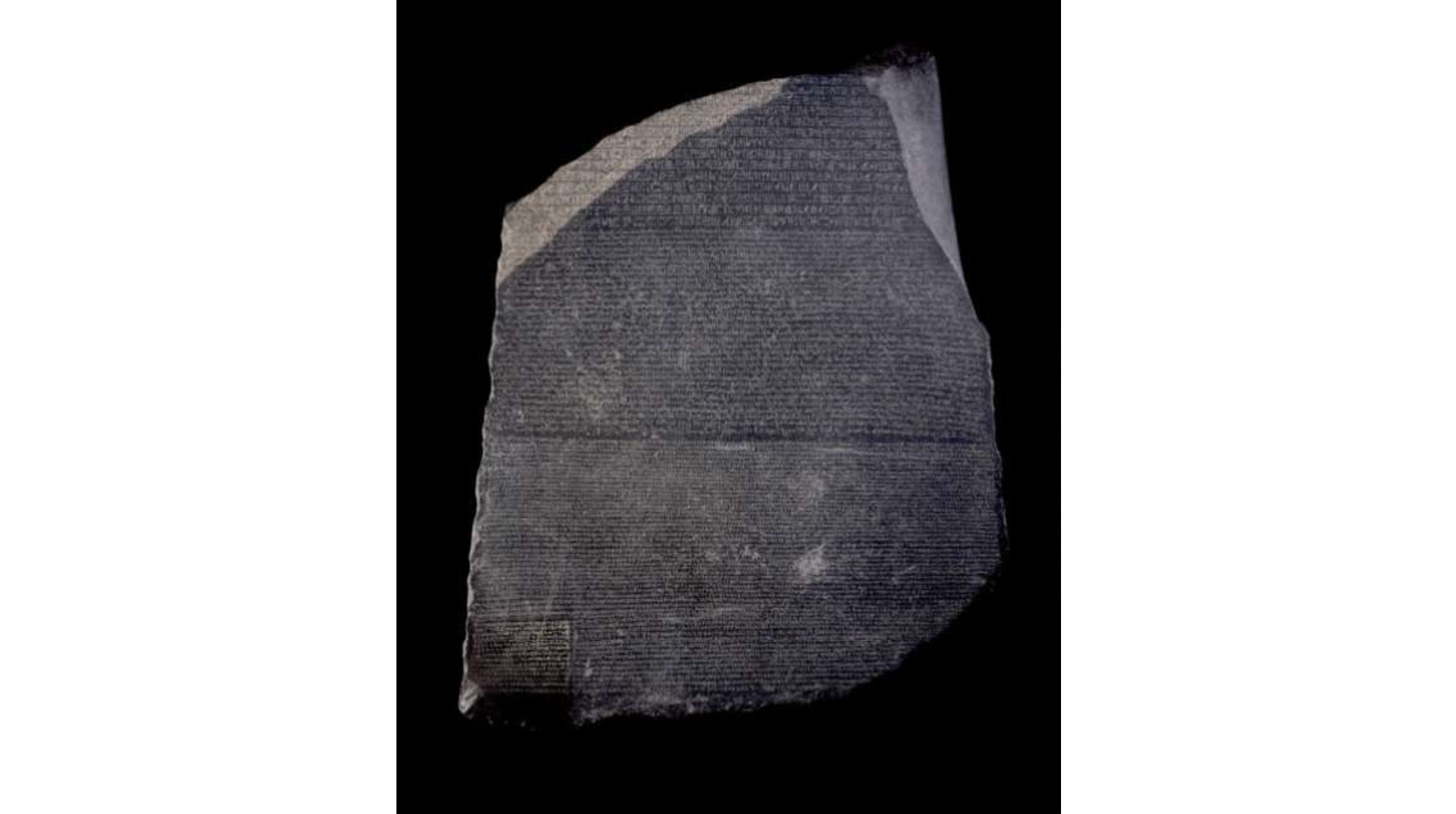
Another famous object of foreign material culture currently residing in the British Museum, the Rosetta Stone, with its three inscriptions of the same text in different languages and scripts, was used to decipher the hieroglyphic symbols of Ancient Egypt. The text, written in 196 BCE, is a religious commemoration of benefits and support conferred on Egyptian priests by Ptolemy V, and an affirmation of the cult of his royal worship. The damaged block of granodorite was found in 1799 by the French military, in the town for which it is named, also known as el-Rashid, located about fifty miles from Alexandria. The stone’s acquisition by the British from the French in 1801, and subsequent decryption in 1822 by the combined work of an Englishman and a Frenchman was a major cultural event, impacting the study of Egypt but also making its mark on the national consciousness, helping form the conception of a European, and particularly imperial Victorian, relationship with antiquity as being saviors of nigh-inaccessible ancient cultures and their artifacts.
Sources
James, T. G. H. (Thomas Garnet Henry). Ancient Egypt: the Land And Its Legacy. London: British Museum Publications, 1988. Online. https://hdl.handle.net/2027/mdp.39015035324634.
“stela: The Rosetta Stone.” The British Museum, www.britishmuseum.org/collection/object/Y_EA24.
“Rosetta Stone.” Encyclopædia Britannica, 22 Mar. 2019, www.britannica.com/topic/Rosetta-Stone.