
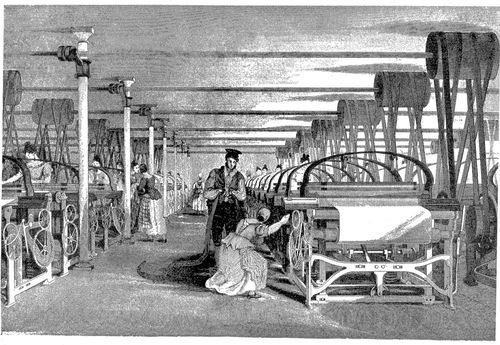
During the Industrial Revolution, women who did not belong to wealthy families had to join the workforce to help their families maintain their finances. They had no choice, but to defy the gender norms of the 19th century however, this had still come at a price. Women tended to receive between one-third to half the salary that a man would receive This pay gap became an area of exploitation for employers to hire women in exchange for cheap labor.
Women were also subjected to long work hours ranging from 11-12 hours sometimes going without food or a break. Women often found themselves in textile mills, cotton factories, or coal mines in dangerous conditions and watched their male counterparts be beaten for not doing well enough though they were spared. We see this in our image depicting a woman working on a Power Loom Weaving in 1835 at a cotton factory
. Upon their return home, the women were expected to maintain the role of being the homemaker adding to their tiring and stressful day. These women were forced to make their own living unlike Jane and Catherine who found a man to marry and live off of their wages
If the loves of these women were a novel like the three that we’ve covered this semester, their story would not be considered a “silly novel” by George Eliot. In her work, 'Silly Novels by Lady Novelists', Eliot describes the typical “...heroine is usually an heiress, probably a peeress in her own right, with perhaps a vicious baronet, an amiable duke, and an irresistible younger son of a marquis as lovers in the foreground, a clergyman and a poet sighing for her in the middle distance, and a crowd of undefined adorers dimly indicated beyond….” (Eliot,1) These women more often than not were not from the high status of being an heiress or peeress rather someone whose family was barely able to financially make ends meet. They also were away for so many hours a day that they did not get the chance to fraternize with potential suitors the way we saw our female main characters in Northanger Abbey, Jane Eyre, and Mill on the Floss.
For more info: https://foundations.uwgb.org/womensroles/#:~:text=Throughout%20the%20In…
Bibliography
Burnette, Joyce. “Women Workers in the British Industrial Revolution.” EH.net, https://eh.net/encyclopedia/women-workers-in-the-british-industrial-rev….
Eliot, George. “'Silly Novels by Lady Novelists.'” Westminster Review, October 1856.
“Women’s Roles in the Industrial Revolution.” Foundations of Western Culture: Industrial Revolution.