
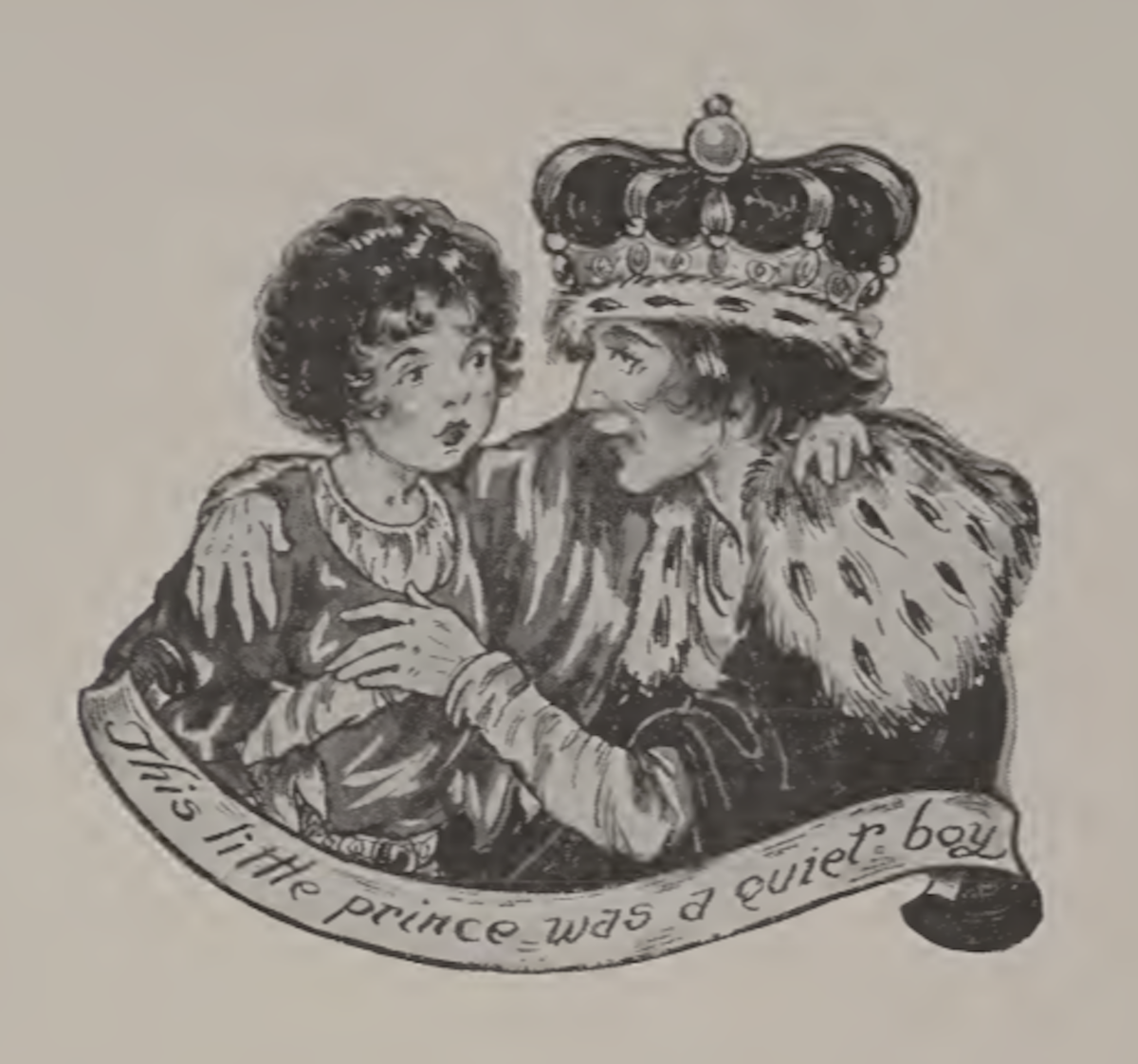
Craik, Dinah Maria Mulock, The Little Lame Prince. Illustrated by Albert Whitman, Albert Whitman & Co., 1927, p. 123. Internet Archive, archive.org/details/littlelameprince00crai_5/page/123/mode/2up.
This illustration shows the type of king that Dolor is perceived to be by his subjects. Here, Dolor is shown as an arguably androgynous man, having no beard and delicate facial features. This is the only image in this edition of the book that presents Dolor in his adulthood, and it greatly contrasts with the images of his father and uncle, who are both presented as unambiguously masculine and powerful in their roles as king. The inclusion of Dolor’s heir within this illustration aids in asserting his identity as a caring, nurturing leader loved by the kingdom. With this in consideration, Dolor’s masculinity is presented as an alternative, yet legitimate expression of his gender as he reigns over Nomansland; though his is quite different from the conventional Victorian ideal of masculinity, Dolor serves as an example of a masculine figure that upholds personal growth and maturity over traditional images of masculinity. Craik, Dinah Maria Mulock. The Little Lame Prince. Illustrated by J. McL. Ralston, Daldy, Isbister & Co., 1875, p. 149. Internet Archive, https://archive.org/details/littlelameprince00crai_5/page/136/mode/2up.