
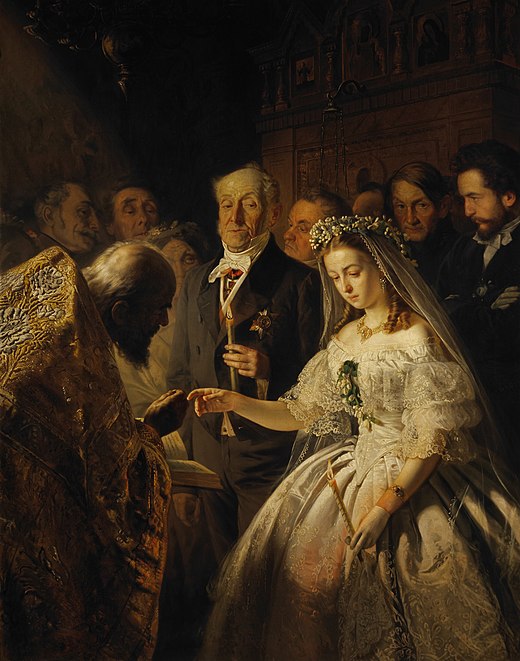
While the issue of marriage and relationships play a large part in Oscar Wilde’s 1895 play, The Importance of Being Earnest, the topic of divorce and unhappy marriages also appears as a supporting theme in the comedy. As mentioned by one of the leading characters, Algernon Moncrieff, “The very essence of romance is uncertainty…Divorces are made in Heaven.” Although Wilde often makes comments on relationships and social issues, the topic of divorce was especially relevant to the audience of his time as more and more people made the decision to divorce their spouse. According to the Report of Royal Commission on Divorce and Matrimonial Causes 1912-1913, the years before and after the publication of Wilde’s play saw a 17.9% increase in divorces between the years of 1894-1898 (Savage).
Prior to the Matrimonial Causes Act of 1857, those who wanted to separate from their spouse would have to get permission from the ecclesiastical courts that would require the couple to jump through several hoops to finally obtain their legalized divorce (Poovey). As a result of the Matrimonial Causes Act, divorces could be granted in a secular court, but remained an expensive matter for the separating couple. Even though the act helped to make divorces easier and more convenient, divorces were still a challenging experience for the women who were involved in the separation. Since women were not seen as their own legal person for much of this era, they needed to provide additional information as to why they wanted a divorce. Unlike men who could divorce their wife over a reason like infidelity, women needed to also prove that their husband had been abusive, had deserted them, or had committed crimes of incest or rape in addition to them being unfaithful (Layton, et. al). Not only did this, but due to the Custody of Infants Act of 1839, husbands were awarded custody of their children no matter the circumstances. If a man decided to divorce his wife, she would not only lose her status and security, but most likely her children as well.
Image:
Vasili Pukirev. The Unequal Marriage. Wikipedia, https://en.wikipedia.org/wiki/Vasili_Pukirev.
Additional Readings:
Holmes, Ann Sumner. “The Double Standard in the English Divorce Laws, 1857-1923.” Law & Social Inquiry, vol. 20, no. 2, 1995, pp. 601–20. JSTOR, http://www.jstor.org/stable/828954.
Shanley, Mary Lyndon. “‘One Must Ride behind’: Married Women’s Rights and the Divorce Act of 1857.” Victorian Studies, vol. 25, no. 3, 1982, pp. 355–76. JSTOR, http://www.jstor.org/stable/3827203.
Wolfram, Sybil. “Divorce in England 1700-1857.” Oxford Journal of Legal Studies, vol. 5, no. 2,1985, pp. 155–86. JSTOR, http://www.jstor.org/stable/764190.