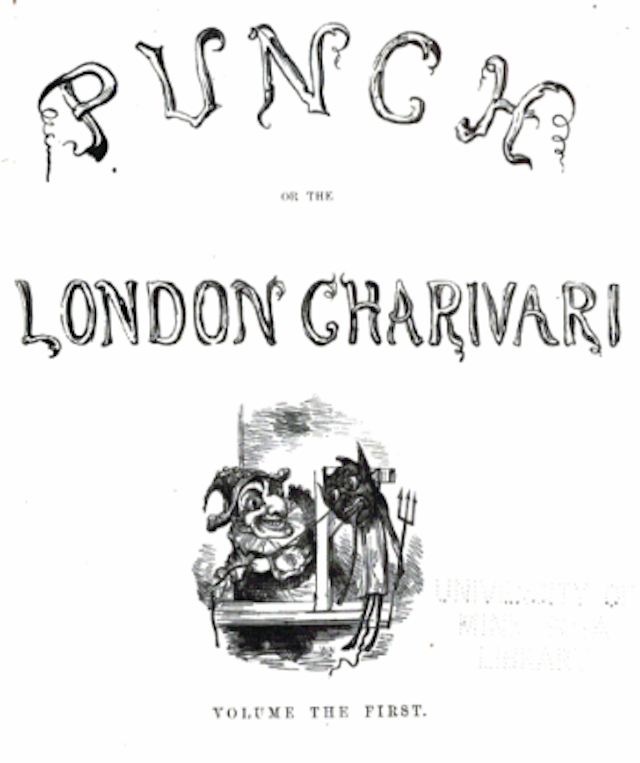
In the 17th century, the Italian puppeteer Pollicinella arrived in England and brought with him his puppet shows, which were to be one of the most popular forms of entertainment in the coming centuries in Britain. These puppet acts evolved into what we now know as the puppet show Punch and Judy featuring a mad couple staging a show filled with ludicrous and nonsensical antics. Punch and Judy held captive audiences for time to come, Punch and Judy shows were familiar sights on the streets throughout the 19th century. "Their performances were often heralded by drums or panpipes played by the Punchman's accomplice or 'bottler', whose job was to collect the money from the audience" ("That's the Way!"). With the sensational nature of these puppet shows came the controversial topics weaved throughout the narrative, these were the sparks that inspired the Punch brothers, Henry Mayhew, Mark Lemon, Joseph Stirling Coyne, and Ebenezer Land to create the Punch periodicals.
The Punch periodicals were first published in Britain in 1841. The popularity of punch grew immensely and outlasted its competitors. It currently publishes occasional periodicals today. Punch provides a rich reflection of the many aspects of life in victorian England that demonstrate the social issues, events, and concerns occurring then. The distinct visuals were so well drawn and fascinating that they could easily be confused for a modern illustration. By addressing a highly broad range of information, Punch was able to reach a great variety of people that would maintain its longstanding popularity. Its captivating and occasionally scandalous periodicals were a source of enthrallment and controversy, its sensationalism held the public of Britain captive. Punch was an echo of the dialogue that occurred in conversations at the dinner table, in the streets, and in the chambers of the home. "Textual and visual metaphors produced a common language through which readers could begin to imagine and debate social and cultural change" (Horrocks et al. 239). The easily consumable nature of the periodicals sustained the wide fan base and placed everyone on the same playing field intellectually so that social issues might be more widely discussed. The satirical tone of Punch's publications alludes to the thoughts being expressed in an informal and unconcerned manner by Britons. It said what many only thought and whispered to one another in a society so focused on propriety. The fact that punch grew and remained in popularity for such a substantial amount of time aids the evidence for the internal dialogue seeking a release from the stringent proprieties kept in the mind.
Punch faced a substantial amount of competition, the periodical overcame these challenges through a particular focus on branding. The recognizable feature of Punch himself from the popularized puppet shows was a notable signifier of the public interest, "The figure of Mr. Punch was deliberately personalised, and the name "Punch" was repeatedly used throughout the magazine" (Horrocks et al. 239). This method proved to be one that would stand the test of time as it exists electronically today with its occasional publications most notable by Mr. Punch himself being the mainstay brand ambassador. Its relevance to the current political and social issues are key elements that allowed it to remain in its popularity as well as the figure of the jolly puppet man. To maintain this relevance, commenting on recent literature publications of the victorian era was not at all outside the question for the periodical.
The admired novels of the time were also frequently critiqued and commented on in Punch's periodicals and were used to gain even more traction with their readers. Punch couldn't resist but report on the portrayed humbleness and low self-image that governesses should have in order to satirize Jane Eyre's diffident attitude. “They (governesses) must be humble, as in that case they will be spared many disappointments, and respectful themselves, as they must not consider they have a claim for respect on any person in the establishment they belong to” (Flanagan). This comment was not out of the ordinary for their publications. The satirical tone was a tool used to point out flawed logic that existed either consciously or unconsciously in regard to societal issues. The fearless nature is an aspect that frequently left Punch in the hot seat while simultaneously promising a place for them in the ears of their curious readers. Punch permeated everyday life and branched into topics in every facet of life, speaking of the latest Punch periodical during the victorian era would be as commonplace as us referencing the use of a youtube video today.
Works Cited
“‘That's the Way to Do It!" A History of Punch & Judy.” Victoria and Albert Museum, Victoria and Albert Museum, 2012, https://www.vam.ac.uk/articles/thats-the-way-to-do-it-a-history-of-punc….
Flanagan, Caroline. Punch, Jane Eyre, and the Governness, Brown University, 2010, https://victorianweb.org/periodicals/punch/flanagan.html.