

Darrell’s Commentary:
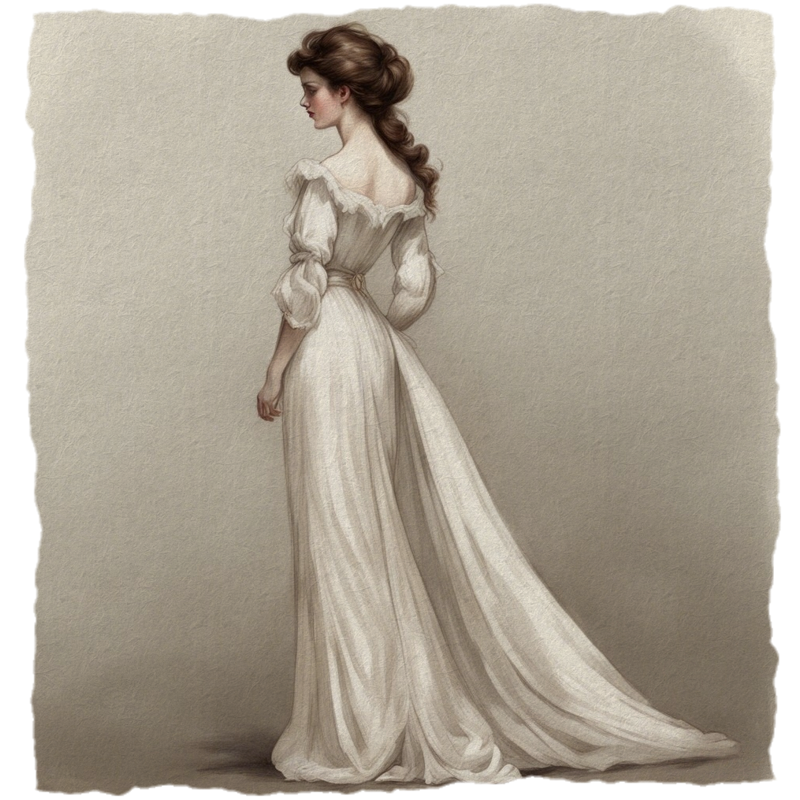
It has been two years now since my darling Phyllis was overcome by consumption, yet barely a day goes by that I do not think of her. I vividly remember the last time I saw her, before her sister took her away from me. She looked absolutely stunning in that long white gown, the way it highlighted her pale skin and stood in stark contrast to her brown hair. Her rosy lips and cheeks were alluring as always, and the gown flowed elegantly over her slender frame. She had always been so beautiful, from the first time I saw her, standing radiant amidst the crowd at the art gallery, a spray of tuberose adorning her dress. But standing in my studio that last day was something new entirely. She looked so pure, so gentle, so patient; waiting for the snow to pass before we could depart. I couldn’t resist painting her that night. My watercolors could never truly capture her exquisiteness, but this simple painting is the last piece of her that I could never let go.
We were ready to escape to Italy together, and I could see the light in her bright grey eyes, waiting for the snow to pass before we could depart, before we could finally be free from the troubles of our world in England. I helped her write the letter to Gertrude, telling her that we were leaving. If only we’d waited to have it sent after we had already left. Then no one could have stopped us.
Maybe I’d have fought harder for her if I’d known it was my last chance to see her. I knew she had grown weak, but I never believed that she would actually lose this fight of life and death. Even that night, as the tensions rose between her sister and myself, I watched my sweet Phyllis collapse into her sister’s arms, the commotion too much for her frail body to handle. I warned Gertrude that taking her away would only make her sickness worse, but she would not listen. But I know that she would have felt better in Italy, surrounded by the calm sea and away from the stress of her family and their photography business.
I’ll never find another woman who could strike such inspiration with her beauty. This picture is the last memory I hold of her. I only wish I had more time. I sent tuberose flowers to her funeral, as a memory of her perfume, but I’m sure they were not taken well. Gertrude was never very fond of me, I suppose it’s difficult to see good in the man that tried to steal her little sister away. If only I could prove my devotion. If only she knew the pain it brought me to gaze at the last picture of her that I will ever be able to paint.
Editorial Commentary:
This entry, more emotional than the others, speaks a multitude toward Victorian ideals. Victorian England was a time when specific expectations of women were prevalent. The mention of Phyllis’ pale skin, slender form, and rosy lips and cheeks can be connected to the beauty standards of the time, which celebrated pale, delicate, and fragile femininity. However, as he conveys that she “was overcome with consumption”, a term used for tuberculosis, her beauty can then be understood as symptoms of her disease. The beauty standards during this era, when connected to diseases at the time that caused paleness and rosy cheeks and lips, led to “the belief that having a disease, like tuberculosis which caused paleness, was supposed to create or enhance beauty”... “since they amplified those features that were already considered beautiful” (Giannotta 73-74). The English obsession with white skin during this period is evident as old advertisements marketed consumable products with “toxic substances like mercury, lead, and arsenic” to women, claiming that, with these products, they could achieve the perfect pale complexion (Giannotta 76). They would prioritize beauty over health, and treat illness with an air of unseriousness, similar to the way that the writer in this entry believed that simply living in Italy would cure Phyllis’ frailty.
Also representative of Victorian ideals is the mention of Gertrude, Phyllis’ sister, as she did not approve of the relationship between the writer and Phyllis. The mention of an "escape to Italy" and the disapproval of Gertrude hint at the strict societal expectations of the time. The couple’s choice to run away suggests that their relationship may not have been entirely socially acceptable, and thus they violated the Victorian standards for women to be “beautiful, classy, elegant, polite, and sexually restrained” (Victorian Era Morality Facts: Moral Behavior, Values, Ideals, Ethics).
As seen throughout all three entries, this writer, a Victorian artist, shows that art played a significant role in Victorian society. Artists, especially painters, were admired and their works were considered a reflection of the era. The writer’s lament about never truly capturing Phyllis's beauty in his drawing touches on the notion of art as an eternal, if imperfect, memory.
Works Cited:
Giannotta, Veronica. “Drop Dead Gorgeous: Beauty and Whiteness in Victorian England.” The General: Brock University Undergraduate Journal of History, Volume 8, 19 Apr. 2023, pp. 73–92, https://journals.library.brocku.ca/index.php/bujh/article/view/4201.&nb…;
“Victorian Era Morality Facts: Moral Behavior, Values, Ideals, Ethics.” Victorian Era, 4 July 2020, victorian-era.org/victorian-era-morality.html?expand_article=1.
“A sketch of a beautiful, tall, slender woman from the Victorian Era with pale skin and brown hair, wearing a loose, shimmering, lustrous garment that is elegant but scandalous, trailing behind her dramatically” prompt. Clipdrop, SDXL 1.0, Stability AI, 4 October 2023, https://clipdrop.co/stable-diffusion?utm_campaign=stable_diffusion_prom….