
Introduction
Byron’s Darkness, written in July of 1816, is a resemblance of the way authors during the period of Romanticism felt about the connection between humans and the environment, while incorporating many themes of the “sublime.” This theme, by definition, is the “grand or terrifying aspects of nature” (Shaw, 2014). This exhibit analyzes these very themes of nature, and how it, through its many aspects, can either aid human existence, or hinder it dramatically.
As described previously, Byron’s Darkness dives deep into this theme of the sublime, although it pays much more attention to the destruction and hindrance of human existence rather than the advancement of it. It specifically encapsulates the eruption of Mount Tambora in 1815, and how it wreaked havoc on humans and society in general. This can be seen when Byron writes "Forests were set on fire—but hour by hour," (Byron, Line 19, 1816), reflecting the complete destruction of forests, which is detailing the sheer power that nature holds in its relationship with humanity. That work also somewhat delved into the realm of animals and their relation to humans, however for the purpose of this exhibit, nature is more in regards to the flora, as opposed to the fauna in an ecosystem. Essentially, this exhibit is working at one main question; What is the relationship between humans and nature, and how does the behavior of one shape the behavior of another?
The exhibit is centered around this essential question, with more attention being paid to the reaction of humans to the actions of the environment. The pictures seen in this exhibit will capture certain aspects of events that have occurred in nature, and much thought will be directed towards the reaction of humans, and how this changed human existence. Byron’s works focus on major events or feature of nature, such as volcanic eruptions or the beauty of mountains, and this will be described in terms of their relation to human existence, and how people are forced to adapt to it. Click through the pictures and take time to read the descriptions in order to really grasp the different descriptions of the relationship between humans and nature during the vast span of the Romanticism period.
Work Cited
Byron. (1816). Darkness. COVE Studio. Retrieved from https://studio.covecollective.org/anthologies/engl-2101-01-british-lite….
Shaw, P. (2014, May 15). Landscape and the Sublime. British Library. Retrieved September 22, 2021, from https://www.bl.uk/romantics-and-victorians/articles/landscape-and-the-sublime.
Images in the Exhibit
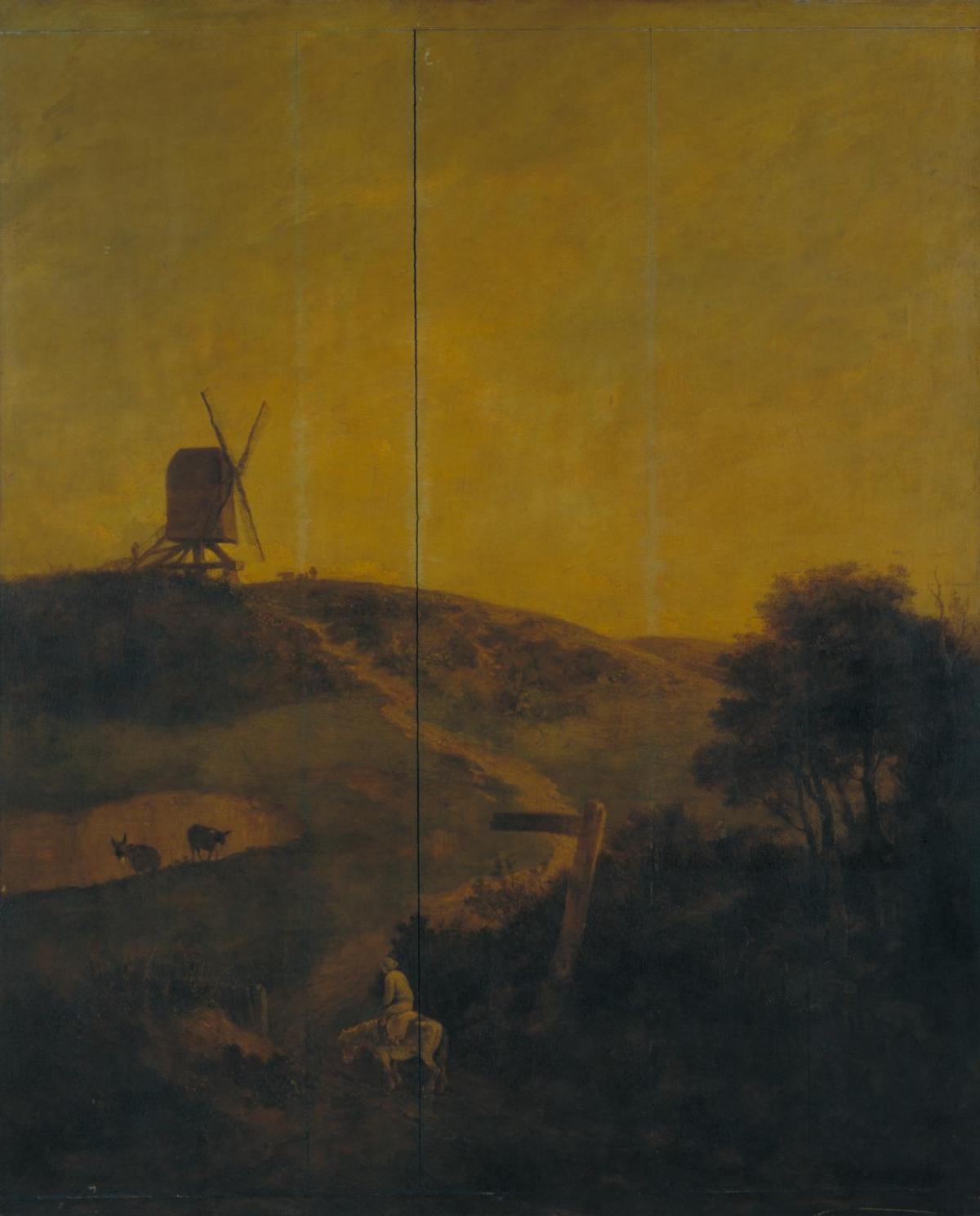
Figure One. Chrome, John. "A Windmill near Norwich and the Year Without a Summer." 1816. COVE Editions. https://editions.covecollective.org/content/windmill-near-norwich-and-y….
This picture is describing the trip that Lord Byron took to Geneva, during the “Year Without a Summer.” This may very well have been the inspiration for Byron’s Darkness, as this sight seen here is a reflection of some of the effects of the eruption of Mount Tambora, and how it impacted humanity. It can be seen that the “bright sun was extinguished,” (Byron, Line 2, 1816) exactly how it was described in his poem describing this cataclysmic event. This perspective of the event is exactly how he described it, the sun cannot be seen, as the dark clouds of ash produce an eerie yellow tint among the darkness of the landscape. What should also be taken into account is the fields being completely empty, and void of activity. This windmill during this time may have been used to grind grain or pump water, although there is no sign of any people in the distance trying to produce anything. This speaks volumes about the effect of this natural disaster on human existence, as all productivity seemed to grind to a halt, given that nature had created such harsh conditions. The whole mood of this depiction perfectly follows Byron’s description of darkness and disparity, and the importance of the relationship between people and nature, all while encapsulating how extraordinary it is that one event can have as big an impact as this.
Figure Two. Cole, Thomas. "A Wild Scene." 1831-1832. COVE Editions. https://editions.covecollective.org/content/wild-scene.
This scene plays into the theme of the sublime, as this is another breathtaking image representing the representation of nature in the eyes of Romanticism authors. In Byron’s Don Juan, another work reflecting the impacts of nature and how it can have drastic effects on human existence, there is a shipwreck leading most of the people to turn to cannibalism. This is a reflection of Byron’s view of nature, because that whole issue is caused by nature, and the impacts of it are seen throughout the book. This relates right back to this depiction of nature, as the human that is barely visible on the left side of the picture is seen to be merely at the will of nature, not controlling it at all whatsoever. This is a statement in my eyes of how small people really are as compared to the awe and power of nature, which is one of the major themes Byron is trying to tackle when writing his pieces relating to nature and the sublime. The mountain and even the feeble, thin tree towering over the person standing on the rocks just illustrates the raw power and awe that is created by nature, because it is emphasized tenfold over the small, insignificant person standing on the side. The fact that nature occupies 95% of this picture really speaks to the massive impact that it has on people, and how the relationship between the two is really in the hands of nature rather than the people.
Figure Three. Bierstadt, Albert. "A Storm in the Rocky Mountains." 1866. Brooklyn Museum. https://www.brooklynmuseum.org/opencollection/objects/1558.
This depiction of A Storm in the Rocky Mountains really brings to life the destruction and awe that Byron is trying to recreate in his detailed writings about nature. This vivid picture of the dark, looming thunderclouds bringing intense shadows over massive mountains just displays the kind of raw power that nature holds. Though Byron describes the nature during the eruption of Mount Tambora as “extinguished with a crash—and all was black” (Byron, Line 21, 1816), this also applies to this picture. The complete darkness, or “black,” can be seen under the rolling clouds, with the crash relating to massive thunder claps. This also relates to the picture entitled A Wild Scene, because the depictions of the towering mountains are so awe-inspiring once again that it just strengthens the message of power that you can see with the clouds rolling in, that even some aspects in nature as mighty as the towering mountains can be dwarfed in power and taken over by massive storms that threaten to flood communities and reshape the landscape. The theme of the sublime is reinforced in this picture through the sheer power conveyed by the storm, and how it is completely unstoppable, rendering humans completely helpless, only to watch as the storm looms over and threatens to wipe out everything they hold dear. Though the last picture was a bit brighter in its interpretation, this once again reinforces the darkness that nature can convey, a theme that Byron used very effectively in Darkness.
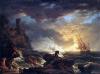
Figure Four. Vernet, Claude Joseph. "The Shipwreck." 1759. Lumen Learning. https://courses.lumenlearning.com/boundless-arthistory/chapter/neoclass….
This is another reflection of the breathtaking power of nature, as can be seen in the dark clouds as well as the waves being even bigger than the people in the picture are. The boat rocking so far to the side reflects the fact that people can try to do whatever they want in order to try to hinder nature and its power, but most attempts will be futile in terms of the fact that nature is a million times more powerful than any human ever could imagine to be. The people are seen dragging a piece of a wrecked ship onto shore, struggling as hard as they can, which again just proves the power of the massive waves portrayed on the right side of the picture. There are five people in total on the rocks that are trying to pull the wrecked pieces of the ship onto shore, but it is still an impossible task as the waves crash against the rocks next to them (on the left side of the painting). This is once again a reflection of the unrelenting force that is nature, and even though it is not an eruption of a volcano or a massive storm, the waves overpowering five of the strongest men that were on that boat just goes to show that in the relationship between man and nature, nature will almost always come out on top. This is a constant theme in Byron’s work, very well portrayed in this painting.