
Display Explanation
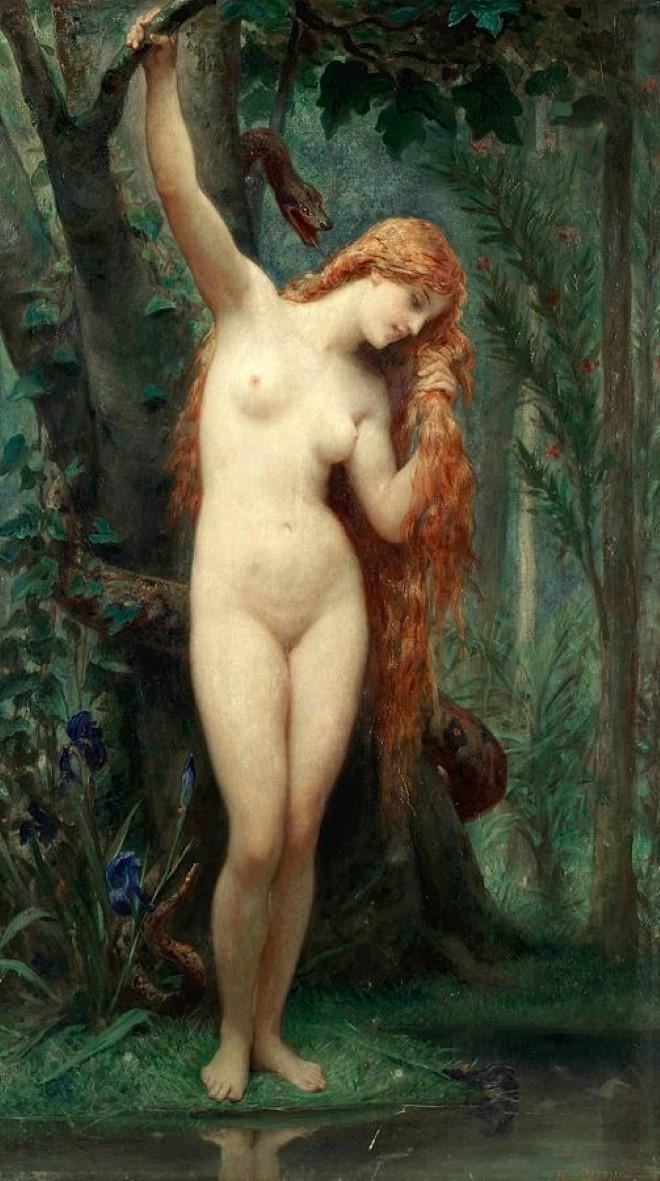
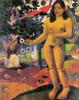
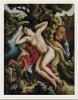
The walls and ceiling are painted a sky blue. The floor is dark green. Fake vines are hung from the tops of each of the walls, draping down and skimming the floor, which is covered in loose leaves. There are multiple round lights on the ceiling, so the room is well lit. Other thick clusters of short vines with blooming flowers hang from the ceiling at random intervals, none in front of the paintings. The back wall is not a wall but a thick curtain of vines that you cannot see through and splits the room in two. The sounds of nature play through speakers at the front of the room. The room has been made into a mini-Garden of Eden. On the right wall is Eve, with her frame wrapped in lilies and orchards of various shades of pink, blue, and orange that match the others in the room. In the middle of the room is a thin pillar that has the installation note. On the left wall is Delightful Land, centered on the wall and surrounded by flowers. Through the vine curtain, the other room is very dimly lit, with most of the light coming from a display light on the painting, Persephone, on the far wall. The sounds of nature are very quiet in here. There are plants on the walls in here as well, but they are instead twigs and affixed to them are rotten apples. The walls and floor are both dark green. On either side of the painting are snake plants potted in red pots.
Installation Note
Welcome to The Poisoning of Eden. This installation transports you into the Garden of Eden by surrounding you with the sights and sounds of nature. There are three paintings featured in this installation: Delightful Land (Te Nave Nave Feuna) by Paul Gauguin, Eve by Joseph Felix-Barrias, and Persephone by Thomas Benton.
Eve and Delightful Land are the first paintings of this installation, and both feature different versions of Eve before she succumbs to sin. In Delightful Land, a colorful Tahitian version of Eve is depicted. The blue flowers are representative of Eve’s sexual desire in the Garden, and her picking them is symbolic of her giving into sin. Similarly, in Eve, she is pictured right before talking with the snake who lurks behind her. In this painting the blue flowers are orchids, a symbol of fertility. Both of these paintings, around twenty years apart, visualize an idealistic woman, both who are untainted by the sin of sexual desire, which at the time of painting was saw as indecent for women to experience and be comfortable with. Eve, in these depictions, is close to the pureness of nudity as in birth – she is wholly unaware that her nakedness may be anything other than natural. These paintings are viewed in the male gaze, where woman should be innocent and pure, and that they are at fault if they are not. It is the pressure of this gaze that makes being naked something to be ashamed of. However, it is Eve’s decision to give into her curiosity, and by doing so she takes the power of her nudity into her own hands, now with the knowledge that those who may gaze at her are not doing so with purity in their eyes.
Past the curtain and into the darkness of sin is Persephone. This painting features a sleeping Persephone being observed unwillingly by Hades in disguise. Again, this painting depicts a pure woman, but instead of her exploring herself the sin of sexual desire, she is forcibly sexualized. This takes the power from her hands, and reveals that regardless of their actions and intentions, women will be sexualized. It is an unpleasantness that sticks to you. When leaving you will return through the vines and back into Eden, where Eve is taking control of her body and sexuality. While the biblical utopia of Eden explores purity in a degrading form, perhaps a more modern Garden of Eden would be one where women are free to own their body and pleasure without it being labeled as sin from unwanted eyes.
Joseph-Barrais, Felix. Eve. 1877 https://www.bonhams.com/auctions/25218/lot/173/ (Links to an external site.)
Accessed 31 Jan 2022.
Benton, Thomas Hart. Persephone, 1939, Nelson-Atkins Museum, Kansas City, Missouri. https://art.nelson-atkins.org/objects/27583/persephone (Links to an external site.)
Accessed 31 Jan 2022.
Gauglin, Paul. Delightful Land, 1892. http://www.ohara.or.jp/en/gallery/te-nave-nave-fenua/
Accessed 14 Feb 2022.