
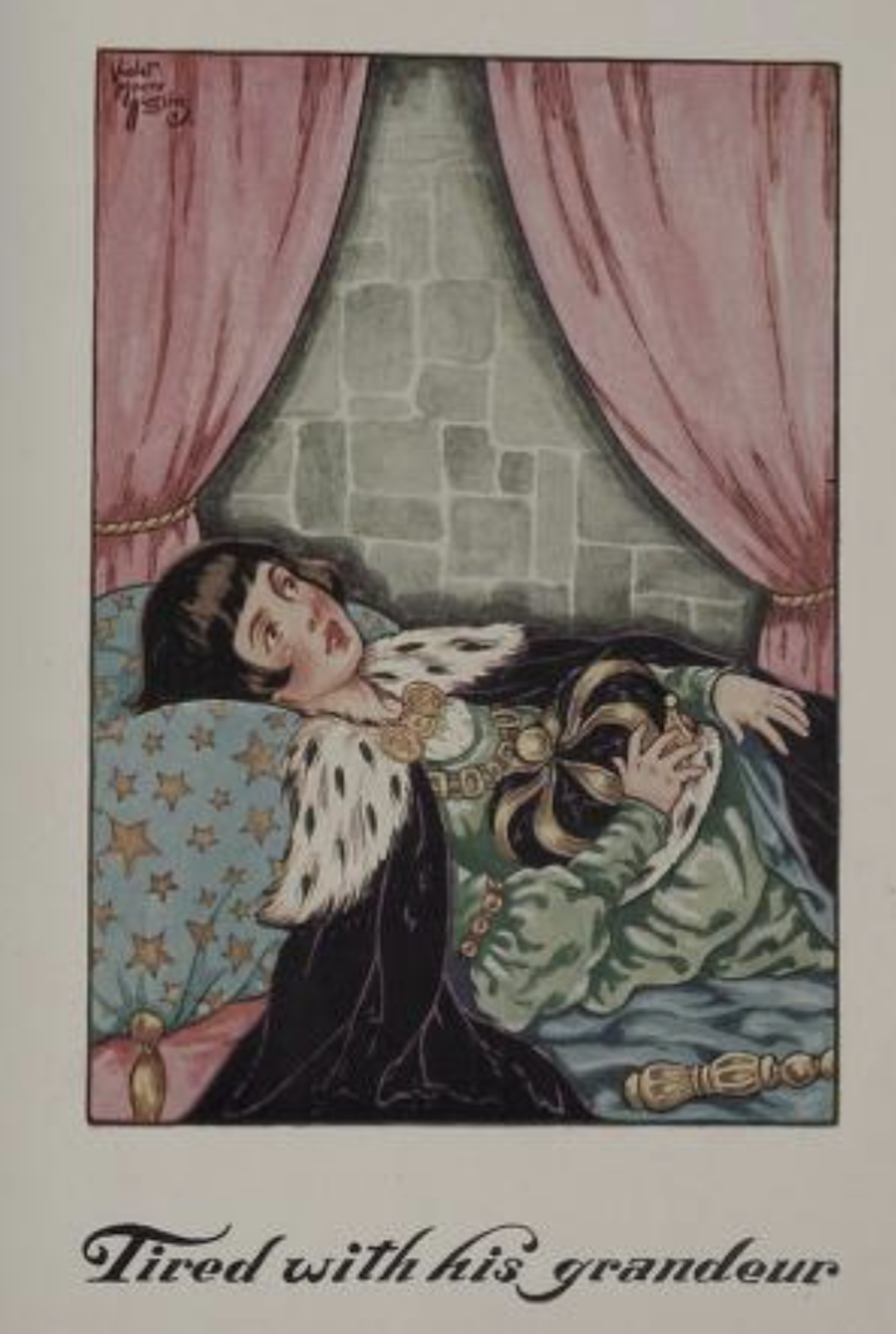
Craik, Dinah Maria Mulock. The Little Lame Prince. Illustrated by Albert Whitman, Albert Whitman & Co., 1927, p. 113. Internet Archive, archive.org/details/littlelameprince00crai_5/page/112/mode/2up.
In this illustration titled “Tired with his grandeur,” Prince Dolor’s posture and weary expression immediately suggest that the sudden pressures of kingship weigh heavily on him—an emphasis on emotional burden rather than physical prowess. Instead of the typical triumphant monarch found in muscular Christian narratives, Dolor appears overwhelmed and introspective, almost sinking into the plush and feminine-coded drapery that frames him. Such a depiction reinforces Dinah Mulock Craik’s reconfiguration of masculinity, in which real “strength” resides not in overt physical might but in moral responsibility and imaginative empathy. As Lily Philipose points out, Craik frequently intertwines domestic or “feminine” virtues—tenderness, compassion, and relational sensitivity—with the demands of political leadership. Far from glorifying an active, assertive ruler who delights in power, this image underscores the cost of moral governance: Dolor’s kingship, like the “domestic ideology” at the heart of Craik’s work, is built on attentiveness to his people rather than on spectacular regal display. He is portrayed, in Alan Richardson’s terms, as a “feminized boy hero,” bearing an internal weight that stems from relational care and imaginative introspection more than from physical challenges.