
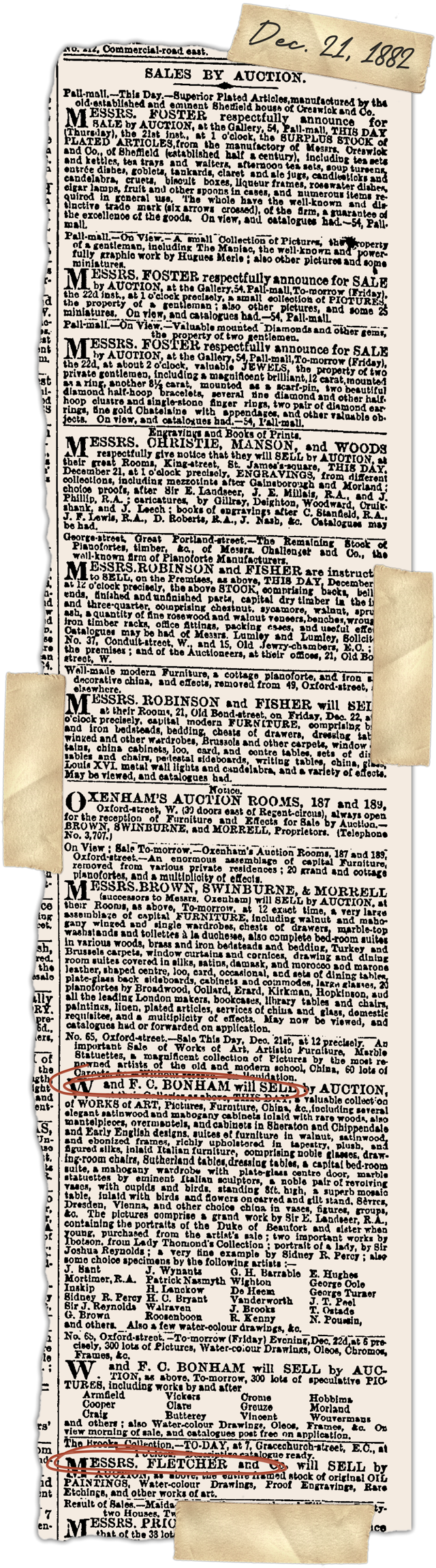

Darrell’s Commentary:
Perusing the “sale by auction” section of The London Times has become somewhat of a habit, though, more often than not, the listings I find are of little interest to me. However, today’s publication promised quite an exciting agenda. There are several fine paintings and other objects that have caught my eye in the catalog, and I fully intend to acquire them for my collection.
Of particular note are some paintings by Joshua Reynolds and Edwin Landseer, both of which are exquisite artists. I have admired their work for some time now and feel their paintings would pair nicely with some of the pieces I have already. The meticulous detail and realism of Landseer's work are unparallelled; I’d be humbled to look at it every day in my own home as I only wish I could paint like him. Not that I would ever call my own art bad, because that just simply wouldn’t be true.
As for the furniture in the catalog, there are several pieces upon which I am eager to place my bids. They offer collections in walnut, satinwood, and mahogany. My attention, however, shall be primarily centered upon the satinwood. Not only does the glossy golden color stand out wherever you put it, but I admire the rich history behind it too. That being said, I will not overlook the mahogany pieces, as I’ve seen some Chippendale style pieces that look absolutely magnificent in red. And I would be foolish not to look at the Italian furniture they have as well! I had an art professor from Italy, and although I was young at the time and many years have passed since then, I could never forget his still life paintings and his focus on the intricacies of Italian furniture pieces. I had never seen the beauty in a piece of wood before watching him, but I think my growing collection of lush furnishings from all over the world would prove that my opinions have since changed.
Moving on, although I will likely be crowded with findings by then, there is one last thing that I’d like to take a look at. My interests lead me toward a marble statuette of Italian origin. It would make quite a splendid addition to my studio!
Oh, these auctions are such exciting events and I always look forward to seeing what beautiful objects they present. I will be sorely disappointed if I do not secure all of these treasures, but I suppose I am not the only man of good taste in these areas so it is to be expected. I eagerly anticipate what new treasures I shall collect.
Editorial Commentary:
From this journal entry, it is evident that the author is an individual of some means, possibly belonging to the middle or upper class of society. This is suggested by their regular perusal of The London Times' auction listings and their intention to acquire pieces for a personal collection. Collecting art, furniture, and antiques was a favored pastime among the Victorian elite, encouraged by the Art-Journal, a magazine that aimed to create “a public for whom art was a regular part of domestic life and leisure activities”. His excitement for the auction and for the further collection of art pieces illustrates how the Art Journal made art "newsworthy" and created a Victorian "public culture" around art (Codell).
The mention of Joshua Reynolds and Edwin Landseer provides significant insight into the art preferences of the era. Sir Joshua Reynolds, although a figure from the preceding century, remained highly respected in the Victorian age for his portraiture. Meanwhile, Sir Edwin Landseer was one of the foremost artists of the Victorian period, best known for his realistic and often emotive depictions of animals. Although his fame began to decline in the 20th century, some of his iconic works remain cherished symbols in British culture. The writer's admiration for the "meticulous detail and realism" of Landseer's works aligns with the Victorian penchant for detailed, realistic art that evokes deep emotions and moral lessons. Mentioning these renowned artists and sharing his enthusiasm for their work represents the notion that “good art was defined by its appeal to the public” (Codell). The journalist even claims himself to be a “man of good taste”, furthering this idea.
The entry's focus on furniture reveals much about Victorian interior design ideals, reminiscent of the Victorian Era Aesthetic Movement. This movement aimed to prioritize “the aesthetic value more than the social and political themes in literature as well as other forms of art” (Victorian Era Aestheticism). As a result, many forms of art changed, and new styles were appreciated.
This commonplace book provides insight into the daily lives and interests of middle and upper class London during the late 1800s, as well as the cultural and aesthetic ideals of Victorian England. The writer's anticipation and excitement about the auction event is a testament to the era's deep appreciation for art, craftsmanship, and history.
Works Cited:
Codell, Julie F. Review of The Art-Journal and Fine Art Publishing in Victorian England, 1850–1880. Victorian Periodicals Review, vol. 45 no. 4, 2012, p. 493-496. Project MUSE, https://doi.org/10.1353/vpr.2012.0046.
"Sales By Auction." Times, 21 Dec. 1882, p. 12. The Times Digital Archive, link.gale.com/apps/doc/CS201638805/TTDA?u=uga&sid=bookmark-TTDA&xid=1e4022ab.
“Victorian Era Aestheticism.” Victorian Era, victorian-era.org/victorian-era-aestheticism.html.