Tea was consumed in Victorian Britain much as it is today- black tea leaves were steeped in a kettle to brew a beverage which could be enjoyed as a recreational drink. Unalike in the current day, however, tea was a semi-formal daily routine, enjoyed with refreshments such as little cakes or sweetmeats. It was served on porcelain dining ware sold in sets, including items such as teapots, cups, tea trays, and saucers. Although this daily meal was referred to as "teatime", there was no set hour for it, and the meal varied about the afternoon- typically after work for laborers. During tea parties, social standards were relaxed- tea was viewed as an informal gathering, particularly as it became accessible to women and the poor as tea itself became cheaper and more prevalent. This ties into the social function of tea- more than an item or ritualized meal, it was an opportunity for casual conversation with family or peers.
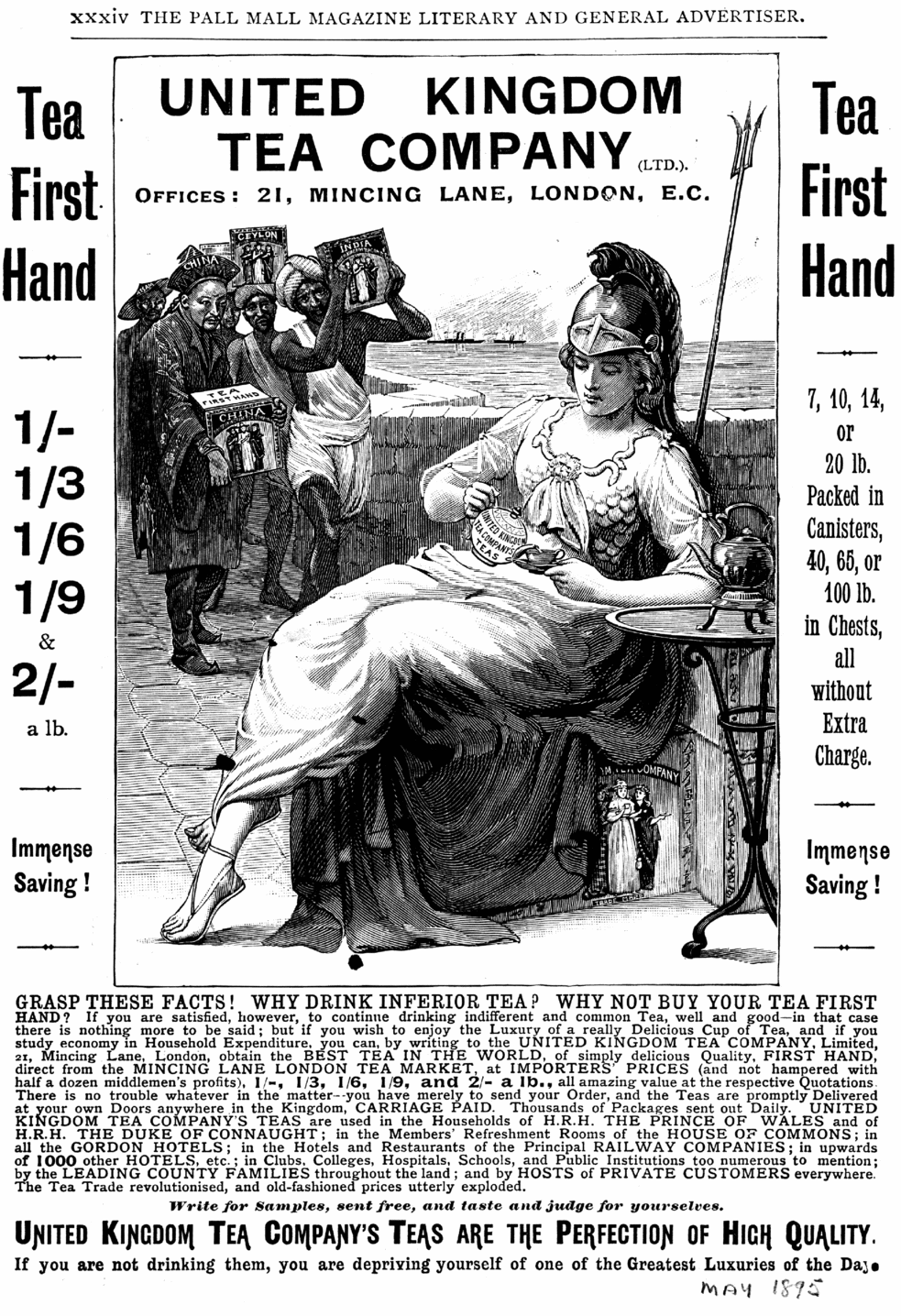
In addition to its social use, tea also had a political function- viewed as the national beverage, it unified the British people under one common identity. Regardless of factors such as class, they all enjoyed the same ritual meal, with the same staple food. This is semi-ironic, considering that tea originated in China, and this tension did not go unnoticed- contemporary newspapers rose concerns about the “purity” of tea, and the British themselves began to grow tea in India when it was discovered to also be native there (and attempted to grow it in America, as well). This reinforced India as an arm of the British Empire and expanded English exploitation and political influence in the region, as they sought to maintain more control over their supply. Thus, tea was paradoxically both a necessity- a basic aspect of social life, and everyday meal- and a luxury- an exotic foreign good representative of the empire's power.
Sources:
Harris, Muriel. “The English Tea.” The North American Review, vol. 215, no. 795, University of Northern Iowa, 1922, pp. 229–35, http://www.jstor.org/stable/25120965.
This source described English attitudes towards tea and tea time. It describes both the social aspects of tea-time- the gossip and informality- and the political aspects- the impact on the English national identity, particularly characterized as an import itself. This characterizes the role of tea in both British daily life and the empire itself.
Fromer, J. (2008). “DEEPLY INDEBTED TO THE TEA-PLANT”: REPRESENTATIONS OF ENGLISH NATIONAL IDENTITY IN VICTORIAN HISTORIES OF TEA. Victorian Literature and Culture, 36(2), 531-547. doi:10.1017/S1060150308080327
This source described the relation between tea and the English national identity, particularly considering its foreign origins. It explained how tea was linked to the notion of “Englishness”, both physiologically and socially, and described the anxiety around the idea that this was an imported good, yet was central to Britain’s identity. Fromer recounts how the discovery of tea native to India cemented them as a part of the empire, and increased British control over the tea supply, and finally describes how tea was paradoxically both a necessity (a daily consumption in mealtime) and a luxury (a foreign good with social and political implications).
"The Tea Plant." Illustrated London News, 10 Nov. 1849, p. 318. The Illustrated London News Historical Archive, 1842-2003, link-gale-com.proxy.uchicago.edu/apps/doc/HN3100023379/ILN?u=chic_rbw&sid=bookmark-ILN&xid=755101f2. Accessed 11 Feb. 2022.
This source, the Illustrated London News, reported on an American’s attempts to grow tea in South Carolina. The tea plants successfully budded, despite being planted in the wrong season. The article also covers some interesting numbers in regards to tea, such as contemporary estimations on the amount of tea consumed by England and her colonies, and the amount of tea produced and exported by China. This emphasizes the extent of the British demand for tea, particularly the need to control its creation and export, and the paper notes that the growing of tea in America “will be attended with vast benefit to the country if completely successful.”
"The Adulterations of Tea." Illustrated London News, 27 Sept. 1851, p. 398. The Illustrated London News Historical Archive, 1842-2003, link-gale-com.proxy.uchicago.edu/apps/doc/HN3100029239/ILN?u=chic_rbw&sid=bookmark-ILN&xid=c19a1295. Accessed 11 Feb. 2022.
This contemporary newspaper article from the Illustrated London News covered concerns about the contamination of tea. It found that green tea was more likely to be tampered with than black tea, owing to the assumption that greener leaves would make the tea seem more genuine, when green tea leaves are in fact more yellowish. The newspaper presumes that the “injurious materials”, such as commonplace leaves, gum solution, or rice, were deception added by Chinese sellers. This article demonstrates British anxiety about relying on an imported good for the national identity, as seen through concerns about deception and impurity.
Vaijayanti, Prasad Mahabal. "Victorian Era Tea Tradition and Tea Parties." Victorian Era. Accessed February 11, 2022. http://victorian-era.org/victorian-era-tea.html.
This source described how Victorians brew and took tea, as well as the social implications. It covered the history of tea as an institution, as well as describing the practical realities of teatime, such as what foods were consumed with tea and what materials tea sets were made of. It also described the societal convention of teatime, particularly in regards to class, gender, and the relation of tea etiquette to Victorian standards.
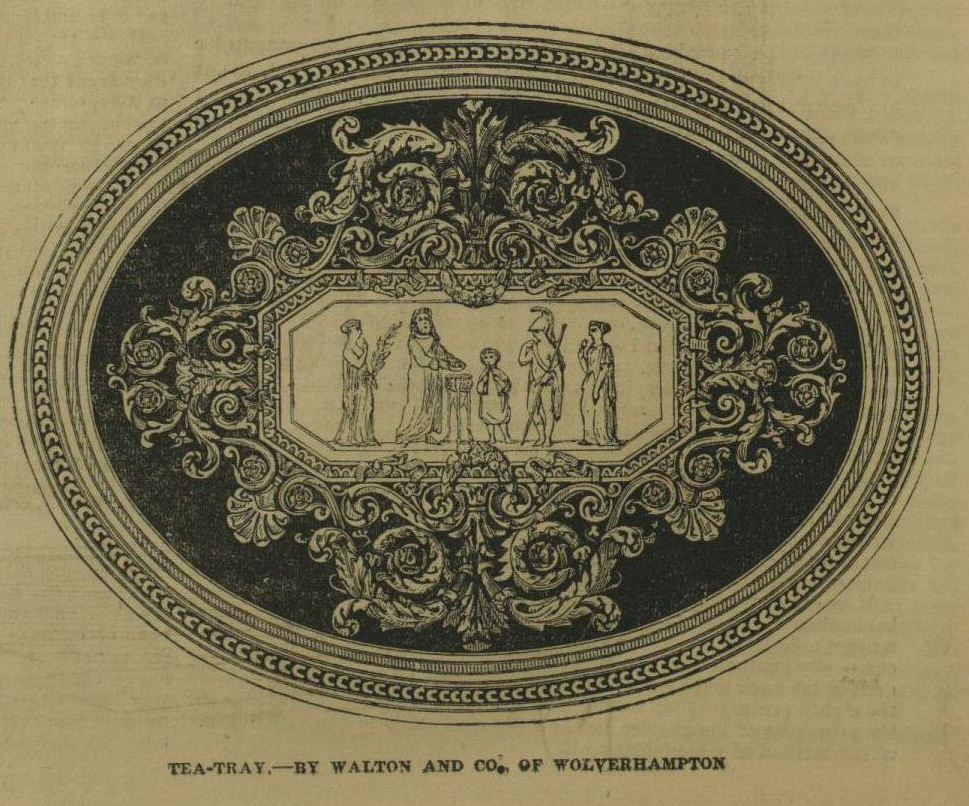
"Tea-Tray. By Walton and Co." Illustrated London News, 20 Sept. 1851, p. 364. The Illustrated London News Historical Archive, 1842-2003, link-gale-com.proxy.uchicago.edu/apps/doc/HN3100029165/ILN?u=chic_rbw&sid=bookmark-ILN&xid=af6b32fc. Accessed 11 Feb. 2022.
This source, the Illustrated London News, provided an image of a tea-tray by Walton and Co. of Wolverhampton in an advertisement. They are composed of glass, iron, and even pearl, with ornamental figures and flowers on top. The tea tray is advertised as durable and difficult to dirty, focusing on both its ornamental beauty and practical purpose, showing British perceptions about the purposes of tea and teatime.
Tea First Hand,” United Kingdom Tea Company. Courtesy of Bodleian Library, University of Oxford: John Johnson Collection; Tea and Coffee Box 2.
This image portrayed an advertisement for tea with connotations in English Empire. It was included in the article “Deeply Indebted to the Tea Plant”, as a reference for how advertising upheld imperial norms. The image demonstrates both the luxury and necessity status of tea, and the anxieties about importing, with the text of the advertisement claiming that it is attained directly without “middlemen”. The image highlights the work of other countries in procuring the teal, by labeling workers bringing the crates as “China” and “India”.
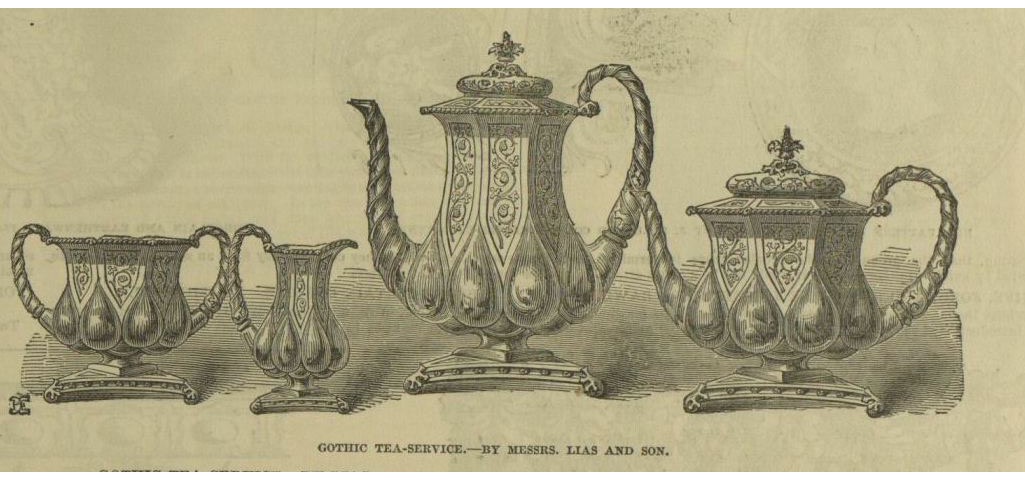
"Gothic Tea Service. By Lias." Illustrated London News, 2 Aug. 1851, p. 155. The Illustrated London News Historical Archive, 1842-2003, link-gale-com.proxy.uchicago.edu/apps/doc/HN3100028700/ILN?u=chic_rbw&sid=bookmark-ILN&xid=6ffd6291. Accessed 11 Feb. 2022.
This advertisement from the Illustrated London News provided an image of a gothic tea set being sold by Messrs. Lias and Son. In Victorian fashion, it is advertised as desirable for being functional and pleasing to the eye, rather than loaded with “unmeaning frippery”, demonstrating contemporary British perceptions about the purposes of tea and teatime.