
Darrell’s Commentary:
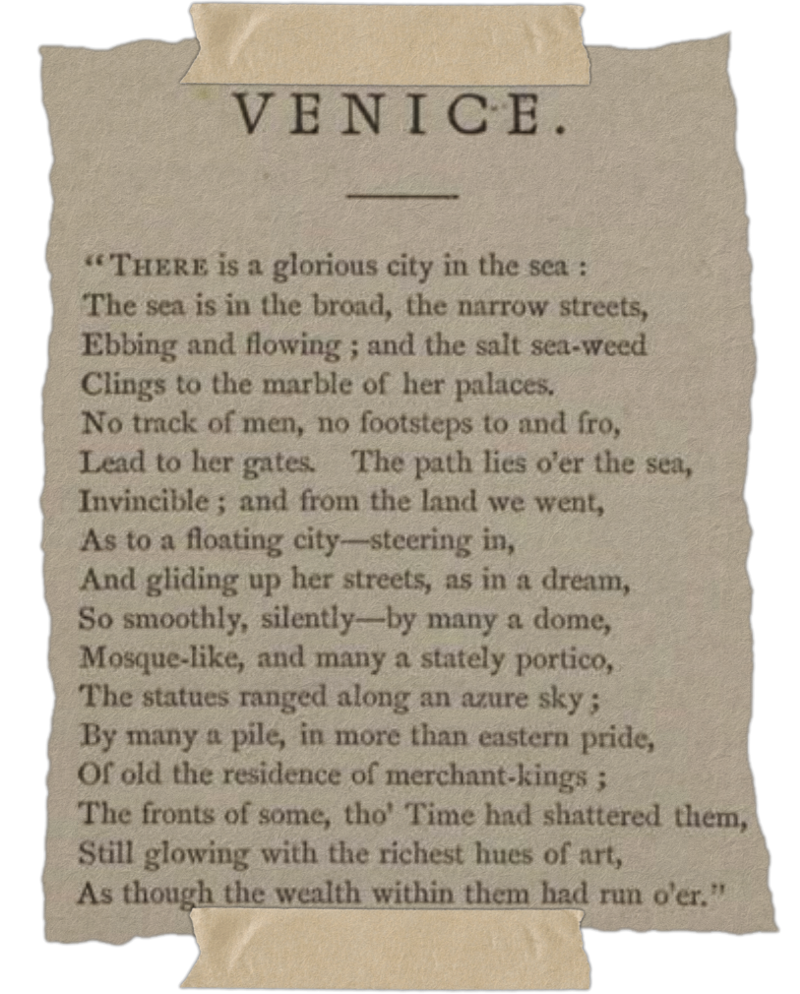
What a glorious day! As I was perusing a travel guide, I came across a magnificent poem about the city of Venice. The vivid imagery of the sea flowing through the streets and the majestic palaces and statues made me long to visit the otherworldly scene once again.
And oh how I wish I could experience its beauty with my lovely Phyllis by my side! Her beauty would complement the splendor of Venice perfectly. As I read the poem, I pictured us gliding through the canals in a gondola, her eyes wide with wonder as she takes in the marble palaces rising from the sea. I would point out the architectural details that catch my artist's eye, and she would sigh over the romance of it all. Perhaps I could even convince her to model for me against the backdrop of the Piazza San Marco or the Bridge of Sighs. Just as the poem describes the city “glowing with the riches hues of art”, her loveliness would be captured for all time in my canvas.
Perhaps I could convince Phyllis to come with me. The travel guide spoke highly of the romantic city, and maybe I could use it to sway her. It even discusses the climate that keeps the weather feeling lovely all year round. However, I have a feeling that the poem will be enough to sway her, along with the fact that I will have to leave her behind if she does not come. The challenge lies in convincing her sister to let her go. I suppose we could just run away together. What more could my beautiful Phyllis want than to stroll through La Serenissima with a gentleman by her side? I do believe that it would be better for Phyllis to come with me, as she’s been feeling weaker lately and the enchanting city would surely lift her spirits.
But even without her I long to lose myself in that floating city once more. For now it can only be a dream, but I cling to the hope that one day, my path will lead me back to glorious Venice.
Editorial Commentary:
This second entry further proves the writer’s position in upper class society as he speaks highly of his past travels and plans for future trips, indicating that he is in a comfortable position to be able to afford such luxuries. His passion for travel and appreciation of beauty and art are reminiscent of the “Grand Tour”, an educational rite of passage of young, upper-class English men in the 17th to 19th centuries, where they, accompanied by a tutor or family member, would travel and learn of various cultures throughout Europe. Although the author doesn’t mention partaking in the Grand Tour himself, his attitude toward ideas of travel, art, and beauty are akin to those who would have been a part of this experience. His infatuation with Venice in particular portrays the city’s popularity among European tourists in the 19th century. They could read travel journals documenting “the awe-inspiring sights and cultural experiences” that the city provided, which evoked curiosity to see the city for themselves (Grove). Today, Venice continues to enchant tourists with its timeless allure.
In addition to the author’s fondness for travel and art, his portrayal of Phyllis is also in line with the division of men and women typical of the Victorian Era. He sees her as beautiful, delicate, and an object of admiration and inspiration. Artists often used their muses as subjects, capturing their beauty in various forms of art, similar to how the writer speaks of painting Phyllis against Venetian landmarks. He paints a picture of the “innocent, pure,” and “gentle” Victorian woman, “willing to be dependent on men and submissive to them”, as he believes that running away to the romantic city with him is all that she could possibly want (Gorham, 4). Furthermore, as he describes the dream-like haze that he imagines the city would put Phyllis in, and assumes that the poem would be more persuasive to Phyllis than factual information like the agreeable climate of Venice, he illustrates the “private sphere of love”, in which “emotions and domesticity” were assigned to women (Gorham, 4).
This entry continues to illustrate the daily lives of Victorian Era individuals, emphasizing their appreciation for art and culture, and affirming their ideals of femininity at the time.
Works Cited:
Burns, Jabez. Help-Book for Travellers to the East; Including Egypt, Palestine, Turkey, Greece and Italy. 1872. Second Edition, Cook’s Tourist Office, p. 146, www.masstourism.amdigital.co.uk/Documents/Details/TCA_B_BxEgypt_1872.
Gorham, Deborah. The Victorian Girl and the Feminine Ideal. 2012. Reprint, Routledge, pp. 3–4, books.google.com/books?hl=en&lr=&id=KT9PEAAAQBAJ&oi=fnd&pg=PP1&dq=victorian+ideals+of+femininity&ots=PbVqeO4EUB&sig=ag9iak6XAtekoDVRY3aYnlrLH40#v=onepage&q=victorian%20ideals%20of%20femininity&f=false.
Grove, Stephen. “Exploring the Enchanting Allure of 19th Century Venice: A Journey through Time.” 19th Century Events and Developments, 6 Aug. 2023, 19thcentury.us/19th-century-venice/.