As a class we will be using the resources of the Central Online Victorian Educator (COVE) to create a collaborative Digital Humanities project in Victorian studies in which we explore the intersecting dynamics of race, gender, class, and empire of the Victorian Era. To complete this project, you will need to add one timeline element, one map element, and one gallery image related to these issues to our collective COVE resources. Provide sufficient detail to contextualize the person, object, event, or place you are sharing; be sure to cite your sources. Try to interlink the three elements, if you can.
I've already populated the timeline with events related to the readings and lectures. These timeline entries are connected to BRANCH (Britain, Representation, and Nineteenth Century History) articles that contextualize these events. BRANCH is a great place to start for research on what you'd like to contribute to our class timeline.
Timeline
Table of Events
| Date | Event | Created by |
|---|---|---|
| 1549 to 1549 | The Common Book of Prayer and it's InfluenceThe Book of Common Prayer, although nearly completely forgotten in contemporary English religion, was very crucial during this era. The bible was translated into a prayer book, which was then revised into the Book of Common Prayer and used by Anglican Christians. Because Chirstianity was such a huge part of life and because the Church held so much power over the people, religious teachings and ideas were sewn into literature. We see this a lot in Jane Eyre, as well as within a few characters of North and South. The Church of England had many restrictions on the people with homelife, worship, and work. The loftiness of it is heavily reflected in North and South in Mr. Hale.
Bolt, P. (1999). The Book of Common Prayer. English Department; North East Worchester College. Title page of Book of Common Prayer [Photograph]. (n.d.). |
Rebekah Hansen |
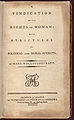
| 1 Jan 1792 | Vindication of the Rights of Woman
ArticlesAnne K. Mellor, "On the Publication of A Vindication of the Rights of Woman" Related Articles |
David Rettenmaier |
| The end of the month Winter 1814 | High Speed Printing PressWhile Gutenburg had created the hand press long before, it's output was a meager 240 pages an hour. The creation of the steam powered high speed printing press by Friedrich Koenig and Andreas Bauer in 1812 was a technological leap in production able to print double sided sheets at 1,100 an hour. After no interest was shown in his home country of Germany Koenig found success in England with the The Times in London. In 1814 the Koenig-Bauer printing press was used to publish The Times five times faster than it had before. |
Dustin Seals |
| 12 Jul 1819 | Britain approves settlement scheme to South AfricaOn 12 July 1819, the British government approved £50,000 for a settlement scheme to South Africa's eastern Cape. Articles |
David Rettenmaier |
| 1828 | The Industrial Revolution: The Portable Steam EngineRailways and trains during the Industrial Revolution brought about a great change throughout Britain. Railways began to expand and more people began to use trains as transportation from city to city. The revolution in steam engines started with the Newcomen engine which was invented to help pump water out of mines instead of using horses to do the work. This engine used atmospheric pressure to push the pistons in the engine down. Later another engine would be created by James Watt in order to create a more efficient way of creating energy. Watt realized that the Necomen engine wasted a lot of steam and he realized that he could fix this by making a seperate condenser. These two inventions lead to the invention of the portable steam engine that was invented in 1828 by The firm of Maudslay, Sons and Field. This made it easier to use an engine in agricultural areas and used for smaller machines. People could use it for one machine on a farm and then take it to another machine when they needed to because it was portable. Steam engines made a big difference in the world during the Victorian time and started the revolution for the engines and machines that we have today. Source: http://www.victorianweb.org/technology/inventors/watt.html
|
Sarah Lyle |
| 1830 to 1832 | The Great Reform Act CrisisIn 1830 some of the Tories wanted to change the Electoral system but Tory Prime Minister Arthur Wellesley advocated against it. The aftermath of that were riots breaking out in Bristol and were quoted as the worse that England had seen in the 19th century. However, in 1832 when the Whigs were in control of the House of Commons, Whig Prime Minister Lord Grey announced the new plan for the Great Reform Act. The Great Reform Act was designed to give more seats to the counties and less to the wealthy. For example, 65 seats were awarded to the counties. 44 seats were distributed to 22 larger towns including Birmingham, Manchester, Leeds, Sheffield and the new London metropolitan districts. 21 smaller towns were given one MP each, Scotland was awarded 8 extra seats. Ireland was given 5 extra seats. It's important to notate this because the Great Reform Act gave more power to the people and it gave less weathly people a voice about what would happen in their lives. |
Allanah Staggs |
| 29 Aug 1833 | Slavery Abolition Act
Articles |
David Rettenmaier |
| 29 Aug 1833 | Factory Act
ArticlesRelated Articles |
David Rettenmaier |
| The Poor Law was transferred to local authorities in 1929, but was finally abolished in 1948 | The New Poor Law of 1834The Poor Law put a new system in place in which the poor were to be housed in workhouses and would be given clothing, food, and some schooling for the children in return for working several hours every day. Some people were optimistic because the new Poor Law would take the homeless off the streets and encourage them to work for a living, but the poor themselves were afraid of the workhouses and rioted against the new law. |
Austyn Thomas |
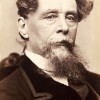
| Feb 1837 to Apr 1839 | Oliver Twist
Related ArticlesHeidi Kaufman, “1800-1900: Inside and Outside the Nineteenth-Century East End” |
David Rettenmaier |
| 4 Sep 1839 to 29 Aug 1942 | The First Opium WarChinese goods such as silk and tea were very popular among British subjects. However, the Chinese were unwilling to purchase British goods in return. In order to create demand in British trade, the East Indian Company and British government began smuggling and selling highly addictive opium into China. In 1839, the Chinese government tried to put a stop to the influx of opium flooding their nation and creating addicts of their subjects. They convininced British Superintendent of Chinese Trade, Charles Elliot to give them the stocks of opium waiting in Canton. Once in the Chinese government's possession, they destroyed the opium. This infuriated the British and the fighting began in earnest the following year. China lost the conflict and was required to open more ports for trade, sign over Hong Kong as a British territory, and pay reparations. Image Source: https://visualizingcultures.mit.edu/opium_wars_01/ow1_gallery/pages/1841_0792_nemesis_jm_nmm.htm |
Shelby Johnson |
| 10 Feb 1840 | Queen Victoria Marries Prince AlbertQueen Victoria and Prince Albert married after an approximately three month engagement. Victoria's outfit choice made world news, she wore a white gown adorned with orange blossoms. The gown was made of satin, and carried deep symbolism. The gown also had an 18-foot long train. Victoria often wore parts of her wedding outfit throughout her life. Though she had already reigned as queen for three years before her wedding, Victoria made clear she wished to priortize her role as a wife as much, if not more, as her role as queen. Known for her shyness, Victoria wished for a small wedding, but was somewhat forced to endure some level of exravaganza as queen. In Victoria's journal, she wrote "This was the happiest day of my life!" Sources: https://www.royal.uk/timeline-queen-victoria-and-prince-albert https://www.vanityfair.com/style/2018/04/queen-victoria-royal-wedding https://www.theweddingsecret.co.uk/magazine/celebrity-weddings-queen-victoria/ |
Dominique Chavez |
| 8 Aug 1842 | Manchester strike
ArticlesChris R. Vanden Bossche, "On Chartism" Related ArticlesJo Briggs, “1848 and 1851: A Reconsideration of the Historical Narrative” |
David Rettenmaier |
| 1845 to 1849 | The Irish Potato FamineIn the year 1845 a blight destroyed the annual crop of potato, which is what the vast majority of Irish people lived on. For four years blight would ravage the potato crops and would contribute to what some have argued might have been between a million to a million and a half deaths. What further contributed to the misery was the lack of assistance from the British rule. |
Dustin Seals |
| 21 Feb 1848 | The Communist Manifesto is PublishedDeveloped in two years yet written in about seven weeks, Karl Marx and Friedrich Engals wrote The Communist Manifesto in London, England. Due to the influx of industry in London, Karl Marx (and a group of other revolutionary socialists) considered the impact this type of social change troublesome. To them, the workers should own the businesses--as it had been for as long as human memory--instead of one owner to many workers making little wages. After its publication it became extremely popular (despite not being particularly new information) and it became an important topic of debate. It became the reasons for the fall of the Csars in Russia and later on resulted in the Cold War. Source: https://www.history.com/this-day-in-history/marx-publishes-manifesto |
Ann Oliver |
| 29 Spring 1849 to 1849 | Koh-i-NoorThe Koh-i-Noor was a massive diamond that has a long and mostly mysterious hystory. There are a few versions of its past, some being that it was sifted out of sand, some that it is cursed and revered by many Indian deities. It was worn by many rulers all throughout India and Asia. It is most controversial because it now adorns the crown jewels in England despite the Indian, Pakistani, Iranian, and Afghanistanian governments having claimed its ownership. The story is that it was taken during the annexation of India by Britian. Queen Victoria was given the diamond when the Treaty of Lahore was signed, "The gem called the Koh-i-Noor, which was taken from Shah Sooja-ool-moolk by Maharajah Ranjeet Singh, shall be surrendered by the Maharajah of Lahore to the Queen of England (sic)" It was worn as a brooch by Queen Victoria and was even put on display at the Great Exhibition in London, but people weren't impressed by the diamonds appearance. Prince Albert had it recut which shaved down quite a bit of its size. It currently resides on the crown that is worn during corronations. ***The image attached is a replica*** |
Ann Oliver |
| 1 May 1851 to 15 Oct 1851 | Great Exhibition
The Great Exhibition of 1851 was an event in the history of: exhibitions; world’s fairs; consumerism; imperialism; architecture; collections; things; glass and material culture in general; visual culture; attention and inattention; distraction. Its ostensible purposes, as stated by the organizing commission and various promoters, most notably Prince Albert, were chiefly to celebrate the industry and ingeniousness of various world cultures, primarily the British, and to inform and educate the public about the achievement, workmanship, science and industry that produced the numerous and multifarious objects and technologies on display. Designed by Joseph Paxton, the Crystal Palace (pictured above) was a structure of iron and glass conceptually derived from greenhouses and railway stations, but also resembling the shopping arcades of Paris and London. The Great Exhibition of the Works of Industry of All Nations became a model for World’s Fairs, by which invited nations showcased the best in manufacturing, design, and art, well into the twentieth century. ArticlesAudrey Jaffe, "On the Great Exhibition" Related ArticlesAviva Briefel, "On the 1886 Colonial and Indian Exhibition" Anne Helmreich, “On the Opening of the Crystal Palace at Sydenham, 1854″ Anne Clendinning, “On The British Empire Exhibition, 1924-25″ Barbara Leckie, “Prince Albert’s Exhibition Model Dwellings” Carol Senf, “‘The Fiddler of the Reels’: Hardy’s Reflection on the Past” |
David Rettenmaier |
| May 1852 | The Victoria and Albert MuseumIt was originally known as The Museum of Manufacturers and contained collections on both applied art and science. The first director, Henry Cole, wanted the museum to be "a schoolroom for everyone" and education of the public was its mission. The museum was first located at Marlborough House, later moved to Somerset House, and finally transferred to South Kensignton where it still remains today. When it moved for the last time in 1857, it was renamed "South Kensignton Museum". The year after efforts were made to have the museum open at later hours so as to be accessible to the working classes by introducing gas lighting. It was renamed "The Victoria and Albert Museum" in 1899. Over the years, many additions have been built onto the museum and its collections are numerous and massive, being one of the largest museums in the world. It is largely an art gallery of many mediums including paintings, photographs, sculptures, tapestries, etc. The V&A has a combined collection of over 6.5 million objects, although not all of them are housed in the museum at the same time. Sources https://www.vam.ac.uk/collections/the-va-story#intro https://www.british-history.ac.uk/survey-london/vol38/pp248-256 |
Elena Ellis |
| 2 Oct 1853 to 30 Mar 1856 | Crimean War
ArticlesStefanie Markovits, "On the Crimean War and the Charge of the Light Brigade" |
David Rettenmaier |
| 28 Mar 1854 | Britain declares war against Russia
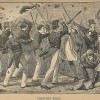
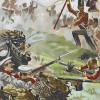
On 28 March 1854, Britain declares war against Russia, thus entering the Crimean War. Image: Russo-British skirmish during Crimean War (anonymous plate). This image is in the public domain in the United States because its copyright has expired. In 1854, in defense of the Turks and of British access to eastern trade routes, Britain entered into war in the Crimea. The two-year campaign represented the nation’s first major military engagement since the end of the Napoleonic wars. It thus sheds light on mid-Victorian attitudes towards national identity, offering a counter-narrative to views of the 1850s dominated by responses to the Great Exhibition of 1851. As literary and visual representations of the war reveal, reactions to this conflict were both more nuanced and more ambivalent than our preconceptions about Victorian jingoism might anticipate. ArticlesStefanie Markovits, "On the Crimean War and the Charge of the Light Brigade" |
David Rettenmaier |
| Aug 1854 | Polio and Cholera EpidemicsIn 1854, John Snow identified the first recorded cholera cases in Soho, London. He identified the water pump on the street as the cause of the outbreak since everyone who got sick was drinking from this pump. This led to a revolution in understanding public water supplies need to be cleaned or risk disease. In this small outbreak 616 people died within one month. London had several severe cholera outbreaks betwee the years 1832 and 1866, which is why it was so feared during this time. The symptoms of cholera include being dehydrated, due to constant diarhea, which led to blue-tinted skin from oxygen loss, muscle spasms, and possibly death. A cure for cholera was not discovered until the late 1880s. Polio was another horrible illness affecting many in the Victorian era, but its first known recorded case was in Ancient Egypt. London's first record of polio came from a pediatritian named Michael Underwood who described the paralyzation and deformation it caused in infants in 1789. The next few reported cases jumped around from Norway, Sweden, and Vermont. This illness comes from poor hygeine, and thus will be present in any unclean place which is why it jumps around so much. The terror of getting polio continued until 1955 when a vaccine was finally discovered. Both of these illnesses contributed to a very high mortality rate in the Victorian era, especially in children. Throughout the novels we've read, Cholera, Polio, and other illnesses (Tuberculosis/Consumption) have been very present and feared. Both of these diseases spread through lack of hygiene and cleanliness, which is why it is so difficult to identify a source. These illnesses became less and less common over time becuase general sanitation habits increased. Sources: https://www.branchcollective.org/?ps_articles=pamela-k-gilbert-on-chole… https://www.bl.uk/collection-items/john-snows-account-of-the-cholera-ou… https://www.passporthealthusa.com/2017/11/history-of-the-cholera-vaccin… https://www.britannica.com/science/polio/Polio-through-history |
Richard Evans |
| Aug 1854 | Polio and Cholera EpidemicsIn 1854, John Snow identified the first recorded cholera cases in Soho, London. He identified the water pump on the street as the cause of the outbreak since everyone who got sick was drinking from this pump. This led to a revolution in understanding public water supplies need to be cleaned or risk disease. In this small outbreak 616 people died within one month. London had several severe cholera outbreaks betwee the years 1832 and 1866, which is why it was so feared during this time. The symptoms of cholera include being dehydrated, due to constant diarhea, which led to blue-tinted skin from oxygen loss, muscle spasms, and possibly death. A cure for cholera was not discovered until the late 1880s. Polio was another horrible illness affecting many in the Victorian era, but its first known recorded case was in Ancient Egypt. London's first record of polio came from a pediatritian named Michael Underwood who described the paralyzation and deformation it caused in infants in 1789. The next few reported cases jumped around from Norway, Sweden, and Vermont. This illness comes from poor hygeine, and thus will be present in any unclean place which is why it jumps around so much. The terror of getting polio continued until 1955 when a vaccine was finally discovered. Both of these illnesses contributed to a very high mortality rate in the Victorian era, especially in children. Throughout the novels we've read, Cholera, Polio, and other illnesses (Tuberculosis/Consumption) have been very present and feared. Both of these diseases spread through lack of hygiene and cleanliness, which is why it is so difficult to identify a source. These illnesses became less and less common over time becuase general sanitation habits increased. Sources: https://www.branchcollective.org/?ps_articles=pamela-k-gilbert-on-chole… https://www.bl.uk/collection-items/john-snows-account-of-the-cholera-ou… https://www.passporthealthusa.com/2017/11/history-of-the-cholera-vaccin… https://www.britannica.com/science/polio/Polio-through-history |
Richard Evans |
| 25 Oct 1854 | Charge of the Light Brigade
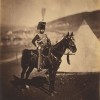
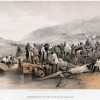
On 25 October 1854, British forces undertook the charge of the Light Brigade at the Battle of Balaklava. Image: Tinted lithograph showing the embarkation of sick persons at the harbor in Balaklava" (William Simpson, artist; Paul & Dominic Colnaghi & Co., publishers, 24 April 24 1855). This image is available from the United States Library of Congress's Prints and Photographs division under the digital ID ppmsca.05686. The image is in the public domain in the United States because its copyright has expired. No other engagement of the war has stuck so vividly in the popular consciousness, aided by Tennyson's poem of the same name, by far the best-remembered cultural product of the war. On the morning of October 25th, 1854, over six hundred British men rode the wrong way down a “valley of death” (so christened first by The Times and later by Tennyson) as enemy guns attacked from all sides. Not two hundred made it out alive. The charge resulted from a series of miscommunications between Lord Raglan, the Commander-in-Chief of the British Forces, and Lord Lucan, the Commander of the Cavalry. Both Tennyson’s poem and many other contemporary responses to the charge suggest that reactions to this event were deeply conflicted, expressing real bewilderment about how to integrate it into preexisting models of patriotic feeling. Moreover, a new form of heroism grew out of the bewildering experience of the Light Brigade’s defeat—and a new sense of a national identity that was based in part on this new heroism. ArticlesStefanie Markovits, "On the Crimean War and the Charge of the Light Brigade" |
David Rettenmaier |
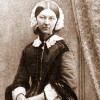
| The start of the month Winter 1854 to Summer 1856 | Florence Nightingale changes modern Nursing during the Crimean WarFlorence Nightingale's volunteer nurse work during the Crimean war held lasting impresstions with the medical community. She proved that sanitation in hosptials and medical residence leads to quicker recovery and less deaths overall. With Nightingale's insight and planning, she created an enviroment of homes for the nurses assisting in the Crimean war. This was a safe place for the female nurses to live while they worked admist the harsh backdrop of war. Her knowledge and patience for the soldiers saved many lives and helped future generations progess with modern medicine. CLondon: Tinderpress. Perry Pictures/Library of Congress, Washington, D.C. (LC-USZ62-5877) Markovits, Stefanie. “On the Crimean War and the Charge of the Light Brigade.” BRANCH: Britain, Representation and Nineteenth-Century History. Ed. Dino Franco Felluga. Extension of Romanticism and Victorianism on the Net. Web. [Here, add your last date of access to BRANCH]. Young, Arlene. “The Rise of the Victorian Working Lady: The New-Style Nurse and the Typewriter, 1840-1900.” BRANCH: Britain, Representation and Nineteenth-Century History. Ed. Dino Franco Felluga. Extension of Romanticism and Victorianism on the Net. Web. [Here, add your last date of access to BRANCH]. |
Rebekah Hansen |
| 4 Nov 1854 | Florence Nightingale landed at Scutari
ArticlesLara Kriegel, “On the Death—and Life—of Florence Nightingale, August 1910″ Related ArticlesStefanie Markovits, “On the Crimean War and the Charge of the Light Brigade” |
David Rettenmaier |
| 30 Mar 1856 | Treaty of Paris
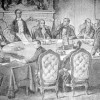
On 30 March 1856, signing of the Treaty of Paris, ending the Crimean War. Image: Treaty of Paris, the participants (Contemporary woodcut, published in Magazin Istoric, 1856). This image is in the public domain in the United States because its copyright has expired. ArticlesStefanie Markovits, "On the Crimean War and the Charge of the Light Brigade" |
David Rettenmaier |
| 1857 to 1 Jan 1858 | Matrimonial Causes Act of 1857This act, passed by Parliament, moved divorce from being in a religious jurisdiction to a civil jurisdiction. Previous to this act, divorce was a lengthy and expensive process that could possibly take years. This act ensured the right of audience to all. Men and women were still given unequal treatment, with men only needing to cite adultery as a reason, while women needed to cite adultery as well as at least one other reason. However, after this act was passed, women continually gained greater rights in marriage and regarding divorce. Because many of the voices of the novels we are reading are women, the need for a protected right to divorce by both parties in the marriage is needed, especially since the characters don't seem to know each other very well before getting married. Image: Royal Standard of the United Kingdom. Image source: https://en.wikipedia.org/wiki/Royal_Standard_of_the_United_Kingdom Sources:http://www.victorianweb.org/gender/layton2.html, http://www.victorianweb.org/authors/collins/tsw1.html, https://en.wikipedia.org/wiki/Matrimonial_Causes_Act_1857 |
Richard Evans |
| 10 May 1857 to 20 Jun 1858 | Indian Uprising
ArticlesPriti Joshi, “1857; or, Can the Indian ‘Mutiny’ Be Fixed?” Related ArticlesJulie Codell, “On the Delhi Coronation Durbars, 1877, 1903, 1911″ |
David Rettenmaier |
| 15 Jul 1857 | Massacre of British at Cawnpore, India
Related Articles |
David Rettenmaier |
| circa. 1859 | George Eliot Publishes Adam Bede Under Pseudonym in 1859Mary Ann Evans, born in Warwickshire in 1819, adopted the pseudonym George Eliot for publication of her work, including her first novel, Adame Bede in 1859. During the early to mid-Victorian era, the parameters of the feminine literary tradition were narrow and restrictive, literature by women often being dismissed as sentimental, frivolous, and domestic. To establish themselves “without assuming feminine identities” (Cambridge) and the accompanying stereotypes, many female writers of the time published under pseudonyms. By doing so, they were able to widen their scope beyond the traditional “domain of feminine writing” (Cambridge) into areas such as politics, social issues, gender roles, economics, and other conventionally masculine topics. Through her journalistic persona, George Eliot experimented with narratives and negotiated relationships with her editor and audience. One example of such critical negotiation takes place in Adam Bede, in which Eliot challenges the Victorian confines of the female by utilizing the “fallen woman” archetype. Victorian moral conventions asserted that, per Darwinian theory, women are born “angels” and men “animals.” It was considered natural for men to explore and appease their sexual appetites, but “unnatural” for women to do the same. Typical belief of Victorian culture held that a woman’s sexuality was dangerous to herself and to society. Rosalind White explains further how a Victorian woman’s identity was linked to her sexuality: “During the Victorian period a woman's identity was indisputably intertwined with her sexual status; a woman was either an untainted "maiden," a wife or mother (which placed her sexuality safely in the domestic sphere), or she was vilified by labels such as "spinster" or "whore," both of which had negative connotations, the former with sexual atrophy, the latter with deviant promiscuity. Essentially, any deviance from the paragon of ideal Victorian womanhood, the "angel of the house," insinuated that a woman's fall was imminent.” Eliot challenged this Victorian ideal by using the “fallen woman”, a term which “refers to an irrevocable loss of innocence, a concept originating in the biblical fall in the Garden of Eden; the characterisation of Eve as temptress inextricably links her fallen state with the loss of sexual purity” (White). Hetty Sorrel, one of the main characters in Adam Bede is a perfect portrait of the Victorian "fallen woman". A lower-class maiden, Hetty is seduced by a life of jewels and satin and becomes sexually corrupted by a man who is above her station and has no intention of marrying her. Had George Eliot not adopted that pseudonym, her infamous work, her psychological realism, and her striking honesty about provincial life in rural England may not have been received and/or accepted in the way that it was. SOURCES: http://www.victorianweb.org/gender/fallen2.html https://artuk.org/discover/stories/ten-women-who-used-pseudonyms-and-one-man# |
Madeline McBeth |
| 24 Nov 1859 | On the Origin of Species
ArticlesNancy Armstrong, “On Charles Darwin’s The Descent of Man, 24 February 1871″ Ian Duncan, “On Charles Darwin and the Voyage of the Beagle” Anna Henchman, “Charles Darwin’s Final Book on Earthworms, 1881” Martin Meisel, "On the Age of the Universe" Cannon Schmitt, “On the Publication of Charles Darwin’s On the Origin of Species, 1859″ Related ArticlesDaniel Bivona, “On W. K. Clifford and ‘The Ethics of Belief,’ 11 April 1876″ |
David Rettenmaier |
| 14 Dec 1861 | Mourning in the Victorian Era: The Death of Prince Albert as a Catalyst for Mourning TraditionsThe mourning process in the Victorian Era was a very different process than it is now. Women in the Victorian Era definitely had very different lifestyle expectations than women experience now. Women were considered very emotional and fair creatures and were not even allowed to attend funerals as it was not deemed appropriate. We see this in play in Elisabeth Gaskell's "North and South" when Margaret wishes to attend her mothers funeral and her father states that women do not normally attend such gatherings. With this in mind, it is important to look into the mourning processes of women in the Victorian Era to better understand the traditions that Margaret experienced. Fashion played a large part in the mourning process of a woman. Queen Victoria influenced a lot of people in their mourning process as she dealt with the death of her husband, Prince Albert, very publicly. Prince Albert passed away unexpectedly on December 14th, 1861 from Typhoid fever. Queen Victoria did not take this well and went into her darkest days following his death. She experienced a depression and did not attend as many social gatherings following his death. She represented this sorrow by wearing all black for years following his death. Wearing black velvet or satin dresses with capes, covered in beads and sequins was a common trend and it became a staple as Queen Victoria continuously for the next forty years of her life following Prince Albert’s death. The picture attached shows an example of a black outfit that Queen Victoria would wear. This trend continued for years and women around London would wear similar dresses in their mourning process. The death of Prince Albert was a large factor in the fashion choices women made when they were in their mourning processes. Works Cited: Photo: “Victorian Mourning Customs.” Lisa's History Room, lisawallerrogers.com/tag/victorian-mourning-customs/. Article: Hansen, Viveka. “Jet and Dressed in Black — The Victorian Period.” Jet and Dressed in Black - The Victorian Period, 2016, www.victorianweb.org/art/costume/mourning/8.html.
|
Cassidy Stoker |
| 1864 to 1889 | The Contagious Diseases ActOriginally intended as a means to regulate prostitution and diminsh the occurences of venereal disease among British soldiers and sailors, the The Contagious Diseases Act soon became a legalized form of forced imprisonment and medical examination. Instituted in 1864 before being expanded in 1866 and 1869, the Act allowed British law enforcement to subject suspected prostitutes to forced examinations. If found to have veneral disease, the women would be locked up in health facilites until considered "clean." If they denied examination they would be subject to a prison sentence of three months. Men were excluded from such examinations and, frequently, not just prostitutes but lower class women were subject to searches. After outcries from all levels of society, the Act was repealed in 1889. The Contagious Diseases Act is a testament to how little control over their own bodies women had in Victorian England. Although allowed to do sex work (but only as a way to placate the male population), prostitutes' bodies were policed in ways that men were not. Even more terrible, these acts were also used on women who were not prostitutes but just happened to be poor. Source: “The Contagious Diseases Act.” Policy Navigator, The Health Foundation, navigator.health.org.uk/theme/contagious-diseases-act. |
Tyler Abbott |
| 2 Jul 1865 | The Salvation Army is CreatedOn July 2nd 1865 an evangelist named William Booth founded the Salvation Army. It was originally named the Christian Mission but was changed to the Salvation Army in 1878. Its mission is to help people meet basic human needs and to preach about God and Jesus Christ. Booth created the Salvation Army because other church groups weren't accepting of the people that he converted to Christianity, as his first group of converts were mostly "thieves, prostitutes, gamblers, and drunkards," as the Salvation Army of the Carolinas states on their website. They amassed 1,000 volunteers by 1874 and spread from the East End of London to other cities nearby. Now there are over 1.6 million members worldwide, and the organization has become incredibly well known for the work that they do for those in need all over the world. Articles https://www.bbc.co.uk/religion/religions/christianity/subdivisions/salv… |
Claire Hunsaker |
| 11 Oct 1865 | Morant Bay Rebellion
Articles |
David Rettenmaier |
| 9 Aug 1870 | Married Women's Property Act of 1870Before this act was passed in 1870, women were unable to hold property after they were married; everything they had was transferred into the husband's name under the name of coverture (with the exception of a dowry), where the couple was considered one person: the man. Once it was passed, it allowed women to retain much of their property upon marriage, including wages, and also enabled them to inherit money (partially). Unfortunately, the act wasn't perfect. It wasn't retroactive, so women already in marriages weren't affected, and men still clearly had the most power in marriages. Women were not yet independent, but it was an important step towards gender equality and the first of several property acts that expanded the financial powers of women. Source: |
William Green |
| 1874 | Emma Paterson founds the first women's unionWhile working conditions and work unions for men were a topic under frequent discussion in Victorian England, there had been no large efforts to create such organizations for women workers. in 1873, Emma Paterson, who had a background in men's union work, studied the work of American women's unions and proposed her ideas which resulted in the 1874 formation of the first women's union: the Women's Protective and Provident League. The League originally represented tailors, book weavers, straw plaiters, and earthenware workers. They worked to improve factory legislation, safety, and equal pay for women. This was the first women's union in Britain and led to the establishment of approximately 30 trade unions. The effect of unionization was huge, but it was much more profound than the immediate workplace results. It was an important, vital first step in workplace rights for women and women's rights in general. Source: https://wcml.org.uk/our-collections/activists/emma-paterson/ https://www.brooklynmuseum.org/eascfa/dinner_party/heritage_floor/emma_paterson Rogers, Frederick. Labour, LIfe and Literature some memories of sixty years. Smith, Elder & Co, 1913, p 92-94. https://play.google.com/store/books/details?id=4wEPAAAAQAAJ&rdid=book-4wEPAAAAQAAJ&rdot=1 |
Tausha Hewlett |
| I can't find an end date. | Harvard ComputersIt is hard for many of us to imagine a time without calculators and computers to do the tedious task of sorting at mass amounts of data. Before computers, actual people had to do this. Data would be collected by men opperating telescopes, then it needed to be processed. Edward Pickering amassed a group of women (hired not only for their ability but mostly because hiring women was much cheaper than hiring men) to sort through this all of this data. The women were tasked with cataloguing the colour and how bright stars were, and also dictating their positions in the sky. Most noteable of these women was Annie Jump Cannon who pioneered a system of spectral classification. Works cited: https://www.britannica.com/biography/Annie-Jump-Cannon |
Ann Oliver |
| Nov 1878 to 2 May 1881 | Anglo-Afghan War
ArticlesZarena Aslami, “The Second Anglo-Afghan War, or The Return of the Uninvited” Related ArticlesAntoinette Burton, “On the First Anglo-Afghan War, 1839-42: Spectacle of Disaster” |
David Rettenmaier |
| 27 Jul 1880 | Battle of Maiwand
ArticlesZarena Aslami, “The Second Anglo-Afghan War, or The Return of the Uninvited” Related ArticlesAntoinette Burton, “On the First Anglo-Afghan War, 1839-42: Spectacle of Disaster” |
David Rettenmaier |
| May 1884 | Lectures on the Industrial Revolution in EnglandIn May 1884, Arnold Toynbee published Lectures on the Industrial Revolution in England where he coined the term "industrial revolution." Related ArticlesErika Rappaport, “Object Lessons and Colonial Histories: Inventing the Jubilee of Indian Tea” |
David Rettenmaier |
| 4 May 1886 to 14 Oct 1886 | Colonial and Indian Exhibition
Featuring extravagant displays from British colonial holdings, the exhibit was organized by the Prince of Wales as an “imperial object lesson” in England’s power and grandeur. ArticlesAviva Briefel, "On the 1886 Colonial and Indian Exhibition" Related ArticlesAudrey Jaffe, "On the Great Exhibition" Anne Helmreich, "On the Opening of the Crystal Palace at Sydenham, 10 June 1854" Anne Clendinning, “On The British Empire Exhibition, 1924-25″ Erika Rappaport, “Object Lessons and Colonial Histories: Inventing the Jubilee of Indian Tea” |
David Rettenmaier |
| 1 Jan 1887 | Year of Jubilee
Related ArticlesErika Rappaport, “Object Lessons and Colonial Histories: Inventing the Jubilee of Indian Tea” |
David Rettenmaier |
| Aug 1888 to Sep 1889 | Jack the RipperJack the Ripper, also known as the Whitechapel Murderer, was credited with five murders in East End of London: Mary Ann Nichols, Annie Chapman, elizabeth Stride, Catherine Eddowes, and Mary Jane Kelley. The murder victims were prostitutes. This serial killer was sensationalized by the media both in the past and now. The public became investing in the case because of the mass coverage. The public was in an uproar because the police had not found Jack the ripper. The polices did not identify the culprit in anyway including gender. In Oct 1888 an anonymous letter was sent to the police accusing Richard Mansfield, the actor who played Jekyll and Hyde, of being Jack the Ripper. Works cited: “Anonymous Letter to City of London Police about Jack the Ripper.” The British Library, The British Library, 9 May 2014, www.bl.uk/collection-items/anonymous-letter-to-city-of-london-police-ab…. “History - Historic Figures: Jack the Ripper (?).” BBC, BBC, 2014, www.bbc.co.uk/history/historic_figures/ripper_jack_the.shtml. “Jack the Ripper Murders.” BRANCH, www.branchcollective.org/?ps_event=jack-the-ripper-murders. Jenkins, John Philip. “Jack the Ripper .” Encyclopædia Britannica, Encyclopædia Britannica, Inc., 6 Feb. 2020, www.britannica.com/biography/Jack-the-Ripper. |
Monica Marron |
| 22 Jan 1901 | Death of Queen VictoriaOn January 22nd, 1901, Queen Victoria suffered a stroke, ending her reign. Her death signals the end of the Victoria era for most Literature and Historical scholars. I believe this event is important because the suspense in not knowing when the governance of your country will change hands has a toll on the mental health of the country. In the years when Queen Victoria's health was declining, the people didn't know if their country would have a quiet or a bloody succession. Her death brought a sense of conclusion as well as hope for the new monarch's reign. Image: "The Funeral Procession of Queen Victoria, Passing through London." From the painting by F. Chardon, in Whates, facing p. 4.. Sources: https://www.rmg.co.uk/discover/explore/death-queen-victoria, http://www.victorianweb.org/history/victoria/funeral.html |
Richard Evans |