My timeline will look closely at how British Literature and its writers found light in difficult situations. Each entry shows how joy, imagination, and connection were used in order to maintain their sense of humanity and remind themselves that goodness still exists even when the world around them feels unstable.
Timeline
Table of Events
| Date | Event | Created by |
|---|---|---|
| 1760 to 1840 | The Industrial RevolutionPhoto Credits: By H. T. Alken - 1831 caricature by H. T. Alken scanned by H. Churchyard from Dorothy George's Hogarth to Cruikshank, Public Domain, https://commons.wikimedia.org/w/index.php?curid=1459272
The industrial revolution started in Britain around the 1760s. During this time, factories, mills, inventions, and scientific breakthroughs changed how people lived and worked. Britain was quickly moving into a world that no one had ever known before, which was both exciting and simultaneously very difficult for the people who lived through it. I think the rapid changes that came from the Industrial Revolution made Romantic era writers cling to nature and emotion even more as a way to stay rooted in themselves. |
Emily Moore |
| 1804 | The Napoleonic Wars Threaten BritainPhoto Credits: By JoJan - Self-photographed, CC BY 3.0, https://commons.wikimedia.org/w/index.php?curid=41869626
In 1804 Britain lived in constant fear of invasion. British citizens during this time believed that Napoleon could cross the Channel at any moment, and because of this the country was anxiously preparing for war. At the same time Romantic Era poets, like William Wordsworth, were turning to nature to find small moments of joy in order to ground themselves in the midst of the uncertainty around them. In his poem "I Wandered Lonely as a Cloud," Wordsworth describes a moment when he feels disconnected from the world around him. When he comes across the field of daffodils, they remind him that the world still contains beauty and light even when he feels lonely. By the end of the poem, when Wordsworth is lounging on his couch, he is able to think back to the memory of the daffodils and the nature scene from the beginning of the poem proving that joy isn't random. Instead it is something that you can keep safe in your memories and return to it when you need a reminder of the goodness in the world. |
Emily Moore |
| 1851 | The Great ExhibitionPhoto Credits: By Dickinson Brothers - Dickinsons' comprehensive pictures of the Great Exhibition of 1851, Public Domain, https://commons.wikimedia.org/w/index.php?curid=543319
The Great Exhibition of 1851 was the first international event of its kind, bringing together art, people, machines and ideas from all over the world. It was held on royal ground known as Hyde Park in London. This event was practically the world's version of the state fair, where people could experience things they had only ever imagined before. I think the combination of curiosity and innovation that we see within the Great Exhibition connects well to British Literature at this time, like Christina Rossetti's "Goblin Market," in the way of constant overwhelm from the crowds and constant persuasion. |
Emily Moore |
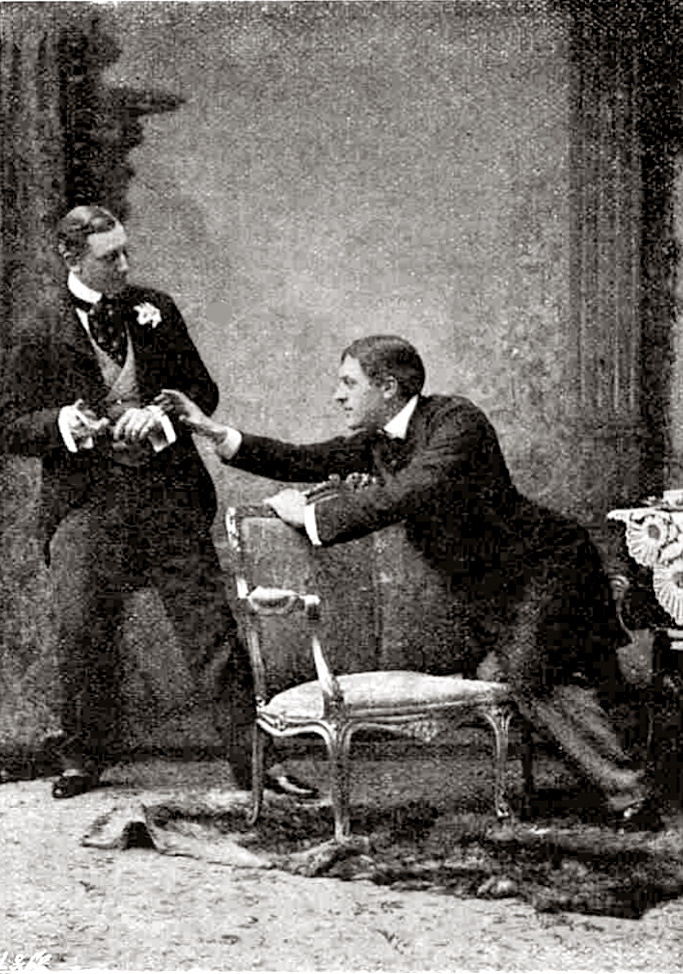
| 14 Feb 1895 | "The Importance of Being Earnest" PremieresPhoto Credits: By Unknown author - Photograph taken at St. James's Theatre, London 1895, Public Domain, https://commons.wikimedia.org/w/index.php?curid=6649967
Oscar Wilde's "The Importance of Being Earnest" premiered at St. James's Theater in London in 1895. His play was very witty and he used comedy to make fun of the strict rules and expectations of British society during this time. Wilde's ability to create something new and exciting, even when it was considered controversial, gave his audience permission to laugh at the world around them and not take things so seriously. At its opening night the play brought out huge crowds and was highly popular, showing that people during this time wanted to break out of the rigidity of Victorian standards.
|
Emily Moore |
| 1917 | WWI - The Battle of PasschendaelePhoto Credits: By Canadian Official photographer - http://media.iwm.org.uk/ciim5/38/665/large_000000.jpgThis photograph CO 2252 comes from the collections of the Imperial War Museums., Public Domain, https://commons.wikimedia.org/w/index.php?curid=63250920
The Battle of Passchendaele in 1917 was one of the most horribly devastating moments of World War I. Soldiers fought through mud, rain, and death which unfourtionately shows how chaotic the war truly was. I chose to include this battle in my timeline beacuse it shows the scene where Isaac Rosenburg was writing and taking inspiration from. Even though the war was gruesome and marked with destruction, writers like Rosenburg still found a way to notice the small flashes of life and goodness through it all. In his poem, "Returning, We Hear the Larks," he describes soilders hearing the sound of birds. This moment is so simple compared to everything that was going on around them but it shows how even in the worst possible situation, something like a bird can show them that beauty still exists in the world. I think that was a turning point in the poem and proves that the simplest things can bring us back to feeling human.
|
Emily Moore |
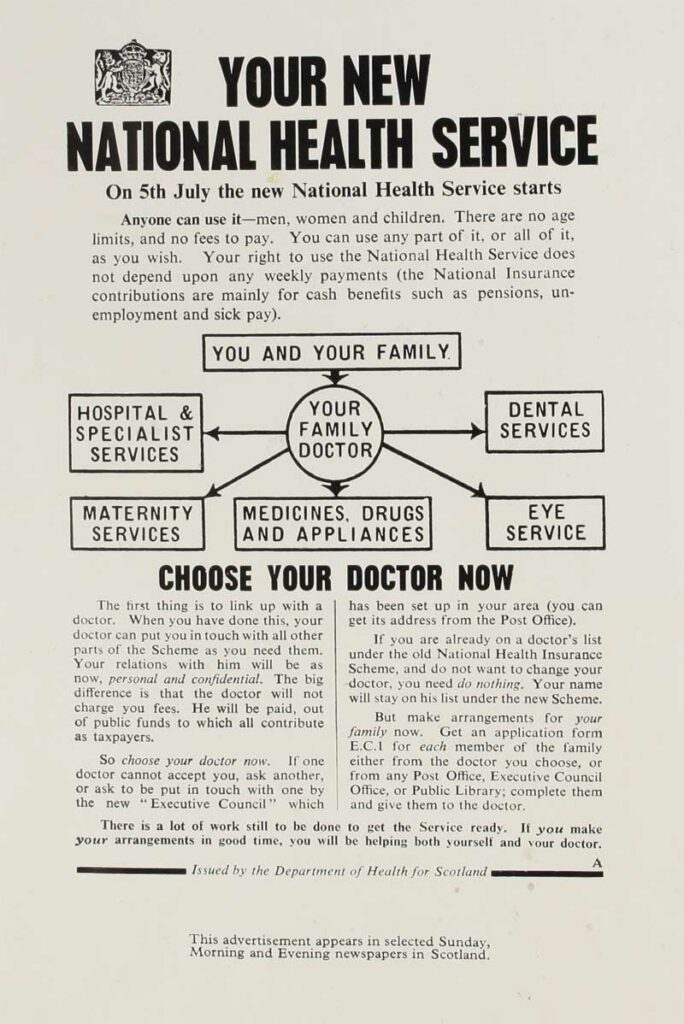
| 5 Jul 1948 | National Health Service was Founded
Photo Credits: National Health Service leaflet, 1948. https://history.blog.gov.uk/2023/07/13/the-founding-of-the-nhs-75-years-on/ The National Health Service was founded in 1948, after World War II, when Britain was still recovering from years of loss and destruction. I find this moment very meaningful because instead of giving up the country chose to build something new based on care. The NHS was created so that every person could recieve medical treatment if needed. No matter their job, income, or background. This was a major shift in how they viewed community and responsibility. I chose this event because it feels like a strong example of finding the good after something terrible. The war had impacted so many people and left towns in rubble, yet their response was to make something that can support others.
|
Emily Moore |