
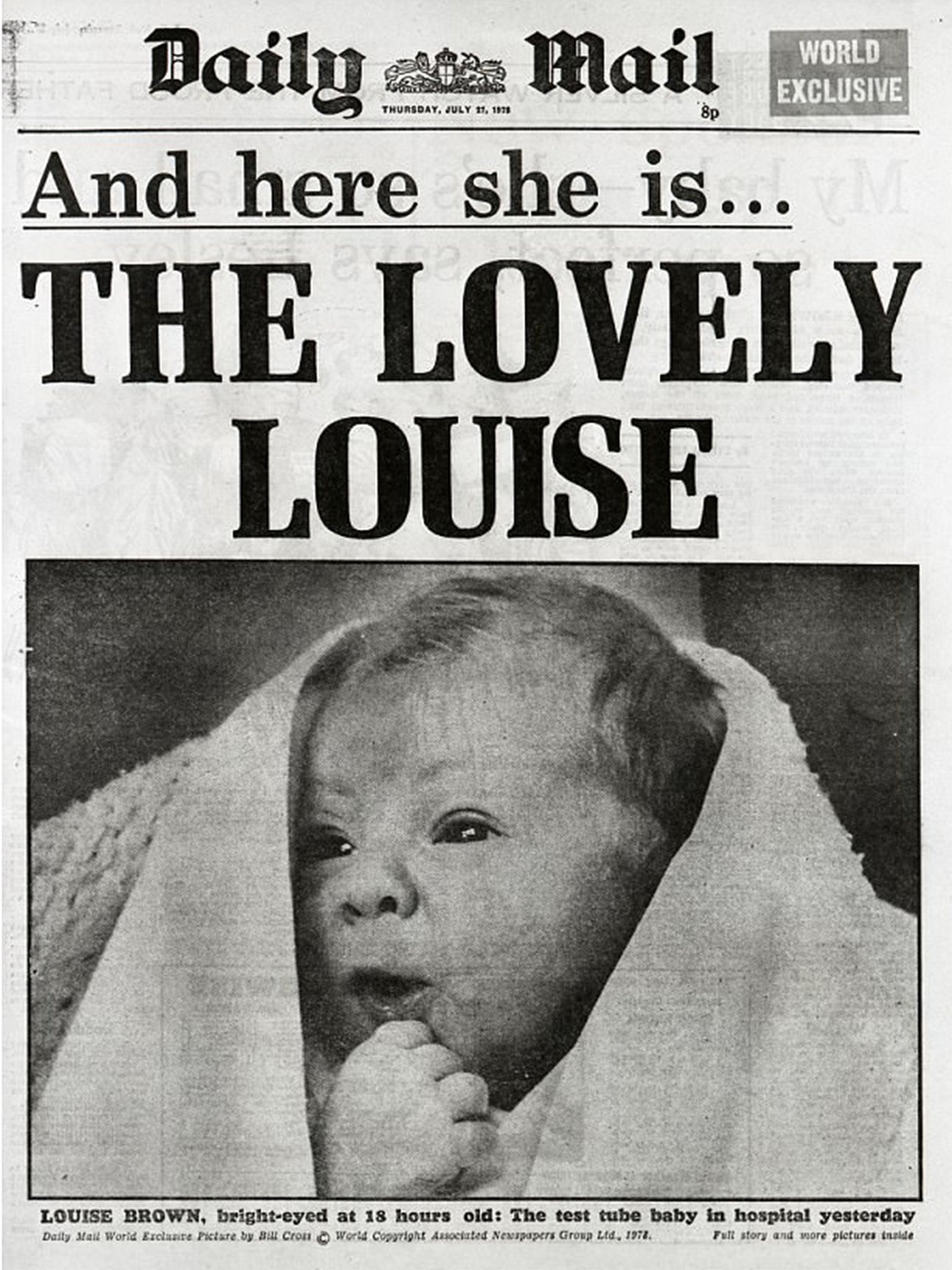
Louise Brown, newborn, Oldham General Hospital, 1978. Photo. Licensed as Public Domain/CC0 via Wikimedia Commons.
On July 25th, 1978 Louise Brown was born via c-section as the world's first baby conceived through in-virto fertilization. IVF was created as a treatment for women who were unable to conceive naturally. This offered real medical hope for those facing infertility during a time with very few options. Her birth was unlike anything the world had seen before. This moment marked a shift in history: the idea that human conception could be created in a lab rather than through a traditional biological process, and it started to become more widely accepted.
In Never Let Me Go, we see Kathy yearn for motherhood. Kathy imagines holding a baby at a young age, rocking the infant back and forth to the music of her cassette tape. While she is too young to completely understand why she is experiencing these feelings she allows herself to sit in the comfort of the moment, like it is an instinct. Then we find out the heartbreaking reality that Kathy can never have children becuase of the biological engineering of the clones.
That moment connects to the history of IVF which began as a way to give people who struggle with infertility a chance at having a child. In today's world reproductive technology was created to bring new life and new possibilities to families. However in the novel, similar scientific advances are used to limit life instead of expanding it. IVF represents science trying to solve the pain of infertility, while Kathy's infertility shows science being used to create it in order to control who can reproduce. These two uses of reproductive science, when looked at side by side, show how the same kind of technology that can offer hope in our world becomes a source of loss in Kathy's world. Looking back at the scene with this information in mind, it makes the idea of longing for a child feel exponentially more tragic.
Citations:
Kamel, Remah Moustafa. “Assisted Reproductive Technology after the Birth of Louise Brown.” Journal of Reproduction & Infertility, vol. 14, no. 3, July 2013, pp. 96-109. PubMed Central, https://pmc.ncbi.nlm.nih.gov/articles/PMC3799275/.
Dow, Katharine. “Looking into the Test Tube: The Birth of IVF on British Television.” Medical History, vol. 63, no. 2, Apr. 2019, pp. 189-208. PubMed Central, https://pmc.ncbi.nlm.nih.gov/articles/PMC6434648/.