
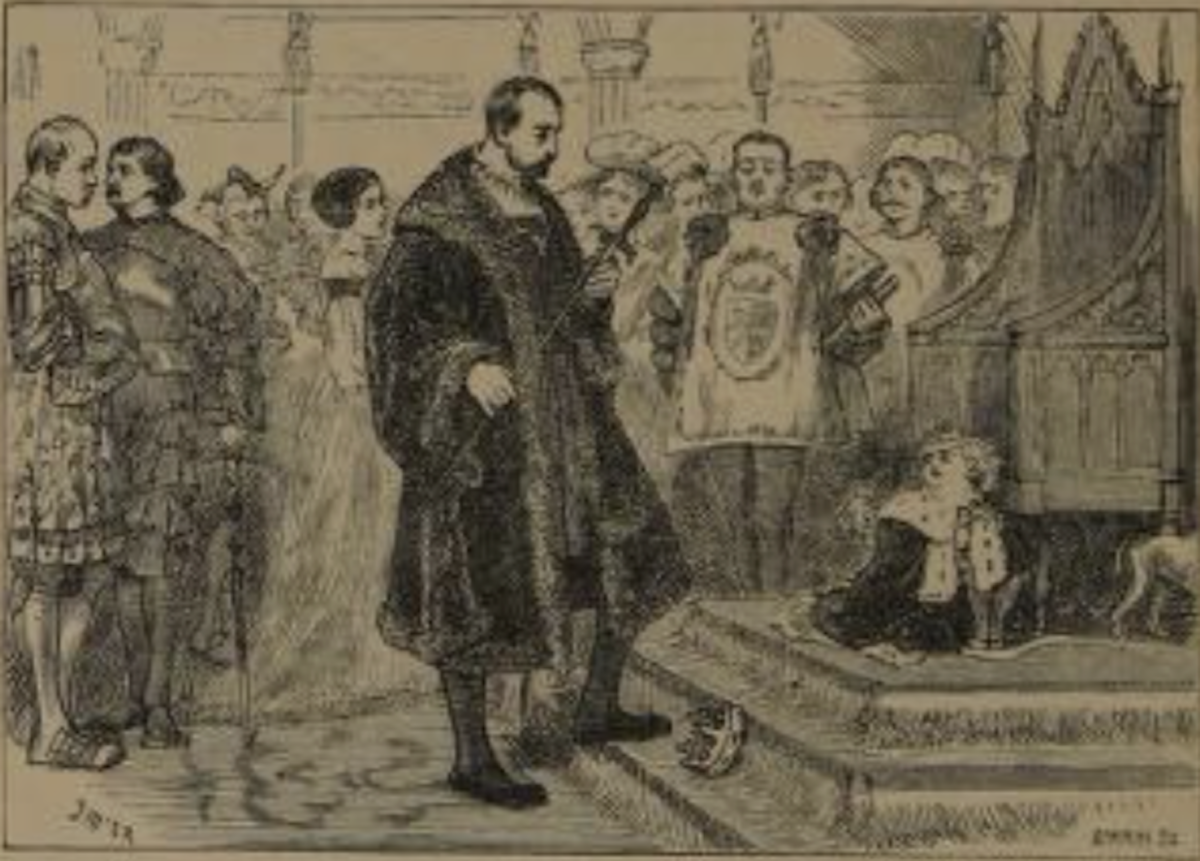
Craik, Dinah Maria Mulock. The Little Lame Prince. Illustrated by J. McL. Ralston, Harper & Brothers, 1875, p. 24. Internet Archive, https://archive.org/details/littlelameprince0000unse_b9p0/page/24/mode/2up.
This illustration of the crowning of the little lame prince evokes a sense of masculinity. This reveals the traditional sense of masculinity of the Victorian era, with the center focus of the imaging being on the King Regent and not the lame prince, although it is the prince who is being crowned. This illustration highlights the idea that disabled people were viewed as less masculine and less capable in society. The prince is not sitting on the throne, he is instead sitting on the ground with his crown far from his head, showing a sense of weakness. The prince is being depicted as childlike and incapable through his disability. To show him helpless and weak on the grown highlights the limitations his disability put on him, instead of showing him sitting in the throne, being portrayed as the intelligent emotionally strong prince he is. In this image his disability is being used to emasculate him. The illustration also positions the King Regent standing above the prince looking down on the child. This signals a sense of hierarchy not only in the prince's disability, but in a masculine sense as well. The king Regent is more masculine and less disabled, allowing him to be seen as better or stronger.