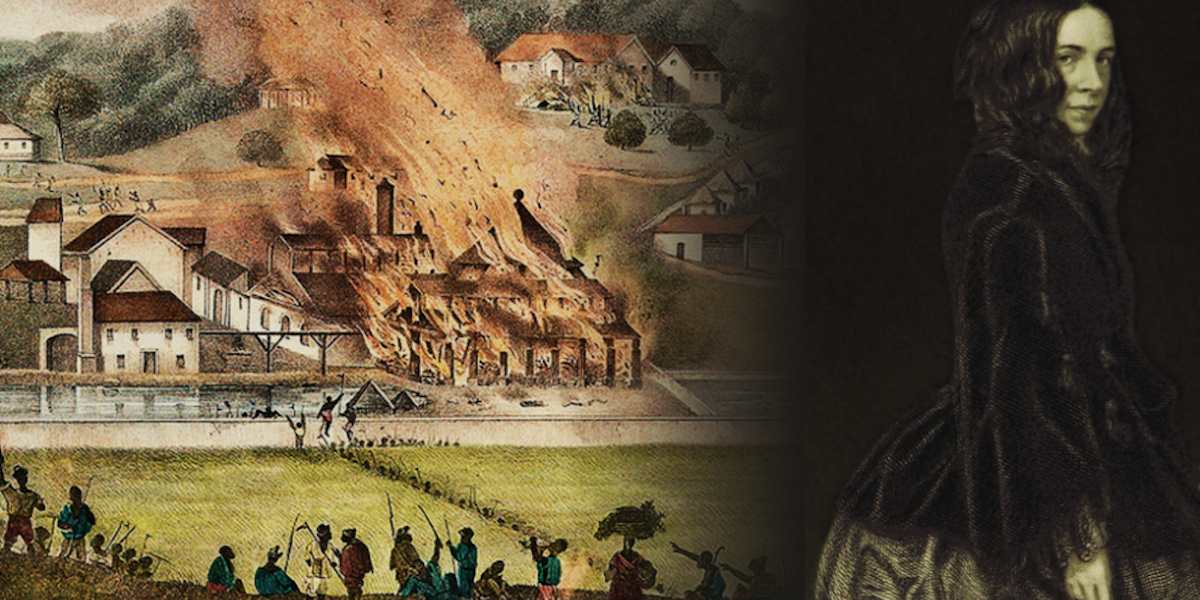
Elizabeth Barrett Browning, Jamaica’s Colonial Legacies, and the Issue of Slavery
Emily Crider
In the wake of the Slavery Abolition Act of 1833, which prohibited the institution of slavery and emancipated enslaved people across the British Empire, Elizabeth Barrett Browning (hereafter EBB) wrote to her friend Julia Martin: “That is settled. The consternation here is very great. Nevertheless I am glad, and always shall be, that the negroes are—virtually—free!——.”[1] EBB’s sentiment reveals the dichotomy, emphasized through her use of “nevertheless,” of British response to the passage of the act, an acknowledgement of stark uncertainty amidst much-hoped for celebration. The then-27-year-old EBB, who had not yet written the works for which she would later become best known, Songs from the Portuguese (written c. 1845–1846 and published in 1850) and Aurora Leigh (1856), occupies a complex place within abolitionist discourses. Though EBB was herself a long-term advocate for anti-slavery causes, both sides of her family were involved in the enslavement industry. Her father’s family, for instance, accumulated significant wealth and status from plantations they owned in Jamaica—and from the exploitation of the generations of enslaved Africans who worked them. EBB’s mother belonged to the wealthy Graham-Clarke family of Newcastle-upon-Tyne, economically linked to the Barretts through Jamaican markets and shipping.[2]
Contextualizing the enduring colonial aftermaths that have shaped and continue to shape contemporary perceptions of Jamaica is essential to understanding the nation’s past, marred by five hundred years of commodification, violence, and subjugation. In EBB’s oeuvre, five poems in particular lend themselves interpretively to addressing the moral and ideological scourge of slavery: “The African,” the first and only one set in Jamaica, written in the 1810s or early 1820s; “The Appeal” (1833); “The Runaway Slave at Pilgrim’s Point” (1848[3]); “Hiram Powers’ Greek Slave” (1850); and “A Curse for a Nation” (1856). Reading the work of EBB through this particular lens reveals not only the ways in which personal and collective histories influence literary expression, but also how texts themselves engage with and challenge the troubling legacies of their own historical moments.
The History of Slavery in Jamaica
By the time British expeditionary forces wrenched Jamaica from the grasp of the Spanish Empire in the 1650s, the island had already been stifled under colonial subjugation for over one hundred and fifty years.[4] Within a decade of Columbus’s “discovery” of Jamaica in 1494 during his second voyage,[5] Spanish invaders, eager to loot the island’s bounty of gold and other precious materials, waged a vicious, imperialist campaign against the indigenous Taino people:
the Spaniards distinguished themselves in the most Inhuman Actions, Committed against the Inhabitants—killing some, burning, roasting, and throwing others to be devoured by Wild and fierce Dogs; and Oppressed the rest, by obliging them to work in their Mines, and do such other heavy labour, as in a few years put an end to that unhappy, though Innocent People.[6]
With the stark decline of the Taino in the first half of the 16th century, the Spanish colonizers sought a new source of labor across the Atlantic, and their participation in the transatlantic slave economy marked the arrival of the first West Africans to Jamaica. It was through the labor of this enslaved population—which then numbered in the thousands—that plantations scattered across the island were able to produce sugar, cotton, indigo, and cocoa to be sent, along with mined gold and hides, to Spain in exchange for goods such as oil, wine, textiles, and livestock.[7] The ensuing century would mark the rise of Jamaica as a model of Spain’s colonial prosperity, a reputation that peaked in the first decades of the 17th century before gradually dwindling as Spanish emigrants and settlers relocated to “more dynamic economic regions of colonial Spanish America.”[8] Jamaica, which had never hosted a dense Spanish population, was economically and militaristically weakened by this shift, leaving the colony vulnerable to invasion by hostile British forces.
Though Spain would not officially cede the Jamaican territory to Britain until the signing of the Treaty of Madrid in 1670, the British crusade for control—known as the Western Design—began over a decade and a half earlier. Often aided by enslaved Africans and Maroon[9] communities who resisted Spanish rule, the British navy under the command of Oliver Cromwell[10] capitalized on Jamaica’s central position in the Caribbean to undermine Spain’s regional influence and interfere with their profitable gold and silver trade, capturing the island in 1654. The brutality that had so long characterized Spanish control over Jamaica did not diminish in the subsequent three hundred years of British rule. Under Britain, there was a greater emphasis on trade between the colonies and Europe, resulting in an exponential increase in the annual rate at which people were brought to Jamaica from their West and Central African homelands. During this period, Spain and Britain established the Asiento de negros, a 1713 agreement that, in part, established a British monopoly on the trade of enslaved people in the Spanish colonies in the Caribbean. It required that Britain maintain a contract—in which the British Queen Anne held partial stock—supplying 4,800 enslaved Africans to Jamaica per year for thirty years.[11] By the time the British Parliament outlawed the transatlantic trade in enslaved people in 1807, twenty-five years before the passage of the Slavery Abolition Act of 1833 that ended the institution of slavery across the British Empire, nearly two million people had been brought by force to the island.
Though British imperialism thrived due to the economic exploitation of Jamaica’s resources, the Jamaican plantation complex was, by design, a framework of globalized exchange, susceptible to the ebbs and flows of imperial tempers. Historians have argued that events such as the American Revolution as well as social and political strife in neighboring Haiti (then Saint-Domingue) and other nearby islands led to growing dissatisfaction with colonial relationships in the Americas.[12] Spurred on by escalating calls for total abolition and various slave uprisings, such as the Baptist War, that burst across the West Indies, parliament passed the Slavery Abolition Act of 1833. The collapse of the slavery economy was far from immediate: “in place of slavery, the negotiated settlement established a system of apprenticeship, tying the newly freed men and women into another form of unfree labour for fixed terms. It also granted £20 million (roughly £1,936,056,651 or $2,505,315,388 in 2025) in compensation, to be paid by British taxpayers to the former slave-owners” across the colonies.[13] Tensions, exacerbated by unemployment, heavy taxation, and droughts, continued to build, reaching a breaking point in October of 1865 with the Morant Bay Rebellion.[14] The extremity of retaliatory violence on the part of Edward Eyre, the British-imposed Governor of Jamaica, sparked considerable backlash both in Jamaica and in Britain, ultimately leading to his recall to London and the dissolution of the Jamaican House of Assembly. The British Parliament established a crown colony system the following year, concentrating full executive and legislative authority in the hands of the Governor.[15] This lasted until 1938 when widespread dissatisfaction with the crown colony administration, aggravated by the global economic depression, sparked riots and protests across Jamaica. Jamaica’s first enduring labor unions and associated political parties were born of this upheaval, amplifying calls for greater self-rule; persistent advocacy from Jamaican political leaders and trade unionists secured the introduction of a new constitution in 1944. This reform established a House of Representatives organized around two parties, allowed for ministerial appointments, and implemented universal suffrage. Though Jamaica achieved full internal self-governance in 1959, it was not until August 6, 1962[KM1] , after three centuries stifled under the weight of British colonial rule, that Jamaica ultimately achieved independence, gaining full dominion status within the Commonwealth.
The Barretts of Jamaica
Before they became “the Barretts of Jamaica,” the owners and proprietors of at least six different estates across the island, the Barrett family was one of many military families aboard the ships forging the path of Cromwell’s Western Design a century and a half prior to the birth of EBB.[16] From the patrilineal descent of Hercie Barrett, an officer serving in the West Indies, emerged not only a strong line of male inheritors but the increasing acquisition of colonial land—and, with it, the establishment of various plantations and their accompanying great houses scattered across the island’s northern coastline.
Though hides were the primary Jamaican export at the time of the British invasion of Jamaica, the Barretts focused largely on sugar production.[17] Sugar was a far more complex crop to produce compared to other exports commonly found in Jamaican fields, including tobacco, cotton, ginger, and indigo, as it “required even more capital, labour, and expertise, including a mill and boiling house, and upwards of 60 hands, as well as a master refiner skilled in the art of making muscovado, the brown sugar.”[18] Given the intricacy of the production process, large parcels of land were divided for an array of uses: fields for growing sugar cane (one always prepared for planting while another is ready for reaping), cow pastures, provision grounds for the enslaved people, and surrounding woodlands. Between the years 1799 and 1804, the point of highest sugar production in Jamaica, EBB’s branch of the Barrett family shipped a total of 5,255 hogsheads (or, around 336,320 gallons) of sugar and 2,037 puncheons (equating to 224,070 gallons) of rum from their four plantations, Cinnamon Hill, Cornwall, Cambridge, and Oxford.[19] Much of this was sold to London merchants such as Richard Walker & Co. and Hibbert & Co., and agreements with Boddington Philips Sharpe & Co. allowed the Barretts to take out loans and pay off additional debts. As one of the primary proprietors of the family estate, the annual income in 1807 of Edward Moulton Barrett, the father of EBB and the then-patriarch of the Barrett family, was £4,000 (roughly £469,943 or $596,034 in 2025), not including the £1,000 (£117,486 or $149,008) per annum he sent to his mother.[20]
The 1807 passage of the Slave Trade Act, a hard-won victory in a particularly intense, decades-long abolitionist struggle, signaled a split in the British colonial consciousness that EBB herself, born into this shifting world, would embody as the descendant of a family whose wealth, status, and role was entirely predicated on the structural violence of a dying institution. From a young age, EBB seems to have been at least somewhat aware of this tenuous positionality, writing her first piece addressing slavery, “The African,” when she was in her early teens. In an 1842 letter, she indicates that she may have derived the inspiration for the two-canto narrative poem from a story about a runaway slave shared by Richard Barrett, a representative in the Jamaican legislature, “benevolent” owner of at least two plantations, and cousin of EBB’s father.[21] The work can be interpreted in various, contradictory ways, exposing plantocratic[22] ideologies that run contrary to the anti-slavery thought that overtly emerges in EBB’s more mature poetry.
Within little more than a decade of her first poem about slavery, EBB would write “The Appeal,” a second, more generalized poem concerned with liberty, justice, and brotherhood. The poem’s 1833 publication situates it in a period of significant social and political transition; not only had the Barretts relocated from EBB’s childhood home at Hope End to Sidmouth the previous year due to financial difficulties on their Jamaican plantations that arose following the Baptist War, but the British parliament had also recently passed the influential 1832 Reform Act, expanding voting rights throughout England, and would sign into law the 1833 Slavery Abolition Act only four months later. “The Appeal” presents, through oblique reflection, a sentimental, fundamentally hopeful attitude towards these various highs and lows of her personal and political circumstances.
The Shift to American Slavery
With the official end of Britain’s participation in the enslavement system, the focus of EBB’s later anti-slavery poetry, shaped by her participation in the mid-nineteenth-century transatlantic slavery movement, turned to the United States. Both “The Runaway Slave at Pilgrim’s Point” (1848) and “A Curse for a Nation” (1856), for instance, claim a particularly notable place in contemporary discourse on American slavery, having been composed following invitations for EBB to contribute to the Bostonian abolitionist publication The Liberty Bell. Appearing in the fraught years preceding the American Civil War (1861–1865), these works, along with EBB’s “Hiram Powers’ Greek Slave” (1850), adhere to an unambiguously anti-slavery precedent established by landmark American texts such as Frederick Douglass’s Narrative of the Life of Frederick Douglass, published in 1845, and Harriet Beecher Stowe’s Uncle Tom’s Cabin, serialized between 1851 and 1852.
Each poem embodies a distinctive moral critique of slavery as an institution, distilling various aspects of its reprehensible personal and collective impact into literary form. “The Runaway Slave at Pilgrim’s Point,” for instance, adopts the voice and perspective of a woman escaping enslavement after killing her baby—the product of rape by her enslaver—and tracks the swift progression of her emotional and psychological trauma, culminating in her heroic defiance of slave hunters prior to—and, interpretively, through—her tragic suicide. EBB’s “Hiram Powers’ Greek Slave” dissects and recontextualizes American artist Hiram Powers’s titular statue, The Greek Slave, sculpted between 1841 and 1843. Though the Greek Slave was initially created as a representation of Turkish atrocities—including Greek enslavement and genocide[23]—committed during the Greek War of Independence, EBB’s sonnet transformed the form of a nude woman in chains into a broader commentary on the nature of possession and freedom through oblique allusion to American slavery. The last and, perhaps, most well-known example of EBB’s slavery poetry, “A Curse for a Nation,” with its command in the opening stanza to “Write a Nation’s curse for me, / And send it over the Western Sea” (lines 3-4),[24] followed in the nationalized footsteps of EBB’s earlier poem “The Appeal.”[25] The famous, meta refrain of “A Curse for a Nation,” “This is the curse. Write,” alludes to a question of personal and collective responsibility, a plea breaching the boundaries of text and context to speak directly to its contemporary—and noncontemporary—audiences.
Inextricably woven in the fabric of EBB’s later work alongside this emphatic critique of Western injustice and brutality is the pervasive influence of the Barrett family’s role in the Jamaican plantocracy. In 1855, the same year she wrote “A Curse for a Nation” ahead of its 1856 publication in The Liberty Bell, EBB penned a letter to British literary critic John Ruskin:“I belong to a family of West Indian slaveholders, and if I believed in curses, I should be afraid. I can at least thank God that I am not an American. How you look serenely at slavery, I cannot understand.”[26] As an Englishwoman descended from a slaveholding family and living, at the time, in Florence, Italy, EBB exemplifies undeniable privilege, remaining functionally removed from the direct engagement enacted and consequences suffered by those who strove alongside the oppressed. Though her work both traces a trajectory of individual ideological development and addresses larger international issues of ethics,[27] it cannot and should not be removed from the colonial contexts that influenced its creation and into which EBB herself was born. The voices and work of Black writers such as Phillis Wheatley, Frederick Douglass, Francis Harper,[28] and Harriet Jacobs are, by nature, deeply personal, always in service of a collective abolition of which they were themselves a part. For this reason, the poems of EBB featured in this anthology are not intended as replacements for but rather supplements to the anti-slavery narratives shared by those who experienced generations of racial violence and subjugation, nor as representative of those accounts that were lost or silenced amidst the systemic suppression of the enslaved people forced to labor on foreign lands, exploited by distant empires.
References
Barrett, R.A. The Barretts of Jamaica. Wedgestone Press, 2000.
Billington, Ray Allen. The Journal of Charlotte Forten: A Free Negro in the Slave Era. Collier Books, 1981.
Browning, Elizabeth Barrett. “A Curse for a Nation.” The Liberty Bell, edited by Friends of Freedom, Prentiss and Sawyer, 1856, pp. 1–10. hdl.handle.net/2027/pst.000020065928. Accessed 25 Feb. 2025.
---. “The African.” 1810s. Armstrong Browning Library, Waco. Manuscript. Baylor University Digital Collections. digitalcollections-baylor.quartexcollections.com/Documents/Detail/the-african/2063687. Accessed 16 Jan. 2025.
---. “The Appeal.” Prometheus Bound, translated from the Greek of Æschylus, and Miscellaneous Poems by the Translator, A.J. Valpy, 1833, pp. 151–155.
---. “Hiram Powers’ Greek Slave.” Household Words, edited by Charles Dickens, vol. 2, Bradbury and Evans, 1850, p. 98.
---. “The Runaway Slave at Pilgrim’s Point.” The Liberty Bell, edited by Friends of Freedom, Andrews and Prentiss, 1848, pp. 29–45. hdl.handle.net/2027/mdp.69015000003364. Accessed 25 Feb. 2025.
Browning, Elizabeth Barrett et al. The Brownings’ Correspondence. Edited by Philip Kelley, Ronald Hudson, Scott Lewis, Edward Hagan, et al., Wedgestone, 1984–. 31 vols. to date. Available online at www.browningguide.org.
Burnard, Trevor. Jamaica in the Age of Revolution. University of Pennsylvania Press, 2020.
Embassy of Jamaica. “History of Jamaica.” Embassy of Jamaica, Washington, D.C. https://www.embassyofjamaica.org/about_jamaica/history.htm. Accessed 2 March 2025.
Harper, Frances E. W. “The Slave Mother: A Tale of the Ohio,” 1857. https://www.poetryfoundation.org/poems/51977/the-slave-mother-56d23017ceaad.
Hart, Richard. Slaves Who Abolished Slavery: Blacks in Rebellion. University of the West Indies Press, 1980.
Knight, James. The Natural, Moral, and Political History of Jamaica (1737–1746), edited by Jack Greene, University of Virginia Press, 2021.
Legacies of British Slavery Database. Centre for the Study of the Legacies of British Slavery, www.ucl.ac.uk/lbs/. Accessed 25 Feb. 2025.
Meichanetsidis, Vasileios. “The Genocide of the Greeks of the Ottoman Empire, 1913–1923: A Comprehensive Overview.” Genocide Studies International, vol. 9, no. 1, Mar. 2015, pp. 104–73, https://doi.org/10.3138/gsi.9.1.06.
Mermin, Dorothy. Elizabeth Barrett Browning: The Origins of a New Poetry. University of Chicago UP, 1989.
Morgan, Kenneth. A Concise History of Jamaica. Cambridge University Press, 2023.
Richards, Glen. “Race, Class, and Labour Politics in Colonial Jamaica, 1900–1934.” Jamaica in Slavery and Freedom: History, Heritage and Culture, University of the West Indies Press, 2002, pp. 340–363.
Stone, Marjorie. “Browning [née Moulton Barrett], Elizabeth Barrett (1806–1861), poet and writer.” Oxford Dictionary of National Biography. October 04, 2008. Date of access 9 Apr. 2025, https://www.oxforddnb.com/view/10.1093/ref:odnb/9780198614128.001.0001/odnb-9780198614128-e-3711
Stone, Marjorie, and Beverly Taylor, editors. Elizabeth Barrett Browning: Selected Poems, Broadview, 2009.
Thomas, Hugh. The Slave Trade: The Story of the Atlantic Slave Trade, 1440–1870. Simon and Schuster, 2013.
Winter, Sarah. “On the Morant Bay Rebellion in Jamaica and the Governor Eyre-George William Gordon Controversy, 1865–70.” BRANCH: Britain, Representation and Nineteenth-Century History, edited by Dino Franco Felluga, branchcollective.org/?ps_articles=sarah-winter-on-the-morant-bay-rebellion-in-jamaica-and-the-governor-eyre-george-william-gordon-controversy-1865-70. Accessed 25 Feb. 2025.
Wood, Marcus. Slavery, Empathy, and Pornography, Oxford University Press, 2002
[1] BC 7 Sept. 1833, EBB, no. 481.
[2] See Marjorie Stone, “Browning [née Moulton Barrett], Elizabeth Barrett (1806–1861), poet and writer,” Oxford Dictionary of National Biography.
[3] Both "The Runaway Slave at Pilgrim's Point" and “A Curse for a Nation” originally appeared as invited contributions to the 1848 and 1856 issues, respectively, of the Boston-based abolitionist annual The Liberty Bell. Because The Liberty Bell was produced for sale in the Christmas market, both poems were published in the preceding year—“Runaway Slave” in 1847 and “A Curse for a Nation” in 1855.
[4] See Jack Greene’s introduction to James Knight’s The Natural, Moral, and Political History of Jamaica (1737–1746). Knight was a merchant, planter, and Crown official in Jamaica during the 18th century, and his two-volume history of the island offers keen sociocultural insight to life on the island, including accounts of the enslaved population.
[5] Knight, 25.
[6] Knight, 42.
[7] See Mark A. Burkholder’s “Spain's America: From Kingdoms to Colonies.”
[8] Knight, xv.
[9] Maroons were formerly enslaved Africans who escaped to the comparative safety of the island’s distant mountains and dense inland terrain. Though many maroons established free communities and worked towards liberating those still enslaved across the island, some aided British attempts to capture and return runaways. See Richard Hart, Slaves Who Abolished Slavery: Blacks in Rebellion (1980).
[10] Among the most well-known and controversial figures in British history, Oliver Cromwell (April 25, 1599–September 3, 1658) was an English statesman, politician, and soldier known for his participation in the English Civil Wars (1642–1651) and advocating for the execution of King Charles I in January 1649.
[11] See Hugh Thomas’s The Slave Trade: The Story of the Atlantic Slave Trade, 1440–1870 (2013).
[12] See Trevor Burnard, Jamaica in the Age of Revolution (2020).
[13] See the Centre for the Study of the Legacies of British Slavery, “Contexts.” https://www.ucl.ac.uk/lbs/project/details
[14] See Sarah Winter, “On the Morant Bay Rebellion in Jamaica and the Governor Eyre-George William Gordon Controversy, 1865–70.” branchcollective.org/?ps_articles=sarah-winter-on-the-morant-bay-rebellion-in-jamaica-and-the-governor-eyre-george-william-gordon-controversy-1865-70
[15] See Kenneth Morgan, A Concise History of Jamaica (2023).
[16] See R.A. Barrett’s The Barretts of Jamaica (2000).
[17] Barrett, 13.
[18] Barrett, 14.
[19] Barrett, 54.
[20] Barrett, 54.
[21] BC 12 Jan. 1842, EBB, no. 899.
[22] Relating to the plantocracy, or the class of landowners that directly benefited from the racist ideologies that undergirded the colonial plantation economy.
[23] See Vasileios Meichanetsidis, “The Genocide of the Greeks of the Ottoman Empire, 1913–1923: A Comprehensive Overview.”
[24] Elizabeth Barrett Browning, “A Curse for a Nation,” p. 1.
[25] Lines 20 and 21 of “The Appeal” offer a parallel command: “Shout aloud the words that free, / Over the perpetual sea.”
[26] BC 5 Nov. 1855, EBB to John Ruskin, no. 3674. Marcus Wood notes that though Ruskin was a critic of the transatlantic slave trade, he was also a “continual, passionate, and public [defender] of slavery systems,” and his desire for “the aesthetic liberation of the English factory labourer…was also a passionate defence of the appropriateness, in fact necessity, of slave labour in the colonies” (380).
For more information about Ruskin’s complex stance on systems of enslavement, see [here].
[27] In a May 30, 1854, journal entry, African-American abolitionist, writer, and educator Charlotte Forten describes her experience reading EBB’s “The Runaway Slave at Pilgrim’s Point”: “how powerfully it is written! how earnestly and touchingly does the writer portray the bitter anguish of the poor fugitive as she thinks over all the wrongs and sufferings that she has endured, and of the sin to which tyrants have driven her but which they alone must answer for! It seems as if no one could read this poem without having his sympathies roused to the utmost in behalf of the oppressed.—” Quote from The Journal of Charlotte Forten: A Free Negro in the Slave Era, ed. Ray Allen Billington, 44-45.
[28] Harper’s powerful 1857 poem “The Slave Mother: A Tale of the Ohio” is told from the perspective of an enslaved woman who, like the narrator of EBB’s “The Runaway Slave at Pilgrim’s Point,” commits infanticide. Harper’s work seems to allude to the real case of Margaret Garner, who, after escaping to the free state of Ohio from Kentucky, killed her two-year-old daughter (and intended to kill her other three children, as well) rather than allow her to be forced back into slavery under the Fugitive Slave Act of 1850. Garner’s story also inspired Toni Morrison’s novel Beloved (1987).