Undisciplining: EBB and Slavery
Emily Crider, Dino Franco Felluga, Kimberly Manganelli, Marjorie Stone, and Jerome S. Wynter
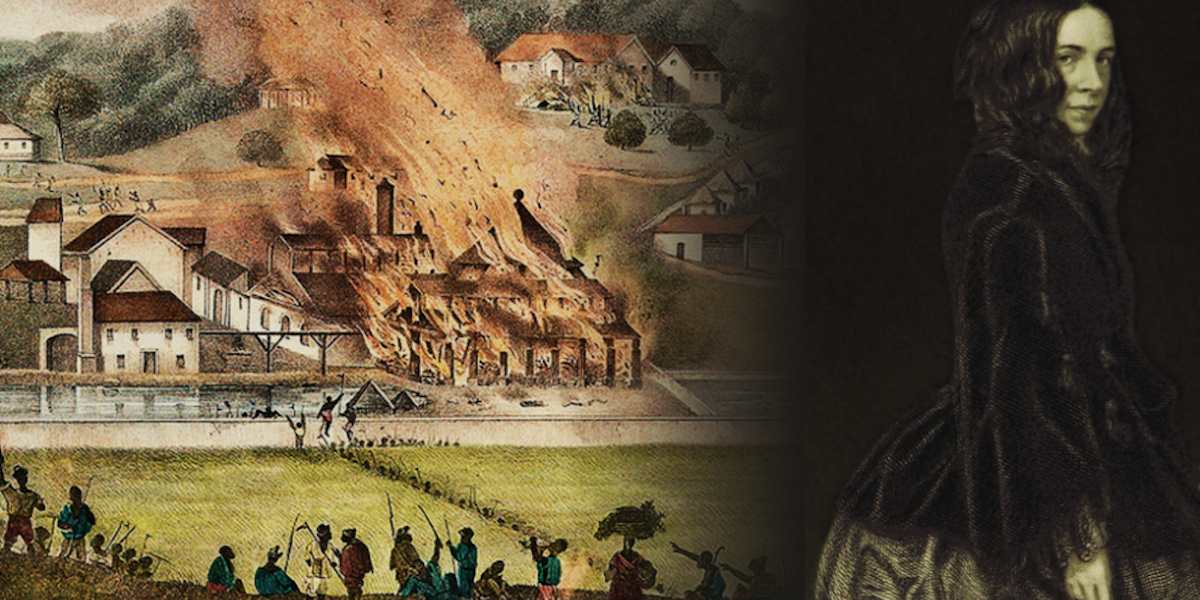
We collect here five poems about slavery that Elizabeth Barrett Browning (hereafter EBB) wrote over her career: her little-known juvenilia, “The African” (early 1820s), “The Appeal” (1833), “The Runaway Slave at Pilgrim’s Point” (1848), “Hiram Powers’ Greek Slave” (1850), and “A Curse for a Nation” (1856). Each of these has been annotated with the goal of facilitating discussions in the undergraduate and graduate classroom.
In this critical introduction, we discuss our methodology for this project from two angles that could both be called “undisciplining.” A first section, “Undisciplining Victorian Studies,” discusses how the term “undisciplining” has been applied to efforts to confront—in both our research and our teaching—the problem of structural racism.[1] In the second section, “Undisciplining the Edition,” we also apply the term to a rethinking of power relations in the editorial act: the imbalances of power that undergird our system of graduate education and scholarly work. A second introductory essay on the history of slavery situates the poems in their nineteenth-century context, from the Barrett family’s own involvement in the Jamaican slavery system, to Acts of Parliament and the American Civil War. Accompanying timeline, map, and gallery elements provide additional information to students, establishing clearer ties between the edition’s selected texts and the social, political, and biographical circumstances of their inception.
Undisciplining Victorian Studies
Our main goal with this collection is to follow recent calls to “undiscipline” or “widen” or “co-liberate” Victorian Studies,[2] a field of criticism that has tended to focus on a canon of white authors without sufficiently addressing the history of colonialism and racism that undergirds the British Commonwealth. As Ronjaunee Chatterjee, Alicia Mireles Christoff, and Amy R. Wong put it, “We don’t have to turn away from the mainstays of Victorian literature to study empire and racialization, although it may be useful to set these works in new constellations.” This collection attempts to do just that. We also follow Chatterjee, Christoff, and Wong in offering this work “in a non-paywalled form” to “enable us to build broader coalitions—especially with those who may not have access to. . . institutionalized spaces.” COVE is nonprofit and is dedicated to making scholarly material more widely available to students and, through COVE Editions, the public. The creation of a timeline, for instance, allows us to assemble an alternative literary history that underscores EBB’s connection to empire and the history of slavery while the map helps us, as Chatterjee, Christoff, and Wong put it, to “Unmak[e] the nostalgia that often undergirds the field’s self-definition . . . by exploding its limited geographic imaginary, which continues to exhibit particular difficulties in dismantling a center/periphery model.”[3] Finally, COVE’s gallery apparatus makes it possible to provide high-definition images of the manuscripts we discuss, along with other helpful material.
Three of the poems on slavery gathered here—“The Runaway Slave at Pilgrim’s Point,” “A Curse for a Nation,” and the sonnet “Hiram Powers’ Greek Slave”—have been extensively discussed in the context of the mid-nineteenth-century transatlantic abolition movement and issues of race, as indicated by the headnotes, reception histories, and summaries of criticism prefacing these poems in The Works of Elizabeth Barrett Browning (Donaldson, Patteson, Stone, and Taylor, 2010, hereafter WEBB). “The Appeal,” one of nineteen miscellaneous poems from EBB’s collection Prometheus Bound, was published in the year that Britain passed the Slavery Abolition Act of 1833 but has been seldom reprinted and even less often discussed until Stone and Taylor republished it in the first volume of WEBB. “The African,” composed in the early 1820s and published for the first time in 2010 (WEBB, vol. 5, pp. 391-408), is even less well known. To date, only one critical work, an article by Jerome S. Wynter in Victorian Poetry, exists on “The African.” Set in Jamaica and focused on an enslaved African chief and his sister, “The African” is an ambitious 694-line Byronic narrative that offers a fascinating glimpse into EBB’s mixed response to her family’s West Indian slaveholding at a time of waning abolitionist sentiment.[4] If, as Wynter argues, “The African,” like “The Appeal,” serves as a precursor to EBB’s involvement in the antislavery debates so evident in her later poetry, it also might be interpreted as somewhat ambivalent about slavery, shaped as it was by the discourse and world view of West Indian plantocracy culture.
Little if any scholarship, however, has considered EBB’s more mature antislavery works alongside either “The Appeal” or “The African.” One notable exception is Wynter, who writes of “The African” and “The Appeal”: “As prototypes of EBB’s radical involvement in the antislavery debates of the nineteenth century, in Britain and America, these two works prefigure the nexus between her mature abolitionist writings and anti-imperialist stance during the second half of her career, from 1840 to 1861” (299). By juxtaposing EBB’s earlier antislavery writings with her later abolitionist poems, this collection not only establishes her involvement in one of the most important issues of the nineteenth century, but also makes it easier for teachers and students to discuss the historical pervasiveness of racial injustice. Rather than relegate such discussions to African American Studies courses and other programs that emphasize transatlantic history and postcolonial theory, we wish to make it easier for anyone to begin discussing these issues in literature or history surveys, thus responding to the challenge posed to teachers and scholars by Chatterjee, Christoff, and Wong:
the need for all scholars, and not just scholars of color, to integrate considerations of race and racial capitalism—the most urgent questions of our time—into their work. And to do so rigorously: after deep reading and learning and listening. These considerations are not ornaments or accessories. They should radically shape—that is to say, at its very roots—how we construct and conduct intellectual inquiry and imagine its stakes.
To engage in these discussions effectively, one needs to have access to the historical background that will properly contextualize canonical works in a British history inextricably tied to colonialism and racism. While this COVE edition presents EBB’s poems on slavery in a new constellation, it also aims to contribute to understanding the global, national, and familial contexts shaping EBB’s poems on slavery, adding to information in the annotations and appendices of teaching editions like the 2009 Broadview Elizabeth Barrett Browning: Selected Poems (Stone and Taylor) and the more extended scholarly apparatus of WEBB material. This COVE edition includes features not often included in print editions, such as links to manuscripts, images, maps, and timelines. For example, it provides material that outlines Hiram Powers’s creation and exhibition of his Greek Slave, as well as a collection of images with accompanying contextual information about the statue’s appearance and reception at the Great Exhibition of 1851. The edition also expands upon EBB’s own family history, highlighting the historical and economic background of the Barrett family’s various plantation houses in Jamaica. A digital gallery displays the manuscript pages of a story written by a family cousin, Richard Barrett, about a runaway slave from which EBB drew partial inspiration for “The African.” In addition to contextualizing EBB’s poems, the secondary introduction on the history of slavery, as well as the detailed timeline tracking key events in EBB’s life amid Britain’s fight for abolitionism, provide invaluable historical details for students and teachers that would also be relevant for the study of such nineteenth-century British texts as Charlotte Bronte’s Jane Eyre (and Jean Rhys’s postcolonial retelling, Wide Sargasso Sea) and William Makepeace Thackeray’s Vanity Fair.[5]
Undisciplining the Edition
The way we approach this edition entails a different kind of undisciplining as well, one that impacts the conventions of textual editing. We wonder if we can use the unique structure of COVE to question the structural power imbalances present in the creation of previous literary editions.
Textual editing is a child of the print book and has been shaped by that genetic lineage. One need only mention the emphasis in past editorial practice on the intention of the author, a practice that accepts without question what was in fact the result of a longue-durée development after the Renaissance, the “author-function,” a principle that did not exist before the Gutenberg revolution and that increasingly makes little sense after the digital revolution. The fixity of print made possible the idea that a single author could claim ownership (and copyright) of a completed work, a notion supported by imagining a genius who could create something completely original as if ex nihilo. Editorial practice followed suit, seeking to discern the final intention of an author to determine the source text in relation to which one can then map variations to the work across multiple witnesses. As many have argued before us, however, the “author-function” is a fabrication undergirded by a transformation in the medium (manuscript to print) by which we receive the literary artifact.[6]
In practice, of course, textual editing in print follows diverse models and methodologies, adapted to different writers, genres, publishing venues, and historical periods, and the debates can be complex. We can give the case of the 2010 Works of Elizabeth Barrett Browning as an example since Marjorie Stone was one of the editors. Some reviewers saw the editors as following an exceptionally author-centered structure in opening the edition with the poet’s own selection and sequencing of her works in the last collection she oversaw in her lifetime, Poems (1856). Other reviewers accepted the rationale for this departure from a more conventional chronological order in posthumous collected editions. As for the editors themselves, at least one member of the editorial team was influenced less by author-centered methodologies than by theories of “multiple-text editing,” which approach authorial intention as “less frequently monolithic than . . . developing or changing” (Shillingsburg 58), and theories of “social-text” editing as conceptualized by Jerome McGann and others.[7]
In this collection on EBB and Slavery, we propose an altogether different principle for digital editorial practice, “open assembly,” which we wish to distinguish from the guiding principle of the first wave of digital archives, “open access.” The first wave of nineteenth-century digital archives aimed largely to replicate the logic of print editions, with the main changes being a radical expansion of the material that could be included and the effort to make that material available to everyone for free: the William Blake Archive, Romantic Circles, the Rossetti Archive, the Algernon Swinburne Project, the Emily Dickinson Electronic Archives, and the Walt Whitman Archive. The guiding structure of the editions followed the logic of print: one or more senior scholars editing the works of the canonical authors of the nineteenth century to create a definitive, authoritative version of source texts. When referencing these archives, one cites the nineteenth-century author alongside the contemporary editor, just as one does in a print edition, e.g., Rossetti, Dante Gabriel, “The Blessed Damozel (with Predella),” The Rossetti Archive, ed. Jerome McGann, <http://www.rossettiarchive.org/docs/s244.rap.html>, followed by the access date.[8] This convention is a good example of the skeuomorph, imposing a structural or design feature from the previous medium (the author-function) to make palatable the radical transformations of the new.[9] What is hidden is the reality of the new medium, which requires a team of people, paid or unpaid, to complete the work of the lead editor, as well as numerous financial supporters since such archives in fact require a great deal of investment not only to create but also to maintain. If one looks at the credits page of the Rossetti Archive, we find listed numerous granting agencies and supporting institutions, a design editor (Bethany Nowviskie), seven program managers spanning a decade, twenty-nine listed research assistants, and ten programmers.[10]
There are some obvious problems with this previous approach. For one, it puts digital editing outside the reach of most academics given the costs represented. Programmers, who build the archives, charge as much as $200/hour for their labor, for example, and there are costs associated with not only hosting but also maintenance. One notable example of the costs involved is the fact that the Rossetti Archive and Romantic Circles had to undergo complete restructuring after the advent of Web 3.0 so that they could adopt the newest state-of-the-art standards for such digital work. The World Wide Web continues to evolve, and sites need to respond if they are to remain viable.
Such digital archives are also often predicated on the prior existence of one or more scholarly editions to build upon as a foundation, which helps to explain why some of the key pioneering sites presented the works of white, male British and American canonical authors as opposed, for example, to the works of writers of color or working-class writers.[11] Consider, for example, the case of the 2010 collaboratively edited WEBB (Donaldson, Patteson, Stone, and Taylor). There was no comprehensive modern existing edition to “replicate” and digitally expand. The closest approximation to it was The Complete Works of Elizabeth Barrett Browning, edited by Charlotte Porter and Helen A. Clarke in 1900. There were, moreover, multiple volumes of letters published after that date to draw on, widely scattered masses of unpublished manuscript materials to transcribe and incorporate, and an extensive body of scholarship to consider and integrate into volume introductions, poem headnotes, and annotations. Under the circumstances, the WEBB editors made the difficult decision to proceed with a print edition, amplified by a “digital surround” to present selected poems that EBB most extensively revised after their first publication. Unfortunately, however, given the size of her oeuvre, this five-volume edition was expensive to produce and purchase and thus can be accessed only in larger university research libraries.[12]
Publication in print and storage in research libraries would seem to offer stability. However, we need to remember that print books do not escape considerations of long-term sustainability, though we tend not to dwell on the infrastructural issues. Beyond the much-discussed crisis of humanities publishing caused by the reduction of university funding for both university libraries and university presses, there is the massive cost of maintaining all those books. Purdue University alone has seven designated library buildings with the attendant costs of a librarian work force and building maintenance, including yearly heating and cooling costs, to preserve what are, in fact, extremely fragile paper books. Multiply that by all the library buildings spread across the world and you have a massive drain on resources to protect a vulnerable publication medium that is difficult for most people to access since you need to get to and have permission to enter the physical archive.
Online archives face their own infrastructural challenges. Most of these sites have relied on unstable continuing support from their host universities, a source of funding that is proving increasingly precarious as the humanities continue to be battered by the shifting of university priorities to the STEM disciplines.[13] Relying on grant funding is even more unreliable; federal funding, for example, is vulnerable to election cycles, with incoming administrations commonly setting new priorities for already scarce humanities resources. In any case, such funding does not support a project beyond the initial building phase. The election of Donald J. Trump exemplifies the problem of relying on universities and funding bodies. The History of Black Writing, which produced the History of Black Writing Novel Corpus mentioned in endnote 9, is now “being reviewed in light of recent changes to federal guidance,” as stated on its home page, which is hosted by the University of Kansas. COVE, which is publishing this EBB and Slavery edition, had its $350,000 National Endowment for the Humanities grant rescinded abruptly mid-course without warning. As stated in the termination letter from Michael McDonald, the Acting Chairman of the NEH, “NEH has reasonable cause to terminate your grant in light of the fact that the NEH is repurposing its funding allocations in a new direction in furtherance of the President’s agenda. . . The termination of your grant represents an urgent priority for the administration, and due to exceptional circumstances, adherence to the traditional notification process is not possible” (“National Endowment for the Humanities Notice of Grant Termination”). It is worth noting that all of the major digital archives mentioned here as well as print editions like WEBB were supported to some degree by NEH funding, often in collaboration with granting council funds in other countries (e.g., Canada and the UK).
Open assembly seeks to approach the act of editing in a different way and on several fronts. COVE: Collaborative Organization for Virtual Education (http://covecollective.org) has served as the testing ground for this approach. The approach is collectivist at the level of both platform and project.[14]
On the level of infrastructure, the platform asks editorial groups, classrooms, and universities that join the collective to pay a fair non-profit price to access COVE’s tools, which in turn supports the platform’s long-term sustainability, including the considerable costs of hosting, updating, maintaining, and bug fixing. We can thus keep our open-access editions available for free on an independent server without relying on any one institution for long-term funding. All money generated through subscription is returned to the collective to support the endeavor. The tools are simple to use and the text-encoding support robust enough that specialized coding knowledge is not required to undertake an edition.
Open assembly also applies to individual editorial projects. Some of our editions follow convention, with a single scholar editing a canonical work.[15] Others, however, have begun to explore the new possibilities opened by COVE’s collectivist approach. Driven by a communal approach to scholarly research, these editions fundamentally challenge traditional models of intellectual labor. As of 2025, three of our editions are the product of a university-level graduate course, with every component created, composed, or assembled by students working alongside a guiding teacher followed by peer review.[16] Several editions have also been created with undergraduate classrooms, though these have either not made it through peer review or have been constructed without the intention of pursuing peer review, designed instead to share with students the complex process of rigorously editing a text so that they can understand the value of scholarly text editing.
Through COVE, open assembly also extends to the creation of resources themselves. We have for example sought to make vetted objects available for reuse through our timeline-, map-, and gallery-builders. Once a timeline, map, or gallery is created, the individual objects of those resources are made available for “open assembly” in new timelines, maps, and galleries, thus challenging our understanding of authorship when it comes to these editorial resources.[17]
We wonder if we can go yet further by resisting the skeuomorphic drag of past ways of approaching the editorial act, instead fully embracing what we are calling—in allusion to but also in contradistinction to Jerome McGann’s The Textual Condition—the digital condition. What if we adopted a fully collectivist and counter-hierarchical guiding principle in pursuing a digital edition? Collaboration by itself does not avoid power dynamics, after all; the benefits of open assembly—its unexplored potential—remain on the horizon. What would it look like for the hierarchy to be reversed or even undone, for the student to stand at the helm of a critical edition, supported by a small group of more established scholars? How does the platform fully realize the new possibilities of the digital condition?
Through this critical edition of Elizabeth Barrett Browning’s slavery poetry, we strive to answer these crucial questions. An open-assembly approach distinguishes this project from more traditional modes of editorialization in three primary ways, the first two already realized, the third imagined in a next phase of development:
- COVE’s timeline, map, and gallery tools already allow creators to re-organize digital objects pulled from elements already in the database, deracinated and interwoven into a new “open” assembly. Building our timeline for the edition, we began by pulling from the COVE database timeline events that were previously published at COVE and BRANCH: Britain, Representation, and Nineteenth-Century History, thus providing direct connections across editions, literary works, and articles. Our anthology could thus enter into dialogue especially with three previously published BRANCH articles—Denae Dyck and Marjorie Stone’s “The ‘Sensation’ of Elizabeth Barrett Browning’s Poems before Congress (1860): Events, Politics, Reception”; Elsie B. Michie’s “On the Sacramental Test Act, the Catholic Relief Act, the Slavery Abolition Act, and the Factory Act”; and Sarah Winter’s “On the Morant Bay Rebellion in Jamaica and the Governor Eyre-George William Gordon Controversy, 1865-70.”—and a previously published COVE edition: Elizabeth Barrett Browning, “A Portrait of Wordsworth,” edited by Felluga, Joshua King, Christopher Rovee, and Stone. This approach challenges traditional notions of authorship since we are assembling for a new purpose the critical work of a collective of authors, with the previous work properly acknowledged but remixed to support a new critical project with new critical goals.
- The second point of distinction in this edition lies in the inversion of the traditional editorial structure. Past COVE editions that were constructed as part of a graduate class have adhered to the expectations and roles of an academic hierarchy: a group of young, inexperienced scholars working under the critical eye of the teacher (Jacobs et al, Kooistra et al, Pionke et al). In this project, we will aim to rethink that power structure by having the graduate student assume the role of editor-in-chief, supported by mentor-experts (Crider et al). Such a shift aims to stay true to COVE’s collectivist and liberatory aspirations.
- Finally, we look to the future by imagining a logical next step that further realizes the implications of open assembly and a collectivist approach to scholarship: the ability not only to publish annotated critical editions open access at COVE Editions but also to assign these editions to classrooms inside COVE’s password-protected space, COVE Studio, such that scholarly annotations are accessible as a separate layer from student annotations added to the critical edition.[18] We thus ensure that these publications invite new “authors”—whether students or established scholars—to continue the conversation, thus more fully realizing Jerome McGann’s argument in The Textual Condition that “All editing is an act of interpretation.”[19]
In whatever myriad forms COVE’s evolution might take, we will continue to search for and find ways of improving upon the static, skeuomorphic editorial models of the past. It is through these aspirations that we best imagine a digital condition that capitalizes on the tools we have already implemented, realizes what is possible, and pursues what has yet to be created.
References
Algernon Swinburne Project. “The Algernon Charles Swinburne Project.” Ed. John A. Walsh. Last modified 14 May 2017. Accessed 3 February 2025. https://webapp1.dlib.indiana.edu/swinburne/.
Allen, Emily and Dino Franco Felluga. Novel-Poetry: The Shape of the Real and the Problem of Form. Oxford: Oxford University Press, 2024.
Banerjee, Sukanya et. al. “Introduction: Widening the Nineteenth Century,” Victorian Literature and Culture, vol. 49, no. 1, 2021, pp. 1-26.
Barrett, R. A. The Barretts of Jamaica: The Family of Elizabeth Barrett Browning, Wedgestone Press, 2000.
Barthes, R. Image Music Text. Trans. Stephen Heath. New York: Hill and Wang, 1977.
Bindas, Ava, Kenneth Crowell, Joanne Ruth Davis, Jun Yi Goh, Cherrie Kwok, K. Marielle Morgan, Rebecca Nesvet, and Adrian S. Wisnicki. “COVE, One More Voice, and the Recovery of BIPOC Voices from Victorian Periodicals.” Victorian Periodicals Review, forthcoming.
Browning, Elizabeth Barrett. The Works of Elizabeth Barrett Browning. Ed. Sandra Donaldson, Rita Patterson, Marjorie Stone, and Beverly Taylor, Pickering and Chatto, 2010. 5 vols.
Christoff, Alicia Mireles et. al. “Undisciplining Victorian Studies,” Los Angeles Review of Books, July 10, 2020. https://lareviewofbooks.org/article/undisciplining-victorian-studies.
COVE Collective. ‘Editions’. Accessed 3 February 2025. https://editions.covecollective.org/.
Crider, Emily and Dino Franco Felluga (forthcoming). “Open Assembly and the Digital Condition,” Global Nineteenth-Century Studies vol. 4, no. 2, 2025.
Derrida, Jacques. Glas, translated by John P. Leavey, Jr. and Richard Rand. Lincoln, NB and London, UK: University of Nebraska Press, 1986.
D’Ignazio, Catherine and Lauren Klein, “2. Collect, Analyze, Imagine, Teach.” Data Feminism. March 16, 2020. https://data-feminism.mitpress.mit.edu/pub/ei7cogfn/release/4.
Drescher, Seymour. Abolition: A History of Slavery and Antislavery, Cambridge University Press, 2009.
Dyck, Denae and Marjorie Stone. “The ‘Sensation’ of Elizabeth Barrett Browning’s Poems before Congress (1860): Events, Politics, Reception.” In BRANCH: Britain, Representation and Nineteenth-Century History. Ed. Dino Franco Felluga. Accessed 15 April 2025. http://branchcollective.org.
The Emily Dickinson Electronic Archives. Eds. Martha Nell Smith, Marta Werner, Jessica Beard, Julie Enszer, and Ellen Louise Hart. Accessed 15 April 2025. https://www.emilydickinson.org/.
Felluga, Dino Franco. “The Eventuality of the Digital,” 19: Interdisciplinary Studies in the Long Nineteenth Century, vol. 21, 2015. DOI: https://doi.org/10.16995/ntn.742.
---. “Going a Step Further than Open Access and Open Source: COVE and the Promise of Open Assembly.” Victorians Institute Journal, vol.49, 2022, pp. 198-209. DOI: https://doi.org/10.5325/victinstj.49.2022.0198
Foucault, Michel [1977]. “What Is an Author?” In Critical Theory since 1965. Eds. Hazard Adams and Leroy Searle. Tallahassee: University Presses of Florida, 1986.
Gallop, Jane. The Deaths of the Author: Reading and Writing in Time. Durham: Duke University Press, 2011.
The History of Black Writing. Accessed 15 April 2025. https://hbw.ku.edu.
History of Black Writing Novel Corpus. Accessed 15 April 2025. https://textual-optics-lab.uchicago.edu/black_writing_corpus.
Housman, Clemence [1896]. The Were-Wolf. Ed. Lorraine Janzen Kooistra et al. Accessed 3 February 2025. https://editions.covecollective.org/edition/were-wolf.
Le Fanu, Jospeh Sheridan [1880]. Strange Event in the Life of Schalken the Painter. Ed. Edward Jacobs et al. Accessed 3 February 2025. https://editions.covecollective.org/edition/strange-event-life-schalken-painter.
Lootens, Tricia. The Political Poetess: Victorian Femininity, Race, and the Legacy of Separate Spheres. Princeton, NJ: Princeton University Press, 2016.
McDonald, Michael. “National Endowment for the Humanities Notice of Grant Termination.” Letter to Craig Goodrich, Board of Regents of the University of Nebraska. 2 April 2025.
McGann, Jerome. Radiant Textuality: Literary Studies After the World Wide Web. New York: Palgrave, 2001.
---. The Textual Condition. Princeton: Princeton University Press, 1991.
Michie, Elsie. “On the Sacramental Test Act, the Catholic Relief Act, the Slavery Abolition Act, and the Factory Act.” In BRANCH: Britain, Representation and Nineteenth-Century History. Ed. Dino Franco Felluga. Accessed 3 February 2025. http://branchcollective.org. North, William [1851]. The City of the Jugglers. Ed. Albert Pionke et al. Accessed 3 February 2025. https://editions.covecollective.org/edition/city-jugglers.
Romantic Circles. “Scholarly Editions.” Accessed 3 February 2025. https://romantic-circles.org/.
Rose, Mark. Authors and Owners: The Invention of Copyright. Cambridge, MA: Harvard University Press, 1993.
Rossetti Archive. “Credits and Acknowledgements.” Ed. Jerome J. McGann. Accessed 3 February 2025. https://www.rossettiarchive.org/about/credits.html.
Shillingsburg, Peter. Scholarly Editing in the Computer Age. University of Georgia Press, 1986.
Stone, Marjorie, and Beverly Taylor, editors. Elizabeth Barrett Browning: Selected Poems, Broadview, 2009.
Stone, Marjorie. “Chronology, Contexture, and Collaboration: Editing Debates and The Works of Elizabeth Barrett Browning (2010),” Global Nineteenth-Century Studies, vol. 4, no. 2, 2025.
Thackeray, William Makepeace [1839-1840]. Catherine. Ed. Sheldon Goldfarb. Accessed 3 February 2025. https://editions.covecollective.org/edition/catherine.
Walt Whitman Archive. “Literary Manuscripts.” Accessed 3 February 2025. https://whitmanarchive.org/.
William Blake Archive. Eds. Robert Essick and Joseph Viscomi. Accessed 3 February 2025. https://www.blakearchive.org/.
Wimsatt, William K. The Verbal Icon: Studies in the Meaning of Poetry. Lexington, KY: University of Kentucky Press, 1954.
Winter, Sarah. “On the Morant Bay Rebellion in Jamaica and the Governor Eyre-George William Gordon Controversy, 1865-70.” In BRANCH: Britain, Representation and Nineteenth-Century History. Ed. Dino Franco Felluga. Accessed 3 February 2025. http://branchcollective.org.
Woodmansee, Martha and Peter Jaszi, eds. The Construction of Authorship: Textual Appropriation in Law and Literature. Durham, NC: Duke University Press, 1994.
Writing Lives: Collaborative Research Project on Working-Class Autobiography. Accessed 15 April 2025. https://www.writinglives.org.
Wynter, Jerome S. “‘I trust that I am a Liberal’: The Politics and Poetics of Elizabeth Barrett Browning’s Early Antislavery Verse.” Victorian Poetry, vol. 60, no. 3, Fall 2022, pp. 297-323. DOI: 10.1353/vp.2022.0016.
[1] See Alicia Mireles Christoff, Amy R. Wong, and Ronjaunee Chatterjee, “Undisciplining Victorian Studies,” Los Angeles Review of Books, July 10, 2020. https://lareviewofbooks.org/article/undisciplining-victorian-studies.
[2] See Alicia Mireles Christoff, Amy R. Wong, and Ronjaunee Chatterjee; Sukanya Banerjee, Ryan D. Fong, and Helena Michie, “Introduction: Widening the Nineteenth Century,” Victorian Literature and Culture 49, no. 1 (2021): 1–26; Catherine D’Ignazio and Lauren Klein, “2. Collect, Analyze, Imagine, Teach.” Data Feminism. March 16, 2020. https://data-feminism.mitpress.mit.edu/pub/ei7cogfn/release/4.
[3] Alicia Mireles Christoff, Amy R. Wong, and Ronjaunee Chatterjee.
[4] EBB most likely composed “The African” around 1822 during a year-long illness (See WEBB, vol. 5.391). In 1822, Britain was very satisfied with its achievement of abolishing the slave trade in 1807. The campaign to end slavery itself did not pick up again (resurge) until after 1823. See Drescher 248-250.
[5] For an essay that illustrates how a similar undisciplining can be applied to Charlotte Brontë’s Jane Eyre, see Ava Bindas, Kenneth Crowell, Joanne Ruth Davis, Dino Franco Felluga, Jun Yi Goh, Cherrie Kwok, K. Marielle Morgan, Rebecca Nesvet, and Adrian S. Wisnicki “COVE, One More Voice, and the Recovery of BIPOC Voices from Victorian Periodicals.”
[6] See, for example, Barthes, Derrida, Foucault, Gallop, Rose, Wimsatt, and Woodmansee and Jaszi.
[7] For a longer discussion of these editorial decisions, see Marjorie Stone’s forthcoming “Editing EBB” essay, which appears alongside a version of this introduction, “Open Assembly and the Digital Condition,” in a special issue of Global Nineteenth-Century Studies on textual editing.
[8] We mention Jerome McGann since we are so indebted to his previous work on the sociability of texts and the need to loosen the parameters of past textual editions. As he writes in The Textual Condition, “The textual condition’s only immutable law is the law of change” (9). He argues that we need to remain attuned to the conditions of the present, which never cease to change: “Those material and institutional conditions. . . are impossible to set aside if one is editing a text; and if one intends to execute a scholarly edition of a work, the social conditions of textual production become manifest and even imperative” (21). As he goes on, “To edit a text is to be situated in a historical relation to the work’s transmissions, but it is also to be placed in an immediate relation to contemporary cultural and conceptual goals” (47). In Radiant Textuality, McGann goes yet further in thinking through what we are calling “the digital condition.”
[9] On the skeuomorph in relation to COVE, see Felluga, “The Eventuality of the Digital.” 19: Interdisciplinary Studies in the Long Nineteenth Century 21 (2015). DOI: http://dx.doi.org/10.16995/ntn.742.
[10] Of course, large print editions, like WEBB, can also include teams of people, though usually not of the same magnitude as such digital editions.
[11] For archives that redress this tendency, see, for example, Writing Lives: Collaborative Research Project on Working-Class Autobiography and the History of Black Writing Novel Corpus.
[12] On the infrastructural issues of brick-and-mortar libraries, see note 12.
[13] Romantic Circles, for example, was closely tied to University of Maryland funding for its lead editor, Neil Fraistat. Once he retired, the university summarily stopped its funding for the platform, necessitating a search for a new host, which led to the transfer of Romantic Circles from the University of Maryland to the University of Colorado, Boulder. As the site’s About page states, this project is now “fully funded by the University of Colorado, Boulder” (“About,” Romantic Circles, accessed February 3, 2025, https://romantic-circles.org/about).
[14] This article explores how the notion of “open assembly” impacts scholarly editing. For an article to explores other implications of open assembly, see Felluga, “Going a Step Further than Open Access and Open Source.”
[15] See, for example, William Makepeace Thackeray, Catherine, ed. S. Goldfarb (2022) [1840]. https://editions.covecollective.org/edition/catherine.
[16] See Joseph Sheridan Le Fanu, Strange Event in the Life of Schalken the Painter, ed. Jacobs et al. https://editions.covecollective.org/edition/strange-event-life-schalken-painter;
William North, The City of the Jugglers,ed. Pionke et al. https://editions.covecollective.org/edition/city-jugglers; and Clemence Housman, The Were-Wolf,ed. Kooistra et al. https://editions.covecollective.org/edition/were-wolf.
[17] Vetted elements are clearly marked as such to distinguish them from unvetted ones.
[18] This return from the future has been one of the guiding principles of COVE, first articulated in Felluga, “The Eventuality of the Digital” and then fully theorized in Emily Allen and Dino Franco Felluga, Novel-Poetry: The Shape of the Real and the Problem of Form, especially Chapter One.
[19] McGann, The Textual Condition, 27.