This is a timeline for events in London's history relevant to course discussion. We will also use it to add content regarding events especially relevant to the novel Bleak House .
Timeline
Table of Events
| Date | Event | Created by |
|---|---|---|
| circa. 200 | Three Mile Long London Wall BuiltAnticipating attacks, the London Wall was built around 200 AD to protect the town. It encompassed the town except for on the river frontage, but it was later filled in here as well. The wall was almost 20 feet high and 10 feet thick. This wall fortified London and displays their preparation for expected attacks and determination to keep their land. (Image found at http://www.greenbeltsociety.org.uk/history/) |
Aubrey Miller |
| circa. 122 | Roman London's Forum and BasilicaIn AD 122, the construction of Londinium's forum and basilica was completed. The forum was a large public gathering area that acted as a marketplace and attached was the town's basilica. The basilica, nearly three stories high, was their town hall or civic center which housed many administrators and court cases. The basilica was a place for legal and business transactions to be carried out, while the attached forum was a place to visit shops and socialize. At the time the basilica was the largest building north of the alps which shows London's significance as an important city in the Roman Empire. Works Cited “The Remains of London's Roman Basilica and Forum.” Historic UK, www.historic-uk.com/HistoryMagazine/DestinationsUK/Londons-Roman-Basili…. (This work is in the public domain in the United States because it was published (or registered with the U.S. Copyright Office) before January 1, 1925.) |
Natalie Hutchinson |
| 19702 | Police Corruption Trials of the 1970sDuring the Police Corruption Trials of the 1970s it was discovered that many of the police force were actually recieving backhanders from criminals. Gangsters of this time would often be involved with the new emergence of drugs. drugs were becoming the new things throughout clubs of the time. Meaning, Gangsters were high users of different drugs such as cocaine and cannibas, which were not deemed bad or dangerous at the time. This can connect to Bleak House as the medicinal use of opium was widely used without the knowing just how addictive Opium is. There were many drugs during the time that should have maybe been illegal that people were not aware of. Not only did they lead people into addictions they also led criminals into a bad relationship with drugs as well. |
Rachel Henriquez |
| circa. 120 | The Building of Hadrian's WallHadrian's wall was built in 120 A.D. when the Roman emperor, Hadrian, visted his troops in Britian. During his visit, Hadrian was impressed of the natural fortifications that the troops where emcamped apon. Wanting to build upon the natural strengths, he ordered a 135 kilometer wall to be built to protect the Roman colony from the rebelious Britons. It helped protect the city of London and the rest of the Roman settlements from raiders up utill the soldiers guarding the wall themselves rebelled. Source: Fall of Civilizations, "1. Roman Britain- The Work of Giants Crumbled." Online Video Clip. Youtube, April 2020. Web. 27 August 2020. |
Kevin Vitwar |
| circa. 407 to circa. 410 | The Abandonment of Roman LondonRoman London was abandoned between 407 and 410 AD, when Roman General Constantine III declared himself to be the new Roman Emporer. He then took all of his troops out of Britain and crossed the English channel to become the new Emporer. He became the co-Emporer, but was captued and executed in 411 AD. The people of Roman London coninued to live there Roman lifestyle for many years, but without taxation, protection, or any support from Rome. The outside marauders began to settle in Britain around 457 AD and Roman London was all but destroyed. Source: The Timeline of the History of Roman London, www.sjsu.edu/faculty/watkins/londonroman.htm. Accessed Saturday August 29th 2020 |
Nick Phair |
| circa. 120 to circa. 140 | Southern ExpansionThe expansion and rebuilding of Roman London led to a south bank settlement, which added acreage and and addition of a bridge. This new settlement helped to advance innovations, and London was growing in population and in ideas. Londinium was at its peak around this time, and had an estimated population of about 25,000 citizens. The south bank settlement was set on two islands in the Thames River, and housed citizens, acting as a city of its own. Source: Ross, Catherine and Clark, John. “Roman London.” London: the Illustrated History. Penguin, 2011. pp. 31–32. Photograph by: “Londinium.” Wikiwand.com. |
Madison Wagner |
| All that is given is the year the wall began to be constructed and that it took approximately 6 years to complete. | The Antonine Wall in Scotland was builtThe building of the Antonine Wall began in AD 142 and took approximately 6 years to complete. It significantly shifted the northern border of Britain, occupied by the Romans at the time. Quintus Looius Urbicus, a Roman general, led the Antonine Wall's construction. It was made of earth and timber and stretched about 37 miles. "It marked the extent of the Roman military advance northwards from the existing frontier of Hadrian’s Wall" (Ben Johnson). The wall's primary purpose was to protect the Roman frontier from the Caledonian raids. Despite time and decay, substantial remnants can still be seen of the wall today. Works Cited Johnson, Ben. “The Antonine Wall, Scotland.” Historic UK, www.historic-uk.com/HistoryMagazine/DestinationsUK/The-Antonine-Wall/. (This work is in the public domain in the United States because it was published before January 1, 1925.) |
Cora Boll |
| circa. 100 | Roman Roads BuiltNearly 8,000 miles of roads where constructed to make conquest easier. The roads were first built to make the most direct route from place to place. As the conquest continued these roads were used quicken the travel of troops and supplies. These roads were made out of what one would most closley realte to cobble stone. Through the development of Roman Britian the road were widely useful to the growing agriculture encomony and merchants looking to transport goods from palce to place. The signfance of these road effected the growth of the economy because goods were transported from place to place more timley. Source: Taylor, Tim. “Roman Roads in England.” Historic UK, www.historic-uk.com/HistoryUK/HistoryofEngland/Roman-Roads-in-England/… 28 Aug 2020. |
Rachel Birdsell |
| circa. 1530 to circa. 1570 | Dissolution of MonasteriesThe dissolution of the monasteries in between 1530 and 1570 paved the way for a shift in the religious and economic aspects of London. The dissolution of the Catholic church led to the establishment of the Church of England. This was a country-wide shift in religion for London. Everyone was considered to be a member of the Church of England. This is seen within the novel Bleak House as all the characters display their sense of faith. Characters like Jellyby are more vocal about their faith and other characters, like Esther, are more subtle in their faith through their actions. Modern-day London has been influenced by this shift in religion through the reaping of the economic benefits.. Henry VIII's decision to acquire the monasteries, allowed the land to be transformed for secular use and allowed for London to expand properties and gain wealth, which is translated to modern-day London.
|
Emma Raimondi |
| 1703 to 1791 | John Wesley EvangelistJohn Welsey was a Methodist Evangelist in London, who also had. Wesley was mainly noted for being the father of the Methodist movement. According to the Victorian Web, Wesely traveld through England spreading the Good News with power and those who would hear would convert. Welsey was noted for his evangelism work with prison groups and the poor. The ways in which he helped the poor involved providing food, medicine and other types of relief ( Britannica). His importance in London is seen in the evanglism work that he did and his works with the Methodist movement. One can also note the relation to Bleak House because Welsey was that shows a great model of philanthropy which the theme of philanthropy is exhibited throughout the novel. The Editors of Encyclopaedia Britannica. “John Wesley.” Encyclopædia Britannica, Encyclopædia Britannica, Inc., 13 June 2020, www.britannica.com/biography/John-Wesley. John Wesley: Originates the Wesleyan Intinerates, 2010, www.victorianweb.org/religion/wesley/6.html. |
Rachel Birdsell |
| 1739 | Foundling Hospital Opens in LondonThe Foundling Hospital in London opened in 1739. A foundling hospital is a place where people, commonly mothers, would abandon their children when they were unable to take care of them. This was very common for women to try and do whenever the child had been born out of wedlock. The term foundling refers to an abandoned child, this is a devastating thought, but for many of the children, they would have better lives growing up not knowing their parents. If the child had been born out of wedlock there would've been great shame brought upon them, but through this hospital they could miss out on some of that. By the 19th century it became more difficult to have children born out of wedlock put into this foundling hospital, "The eighteenth-century petitions were very different documents from those of the nineteenth century in which a petitioner had to prove that she had been seduced after a promise of marriage, or raped, that this was her first child and that she always acted respectably before her pregnancy" (Evans). The demand for the hospital was so high in the beginning that in 1742 a lottery system was introduced to decide whether a child was to be admitted or denied. "Mothers wishing to bring in their children were asked to draw coloured balls from a bag. If they picked a white ball, their infant was provisionally admitted; if they picked a red one, they could wait and see if one of the infants already accepted turned out to be ineligible because of an infectious illness. A black ball meant outright rejection" (Banerjee). This was eventually abolished when the government offered grants and financial support. For a period of time every child was accepted, but this caused mass overcrowding, and was eventually stopped when the government grant ended. Sources: Evans, Tanya. “‘Unfortunate Objects’: London’s Unmarried Mothers in the Eighteenth Century.” Gender & History, vol. 17, no. 1, Apr. 2005, pp. 127–153. EBSCOhost, doi:10.1111/j.0953-5233.2005.00375.x. Banerjee, Jacqueline. “Admission Procedures at the London Foundling Hospital.” Two. Admission Procedures at the London Foundling Hospital, www.victorianweb.org/history/orphanages/coram2.html.
|
Nick Phair |
| 1790 to 1850 | Flourishing of Evangelical ProtestantismIn the late 1700s and through the 1800s, a religious movement began to sweep London. Evangelical Protestantism established itself in the Chruch of England. This new movement believed that humans need the Lord because they are sinners. Protestantism emphasized the importance of a personal relationship with Christ instead of the rituals and practices of religion. The movement also stressed the importance of sharing their faith with others which is how evangelists came to be very prominent in society. In Bleak House, Mrs. Pardiggle is an example of this evangelical movement. She reads the Bible to those who may not ask for it and she tries to spread the message of her faith to those around her. Dickens is displaying the actions of that movement during the time within the novel.
|
Emma Raimondi |
| circa. 1795 | London Missionary SocietyThe London Missionary Society begun roughly in 1795. This movement of missionaries was not central around one specific church. The start of their outreach was focused in China, however, this spread throughout the rest of Asia by the end of the 19th century. These missionaries established hosptials and began a medical scool in China. This event is significant to both London and Bleak House because it shows the importance and rise in missionary moments throughtout London, even predating the 19th century. Source :“London Missionary Society Collection.” National Library of Australia, www.nla.gov.au/selected-library-collections/london-missionary-society-c…. Accessed 17 Sept 2020. |
Rachel Birdsell |
| 1795 to 1869 | George PeabodyGeorge Peabody was a well know philanthropist in the 19th century. Peabody was born in America, but also spent considerable time aiding the poor in London, where he died. Though Peabody did not cling tightly to any religion, his work is still worth noting in it's imporance to Bleak House and 19th century London. His work with the poor in London was looked on with favor in his time and was well repsected, stated by the Victorian Web. Peabody ties to Bleak House because throughout the novel one can see the role philanthropy had through the characters of Mrs. Jellyby and Mrs. Pardiggle. Through Dickens, one can start to idenify which theory of philanthropy would be more favorable, futhermore, I think the theory of philanthropy practiced by Mrs. Pardiggle would more closely relate to Peabody. Accoriding to the Victorian Web, Peabody gave over $8,600,000 away. These funds were not only to the poor, but the money was also used to establish housing for the poor. Source: “George Peabody.” George Peabody (1795–1869), The Victorian Web, May 2019, www.victorianweb.org/history/philanthropy/peabody.html. |
Rachel Birdsell |
| circa. 1800 | Gothic Revival In the ChurchesIn the early 1800s, a Gothic Revival was occurring in the churches within London city limits. The architecture was becoming popular again as the wave of religion was sweeping society. However, Evangelical Protestants initially rejected this movement because they didn't want to be associated with the Roman Catholic religion. They viewed themselves as reformed and did not want to be involved with the past actions of the Roman Catholic church. In the city, many of the churches were being reformed to gothic architecture but churches in the country were not being redesigned at all. This can be seen in Bleak House when Esther attends a church that she describes as solemn, dark, and small. This could be because of the Church of England's resistance toward the Gothic revival.
|
Emma Raimondi |
| 1823 | Marriage Act of 1823The Marriage Act of 1823, added on to the original Marriage act of 1753. The first Act called for ceremonial marriage, no marriages in secret. The revised Act called for the consent of the women before marriage. Originally "unless young women were widowed, England did not allow independent marital consent"(Nelson, Heather). The Act changed this and opened the door for women to gain a little more authority when it came to their lives. It also relates to Charles Dickens' Bleak House, as we think of the different independent women throught the novel, Mrs. Jellyby, or Mrs Snagsby, who are more outspoken. They have a bit more edge in their marriages whereas other women may be in a more abusive marriage. It is interesting to look at the different women throughout the book and see how their social constructs vary. Nelson, Heather. “‘When a Daughter Elopes to Gretna, Generally It Is a Wicked Thing’: Female Consent, Clandestine Marriage, and Susannah Frances Reynolds's Gretna Green; Or, All for Love.” ANQ: A Quarterly Journal of Short Articles, Notes, and Reviews, volume 28, number 2, 2015, pages 79-86. Taylor & Francis, www.tandfonline.com/doi/abs/10.1080/0895769X.2015.1035367?journalCode=va.... |
Rachel Henriquez |
| 1824 | The Vagrancy Act of 1824The Vagrancy Act of 1824 is an act that was implemented in the 19th century to punish those who slept within a public space or actively ask for money in public. The original purpose of that act was to keep track of the rising rates of homelessness but instead has applied more stress to struggling individuals. In addition, the individual is not able to reach out for any support that may be offered as a result of this act. To this day, the Vagrancy Act is still in place despite opposition. Charles Dickens has made homelessness a topic of discussion in the novel by introducing a character that suffers through homelessness, as well as how many people of different social classes react to such a character. It could be implied from the novel that at the time, the people in London did their best to not associate themselves with homeless people nor did they attempt much to help them, due to the misconception of homeless people being branded as "lazy." Because of this, there has been little and slow reform to tackle the concerning rise of homelessness.
|
Lizbeth Yvey |
| 1831 | The Development of the Legal Profession of a LawyerIn London, the job of a lawyer is developed into a legal profession with time and in society, it becomes a privilege to be represented by an attorney. Through time, successful lawyers formed a large proportion of the growing middle class and they gained respect as a profession. In early times, the job was divided up into two categories barristers and solicitors, usually being called attorneys until 1875. The number of people in this job continued to increase and by 1689 there were 3,000 barristers in England with over double the amount of attorneys. In the late 15th century, Attorneys were in general of less social standing than the barristers and attorneys in London, as they got more practice, began to be more respected as a profession. In the 18th century, the number of attorneys doubled, and many believed that because attorneys were too numerous, they could easily become dishonest. Finally, the status of the attorney rose with the reforms of the 19th century. The legal profession of the attorney became more successful and they became valuable members of the society. People looked at it as a privilege to have an attorney representing you in court and this changed with the society of the law, formed in 1823 with later a charter given in 1831 to regulate the profession. We see the development of this profession with the characters like Mr. Tulkinghorn in Charles Dickens' Beak House. that represent people in court. Sources “Lawyers in England and Wales.” FamilySearch Wiki, www.familysearch.org/wiki/en/Lawyers_in_England_and_Wales. |
Natalie Hutchinson |
| 1833 to 1842 | Campaign Against Child LaborIndustrialization during the 19th century led to increased child labor, especially within the mines and factories, where children were taken advantage of within the workplace. Research shows that the average age of child workers was between 8-10. Many people within society began to speak against this, including Charles Dickens and other authors during this time. This eventually led to campaigns against child labor where two pieces of legislation were eventually signed and passed- The Factory Act of 1833 and The Mines Act of 1842. The Factory Act made it illegal to employ children younger than nine years old and limited the hours that children between 9- 13 could work. The Mines Act raised the age that a child could work in the mines to 10 years old. Griffin, Emma. “Child Labour.” The British Library, The British Library, 7 May 2014, www.bl.uk/romantics-and-victorians/articles/child-labour. |
Lindsey Outland |
| 1834 | Poor Law of 1834Before 1834, the upper and middle classes were taxed on maintaining the poor and it was costly. To make matters worse, the upper and middle classes had prejudices about the poor not having the initiative to look for work and that they're wasting their wealth on lazy people. Then, the Poor Law of 1834 was introduced in hopes of reducing the costs of looking after the poor and hence reducing taxes. The law allowed parishes to form unions which then formed workhouses for the poor to work in. It was the only way that they could get help and unfortunately, the conditions were not adequate. There were many regulations which proved to be uncomfortable, with diets being extreme and even children finding themselves working their life away. Not shortly after, there were many scandals concerning the awful conditions, as well as abuse, being rampant in these workhouses. Dickens puts homelessness and poverty at the forefront of the novel. Jo is one of the characters who exemplified best on what the lower classes had to go through, which meant they would receive little to no help and when they were offered, usually many would abuse their power over the poor. Even the upper-class characters we are introduced to have prejudices and different mannerisms around those they deemed to be unworthy of their time due to their social class. Once again, this is due to the notion of people either being self-made (poor to middle class) or being part of a lower class in general. The Poor Law not only worsened the conditions for the homeless and lower class, but it was the public acceptance of the selfishness the upper classes have and how the gap is tremendously huge.
|
Lizbeth Yvey |
| 1839 to 1860 | England And China: The Opium Wars, 1839-60As Great Britian imported Opium into China, an estimated 12 million Chinese men became addicted to Opium. This caused for production as well as stardard of living to go down. China then made laws against Opium and this caused conflict between Great Britain and China. Thus forth leading to the Opium Wars. Allingham, Philip V. England and China: The Opium Wars, 1839-60, 26 June 2006, www.victorianweb.org/history/empire/opiumwars/opiumwars1.html. |
Rachel Henriquez |
| 1839 to 1886 | Victorian Divorce and Child CustodyIn the Victorian era, divorce grew to become more popular and used. Many divorces where caused by adultery, however, only a woman’s unfaithfulness was grounds for divorce, while men could get away with being unfaithful (Wagner, Tamara). An Act of Parliament in 1839 allowed women claim to their children, previously they had no claim to them (Custody Rights). In 1873, Parliament past the Infant Custody Act of 1873, which allowed Chancery to deem any parent who was worthy custody of children in divorce, however, it later became customary for the courts to grant the mother custody of the children in 1886. The topic of divorce in the novel is alluded to in the relationship between Lady Dedlock and Sir Leicester. Sir Leicester is informed of Lady Dedlock’s adultery and motherhood of Esther. This would give him grounds to divorce her, he, however, does not and proves himself to be a good man. “Custody Rights.” UK Parliament, www.parliament.uk/about/living-heritage/transformingsociety/private-liv…. Wagner, Tamara S. “Wives and Fathers: Fatherhood and Divorce Laws in the Victorian Novel.” The Victorian Web, National University of Singapore/ University of Cambridge, 16 Nov. 2002, www.victorianweb.org/authors/collins/tsw1.html.
|
Kevin Vitwar |
| 1840 | Vaccination ActDuring the mid 19th century, England was swept with three severe waves of contagious diseases. Over half of deaths in England during this time were attributed to infection. This gave rise to the Vaccination Act which gave offered free vaccination to anyone, including the poor who needed it most. This set in motion several more health reforms and vaccination laws. Source: Diniejko, Andrzej. A Chronology of Social Change and Social Reform in Great Britain in the Nineteenth and Early Twentieth Centuries, 2014, www.victorianweb.org/history/socialism/chronology.html. |
Jessica Renner |
| 1840 to 1840 | British BeehiveThe graphic artist George Cruikshank created the 'British Beehive' to depict the concept of class division in British society during the 19th century. This Beehive is separated by class and occupation, with the royal family at the top of the hierarchy, the middle section includes booksellers, mechanics, weavers, jewelers, glaziers, tea dealers and inventors, and the bottom the cabmen, shoeblacks, coalheavers, sweeps, and dustmen. This concept of class division is apparent in the novel as we see characters who come from poverty while others are in higher social classes. This piece of artwork demonstrates the class division within British society during the 19th century and gives insight to the careers withing each "status".
Hughes, Kathryn. “The Middle Classes: Etiquette and Upward Mobility.” The British Library, The British Library, 13 Feb. 2014, www.bl.uk/romantics-and-victorians/articles/the-middle-classes-etiquett…. |
Lindsey Outland |
| 1840 to 1842 | Use of Medicinal OpiumThe use of Medicinal Opium was believed to be a "medical miracle"(Ward ) at first. People did not know about the highly addictive substance we know today. In Charles Dickens Bleakhouse, you notice a character who dies to overdosing on Opium. You also see characters struggling with the disease known as Gout. Opium would have been used to treat Gout, with people not knowing that it would most likely make the disease worse. In the Victorian Era in particular, Opium would be used to calm infants, not knowing that it would actually kill the babies. "Malnutrition rather than overdose killed teh children" since the opium reduced appetites(Ward). Eventually Great Britain would catch understanding of the addictive and dangerous tendencies of the drug. Fay, Peter Ward. The Opium War 1840-1842. Chapel Hill: University of North Carolina Press, 1975. Wohl, Anthony S. Endangered Lives: Public Health in Victorian Britain. Cambridge: Harvard UP, 1983. pp. 34-35. |
Rachel Henriquez |
| 1842 | The Detective Branch of the Metropolitan Police FormedThe Police Act of 1829 caused the formation of a police force in London to combat crime and then in 1842, the detective branch of the police was formed, aimed to prevent crime instead of just dealing with the repercussions after-the-fact. This specialization of the police force shows the importance and value in having specialized positions. People understand that instead of just going to anyone in the field, it is necessary to go to a professional. After 1842, detectives start showing up as characters in fiction, such as Mr. Bucket in Dicken's Bleak House. Articles Editors, Litencyc. "Detective Branch of the Metropolitan Police formed". The Literary Encyclopedia. First published 12 December 2007 [https://www.litencyc.com/php/stopics.php?rec=true&UID=5480, accessed 25 September 2020.] |
Natalie Hutchinson |
| Jul 1842 | Sanitary Condition of the Labouring Population
Related ArticlesPamela Gilbert, "On Cholera in Nineteenth-Century England" Barbara Leckie, “‘The Bitter Cry of Outcast London’ (1883): Print Exposé and Print Reprise” |
David Rettenmaier |
| Feb 1848 | Roman villa discovered
Articles |
David Rettenmaier |
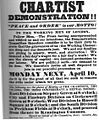
| 10 Apr 1848 | Chartist Rally, Kennington
Led by Feargus O’Connor, an estimated 25,000 Chartists meet on Kennington Common planning to march to Westminster to deliver a monster petition in favor of the six points of the People’s Charter. Police block bridges over the Thames containing the marchers south of the river, and the demonstration is broken up with some arrests and violence. However, the large scale revolt widely predicted and feared fails to materialize. ArticlesJo Briggs, “1848 and 1851: A Reconsideration of the Historical Narrative” |
David Rettenmaier |
| 1853 | Elizabeth Gaskell's Novel Ruth ReleasedThe novel Ruth written by Elizabeth Gaskell was an extremely controversial book to be released during the time. During the time period there were very few novels that would focus on the hard problems that plagued society. One of the topics that was talked about the least was illegitimate children. All of the novels of the time that even discussed the topic fully condemned it, and believed that the people who participated in this act should be social outcasts. This is where the novel separates itself from the other's in the time period, "Mrs. Gaskell's novel was very sympathetic toward the poor victimized mothers of bastard children and blamed society as the real cause of illegitimacy" (Haller). In the novel, Ruth was met with much sympathy for the situation she found herself in "Even when it is discovered that Ruth is to have a child, an event that could make her ordeal as a social outcast even more painful, Mr. Benson can see that it, too, is a blessing if approached properly" (Malcolm). This novel made little change to the views of the people though, many families wouldn't allow their daughters to even read the novel in fear that they would see illegitimacy in a positive light. Sources: Haller, Dorothy L. Bastardy and Baby Farming in Victorian England, people.loyno.edu/~history/journal/1989-0/haller.htm. Malcolm, Elizabeth. Ruth, www.victorianweb.org/authors/gaskell/malcolm/4.html. |
Nick Phair |
| 1853 | Smallpox Vaccination Required by ParliamentFor centuries, the smallpox virus devastated the populations of the world. Early vaccinations where developed in India and China in the 10th century. These processes where called variolation, which was where they would take puss from and smallpox victim and infect others with it, which caused the death percentage to drop from 20%-30% to around .5-2% (Flight, Colette). Much later in 1721 A.D., Lady Mary Wortley Montagu was responsible for bringing modern vaccination to England (Flight, Colette). With rising popularity of vaccinations, the British Parliament decided to pass the United Kingdom Vaccination Act of 1853, which made vaccination of children mandatory (United Kingdom Vaccination Act of 1853). This greatly helped decrease the death rates of the smallpox virus and encouraged mandatory vaccinations around the globe. In Bleak House, we can see the smallpox virus run rampant, it infects Esther, Jo, and many others. We can assume that since Esther and Jo contracted the virus that they did not receive the vaccination, which means that the events of Bleak House could have taken place before 1853 A.D. Or, my personal favorite theory, they were unregistered children whose parents broke the law by not registering their kids which caused them to not be vaccinated (England Epidemics and Major Causes of Death). This theory fits with what we know about Esther and Jo’s background, and many be the reason they contracted the virus.
“England Epidemics and Major Causes of Death S to W (National Institute).” FamilySearch Wiki, The National Institute for Genealogical Studies, 25 Dec. 2015, www.familysearch.org/wiki/en/England_Epidemics_and_Major_Causes_of_Deat…. Flight, Colette. “History - British History in Depth: Smallpox: Eradicating the Scourge.” BBC, BBC, 17 Feb. 2011, www.bbc.co.uk/history/british/empire_seapower/smallpox_01.shtml. “United Kingdom Vaccination Act 1853.” Policy Navigator, navigator.health.org.uk/theme/united-kingdom-vaccination-act-1853.
|
Kevin Vitwar |
| Jun 1868 | The General Examination for WomenIn June of 1868, the University of London's Senate allowed for a General Examination, which would be the first university to accept female candidates to take an exam for a certificate in the 19th century. In May of 1869, there were nine candidates, and only six passed. They had been tested on various subjects and had to pass six of them, with questions ranging from "extracting the square root of 384524.01" to writing an essay about the character of Queen Elizabeth. However, instead of receiving degrees, they would receive "Certificates of Proficiency." It would take another decade for women to fully receive degrees they rightfully deserved. Despite only receiving certificates, the passing candidates went on to have successful careers and inspired women all across London and the United Kingdom to pursue higher education. From 1869 to 1878, more than 250 women had taken the General Examination, and 139 passed with 53 receiving Honours. Dickens was critical to the idea of women breaking the typical stereotypes placed on them, and an example being Mrs. Jellby. Dickens had portrayed Mrs. Jellby in a negative light since she was busy with her ambitions in Africa that she neglected her children and her duties as a mother and wife. However, at the end of the novel, Mrs. Jellby attempts to shift her failure in Africa to focus on women being in Parliament. While it may take a while for women's rights to be explored and taken seriously in the 19th century, Mrs. Jellby's new pursuits could be worthwhile than the colonization of Africa, according to Dickens. And the General Examination allowed for women to have ambitions and opportunities than to live one set lifestyle placed on them. However, it took many years for change to occur for women, especially concerning professions and being rightfully paid for their work. Specifically, in 1970, there was the rise of the Women's Liberation Movement which was a set of marches that found for the demand for equal pay for women and wages for housework. The movement did entice change, as sex discrimination laws were put in place. Overall, Mrs. Jellby holds onto a hope that will eventually flourish, even if the change is overdue for women's rights. There were small steps and improvements, such as the General Examination, which inspired feminists of the 1800s to pursue and challenge their societal and cultural values that led to the Women's Liberation Movement nearing the end of the 1900s. From then on, the future for women expanded and opened doors to unknown heights that women were allowed to dream on. It compares drastically to the time Bleak House was set in, as Dickens portrayed homely and obedient women in a positive light and women who had ambitions in a negative light. Now, women are able to have a place in the workforce and have their rightful payment for their work. Not only did the role of women change, but it also changed societal norms and challenged them. While there still be stereotypes dating before the 1800s, there has been significant social reform and feminists paved the way for women having the choice of pursuing their dreams without limits.
|
Lizbeth Yvey |
| 15 Aug 1868 | The 1868 Reform ActIn 1868, the Reform Act was passed, giving the power to vote to the citizens lower on the social and economic scale. This act was revolutionary because we see the middle classes sharing power with the upper classes. After the Reform Act, many homeowners and working citizens could vote and be represented in the parliament's decision making. Bleakhouse, set in London in the 1850s, was written during a time when middle-class jobs such as lawyers or doctors were becoming more respected as professions. Between this shift and the Reform Act, there is a change in perspective of the social classes, and the citizens that were voiceless are now gaining respect. This is an interesting event to keep in mind when reading about the middle-class characters in Bleakhouse and the gradual changes and adjustments they're experiencing to their social and economic class standing. Everett, Glenn. “The Reform Acts.” The Victorian Web, 1987, www.victorianweb.org/history/hist2.html. |
Natalie Hutchinson |
| circa. 1890 | "Criminal Classes"During the 19th century, the ways criminals were identified began to shift. Big names such as Edwin Chadwick began to link criminal offenders with those individuals that were within the lower classes of British society. This ideology that the lower class individuals were linked to crimes spread and the term "criminal classes" and "dangerous classes" evolved to describe people in the lower classes that were thought to be criminals or dangerous based on class ranking and how society perceived them. Many people wrote about and alienated this class as if, "members belonged to some distinctive, exotic tribe of Africa or the Americas". This is demonstrated within Bleak House when we see George become accused of the murder of Mr. Tulkinghorn based off the black mail and debt that took place between George and Mr. Tulkinghorn.
Emsley, Professor Clive. “History - British History in Depth: Crime and the Victorians.” BBC, BBC, 17 Feb. 2011, www.bbc.co.uk/history/british/victorians/crime_01.shtml.
|
Lindsey Outland |
| Oct 1957 | The Abolition of the London County CouncilThe London government in October 1957, proposed that the London County Council (LLC) be replaced by a council for the wider London. Later, the Greater London Council (GLC) was created to operate over the larger London, instead of just locally. This change in government strategy was a large change for London in the 1950s and this reflects some of the governing changes that earlier occurred in 19th century London. For example, in the 19th century, there was a shift of authority moving from the Beadles to the Police force in 1829, and later to a specialized detective branch. The specialization of authoritative forces occurred in 19th century London and continued through the 20th century. Sources “The Rise of Greater London.” London: the Illustrated History, by Catherine Ross and John Clark, Penguin, 2011, pp. 292–293. Dickens, Charles. Bleak House. B. Tauchnitz, 1853. |
Natalie Hutchinson |
| The end of the month Summer 1959 | Mental Health Act of 1959: Modern and Victorian Mental Health in LondonNumerous suicides are present within the novel Bleak House, but are not considered or presented from a mental health perspective. This is due to the development of the psychology field taking place in the later 19th century. Mentally ill or suicidal patients were transported and housed in the demoralizing and dehumanizing asylums, and many never recovered, but terminated their misery through suicide. These patients were not addressed in proper medical accordance to their mental states, but instead addressed as the hopeless of society. Through reform entering into the 20th century, medical and more moral practices evolved with the advancement in psychological and medical knowledge and implementation of legislative acts. This evolution culminated with the Mental Health Act of 1959, which eradicated any immoral detention methods and allowed for full transition of mental health issues to be treated as medical issues. The evolution of mental health, as it pertains to Bleak House and the presence of suicide, demonstrates how mental health and suicide has transformed in how it is perceived by society. The characters who were closely linked to the characters who committed suicide were most certainly haunted by these occurrences, but did not know how to interpret them or even intervene with these individuals, on a level psychological stability. From Victorian Era lack, thereof of knowledge to modern awareness, time has been the benefactors for mental health and suicide awareness. Turner, John, et al. “The History of Mental Health Services in Modern England: Practitioner Memories and the Direction of Future Research.” Medical History, vol. 59, no. 4, 2015, pp. 599–624. Crossref, doi:10.1017/mdh.2015.48. |
Josie Trombley |
| circa. 1960 to circa. 1970 | Gangland and CrimeThe social and economic changes had brought along new lines to be crossed over what was legal and illegal. Doors to new money-making businesses opened, along with new opportunities for crime. "Gambling, vice, clubs, white collar fraud, property development and Mafia-style money laundering were the key areas for London's modern-minded criminals in the 1960s. Drugs were added in the 1970s'' (Ross and Clark, 304). Many changes economically and socially have occurred between the 19th century in London and London in the 1960s and 70s. In 19th century London, and as seen in our research and reading of Dickens' Bleak House, crimes most often committed were petty thefts and violent crimes. Of course, there will be crime in every era of history, but new opportunities will present themselves. Ross and Clark explain in London, The Illustrated History the rise of businessman gangsters. Some gangs were more modern-minded and primarily used tact, while others “ran their empires with old-fashioned criminal values, using fear and physical violence" (Ross and Clark, 304). In our reading of Bleak House, we read of murder, particularly Mr. Tulkinghorn's murder, and the possible murder (though more plausibly a suicide) of Nemo. Theft was a very common occurrence in the streets, but now in the 60s and 70s we see a rise of more organized crime. The problem of crime exists both in the old ways and in new forms. “Gangland and Crime.” London: the Illustrated History, by Catherine Ross and John Clark, Penguin, 2011, pp. 304–305. |
Cora Boll |
| 1960 | Class Rifts and The Rise of The MiddleIn the 1960s, the Greater London City Council was focused on creating more homes in the city. They focused on buying land from current landlords, and built modern apartment buildings to accomplish their task. In 20 years, their ownership of homes more than doubled, and they did this by building 400 high rise apartment blocks. These new homes made it easier and more afforadlbe to live in the city, and also took vasts amounts of tenants, out of landlord control. However, the poor still struggled breaking out of their inner city renting, and simply couldn't gain enough capital to leave their endless cycle of being stuck under landlords. A change of tastes also happened around this same period. Old homes made in Georgian and Victorian styles became more popular and started to attract new owners. The tensions between landlords and tenants also rose during these times. Landlords where evicting their tenants after realising the rising value of their properties. The city of London had mostly been a city dominated by renters, however, more people decided to become home owners during the same period. With more government owned housing, it caused the middle class renters to be able to rise up in social standing, while the upperclass landlords became less powerful with more and more tenants leaving for the newer government owned appartments. This was the cause of the class tensions during this time. The city of London has changed in the way we see government owned housing. In Bleak House we see that Captain Hawdon rents a room from Mr.Krook, which would be fairly common back then. However, in modern London, many renters have changed who they rent from, instead of renting from individuals they now rent from the government. This has eased the tenant, landlord tension by simply getting rid of the landlord by replacing them with the government. While some private landlords still esist, they simply to do not esist in the same numbers that they used too. Ross, Cathy, and John Clark. London: The Illustrated History. Penguin Books, 2011. |
Kevin Vitwar |
| circa. 1961 to circa. 1981 | Slum Clearance and Home OwnershipIn Bleak House the main areas of London are commonly thought of as slums. These were dirty places that were unliveable to our standards in modern times. These slums were also not owned by the people living there, and the landlords were commonly referred to as slumlords who commonly tried to keep their tenants in the slums. From 1961 to 1981 the percentage of homes that were local authority-owned homes skyrocketed from 21% all the way to 46%. This is a massive increase, doubling the percentage of homes that are owned in 20 years is incredible. This was a massive increase in the quality of life for so many people. Source: Ross, Cathy, and John Clark. London: The Illustrated History. Penguin Books, 2011. |
Nick Phair |
| 1965 | Housing in the SlumsAs reflected in Bleak House, the Victorian housing situation for the poor was not the best. One can see this through the character of Jo and the quality of his condtion and his tradgetic death. By the 1965's there were efforts being made to improve the housing in the slums. Through this effort there were over 400 high-rise blocks added in London (214). There was immense need for these housing complex's being build and this is a clear change from the London we have seen throughout Bleak House. These housing blocks provided space for the citizens of London to have proper and safe housing. Though the building of architecture is not my study focus I still thing this event pertains to philanthropy because the building of the housing had a direct postive impact on the poor and meet their basic needs. |
Rachel Birdsell |
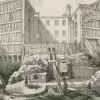
| 1973 | Tolmers Square Protests and the Levy DealIn 1973, the CIS report was published to show the information on the Levy Deal. The Levy deal was a plan placed before the London Council meant to develop more land for office buildings as well as some housing. This did not sit well with the public at the time due to the open homes that were not affordable and the lack of attention towards the financial struggles of the poor. As a result of this desire for "profit" as the common people at the time would have put it, the publishing sparked protests. The developers had made it more difficult for the councils to build housing with increased financial need. Although these events of the Levy deal and the Tolmers Square protests are only a small portion of the housing crisis at the time, they give a good representation of the struggles for those that were homeless, unemployed, and single. It also gives a good representation of greed that drove the focus to profits rather than the well being of the unfortunate. The campaign of Tolmers square stretches beyond 1973 and began decades prior. Development continued and the tension to protect the unfortunate continued as well. It was a tough time, but not for everyone. The image found with this event shows the destruction of properties for the new ideas presented by the entrepreneurs of real estate. Knowing the need for housing at the time adds weight to the actions found within the picture. Ross, Cathy, and John Clark. London: The Illustrated History. Penguin Books, 2011. Wates, Nick. The Battle for Tolmers Square. Routledge & Kegan Paul, 1976. |
Brandon Krueger |
| 1979 to 1979 | Margaret ThatcherIn 1979, Margaret Thatcher was sworn in as the first female Prime Minister. This was a major turning point within Britain and quickly changed the cultural context within British society. Along with changing the cultural context and role of women within British society, she also implemented change within the economy which led to lower unemployment rates and an overall higher economy. Additionally, Thatcher made owning a home more common than any other government leader and also adjusted income tax which helped working-class and low-class families in terms of finances. The concept of a female leader, owning houses, and the changes made throughout the economy and society were new concepts for Britain and represents a change from society within Dicken's era. “Margaret Thatcher Sworn in as Britain's First Female Prime Minister.” History.com, A&E Television Networks, 21 July 2010, www.history.com/this-day-in-history/margaret-thatcher-sworn-in. |
Lindsey Outland |
| 2007 | Quality of Life in Modern LondonIn the textbook London: The Ilustrated History, it states that the Mercer's quality of life index ranked London 39th (Clark & Ross 317). Issues outlined in Bleakhouse still persisted in modern London, such as disease. In Bleakhouse, Dickens references the rampant diseases in London several times by featuring characters who have been struck by illness including Caddy's baby, Jo, and Esther. Tuberculosis, a disease associated with the poor, resurfaced in London. Despite the decades that had passed between the time of Dicken's novel to modern London, disease was an issue that remained. sources: “The Quality of Life.” London: the Illustrated History, by Catherine Ross and John Clark, Penguin, 2011, pp. 317–317. Dickens, Charles. Bleak House. B. Tauchnitz, 1853. |
Jessica Renner |
| circa. Summer 43 to circa. 43 | Founding of LondiniumForces of the emperor Claudius reestablish Roman influence using this strategic location in the Thames valley. Londinium's location allowed Rome to finally gain a more permanent foothold in Britain. Londinium's location on the Thames was also located along roads connecting large tribal towns like present-day St. Albans, Colchester, and Canterbury that later became Roman towns. Image Source: Naples National Archaeological Museum. Photograph by Marie-Lan Nguyen (2011), CC BY 2.5, https://commons.wikimedia.org/w/index.php?curid=23198004 |
Laurie Hatch |
| circa. 60 to circa. 60 | Boudicca's RebellionBoudicca was the queen of the Iceni Tribe who led a revolt against Rome. Accounts show that she first struck the city of Camulodunum within her attack where she massacred and began destroying the settlement. She continued her revolt where many Roman forces tried to stop her but proved ineffective. By the end of this revolt, Boudicca massacred all those who had not yet fleed the scene, successfully defeated the Roman Ninth Legion, as well as destroyed much of Londonimium.
Mark, Joshua J. “Boudicca.” Ancient History Encyclopedia, Ancient History Encyclopedia, 26 Aug. 2020, www.ancient.eu/Boudicca/. |
Lindsey Outland |
| 70 | Building of the AmphitheaterAmphitheaters were a source of entertainment for the people of Roman London during this time. The first one was built north-west from the main settlement. It was dug into the ground and built out of wood. Supporting the wooden tiers of seats, was an oval-shaped earth bank that surrounded the whole structure. Due to the amphitheater being built into the ground, it was susceptible to becoming waterlogged. Therefore, an oak draining system was built in to prevent this. The amphitheater saw many renovations in the passing years and remained a major form of entertainment for the Roman London people up until the 4th century. “Roman London.” London: the Illustrated History, by Catherine Ross and John Clark, Penguin, 2011, pp. 42–43. |
Jessica Renner |