This timeline will be collaboratively constructed by the members of Utah Valley University's Fall 2018 "Victorian Literature" class. It will place a selection of key political, social, and historical events in conversation with our course texts. Timeline events will be chosen for their relevance to the content and context of our readings and will be complemented by a brief annotation exploring the relationship between literary and cultural history.
Timeline
Table of Events
| Date | Event | Created by |
|---|---|---|
| 11 Aug 1492 to 18 Aug 1503 | Alexander VI is elected PopeOn August 11, 1492 Rodrigo Borgia is elected Pope and becomes Alexander VI. He retains the papacy until his death in 1503. |
Madison Hollingsworth |
| 1704 to 1717 | The Arabian NightsAntoine Galland first translated into french four volume of stories he possessed from Syria. The original title of the volumes was "Alf Layla wa Layla" or "A thousand Nights and a Night". When translated into french it was known as "Les mille et une nuits". In his "translation" of the tales, Galland is known to have altered and embellished the stories as he saw fit, adding in what are now known as the "Orphan Tales" to the works. Such tales include "Aladdin and the Wonderful Lamp", "Ali Baba and the Forty Thieves", and "The Seven Voyages of Sinbad." The tales of the Thousand and One Nights began to appear in England as early as 1706, though it is likely some had copies of the french version of the tales. It was renamed as" Arabian Nights' Entertainments" or sometimes "The Thousand and One Nights." Hundreds of editions of the stories circled Europe in the 18th and early 19th centuries, all based on Galland's original works. |
Austin Gottler |
| circa. 1820 | The Industrial Revolution and Child LaborChild labour was not an invention of the Industrial Revolution. Poor children have always started work as soon as their parents could find employment for them. But in much of pre-industrial Britain, there simply was not very much work available for children. This changed with industrialisation. The new factories and mines were hungry for workers and required the execution of simple tasks that could easily be performed by children. The result was a surge in child labour – presenting a new kind of problem that Victorian society had to tackle. Research has shown that the average age at which children started work in early 19th-century Britain was 10 years old, but that this varied widely between regions. In industrial areas, children started work on average at eight and a half years old. Most of these young workers entered the factories as piecers, standing at the spinning machines repairing breaks in the thread. A few started as scavengers, crawling beneath the machinery to clear it of dirt, dust or anything else that might disturb the mechanism. In the mines, children usually started by minding the trap doors, picking out coals at the pit mouth, or by carrying picks for the miners. As work was often scarce in the country, rural children tended to start work later – typically at 10 and a half years old. Their work consisted of bird-scaring, sowing crops and driving horses. In towns, most boys were employed as errand boys or chimney sweeps, though once again finding employers who wanted to hire a child could be a difficult task. The average age for starting work was 11 and a half years old. There was, therefore, considerable variety in the age at which children started work, with those in the industrial districts typically starting work the youngest. All children laboured under the same disadvantages, though, working for very low pay, performing work that was dirty and dangerous, and usually working long hours as well. |
Jillian Innes |
| circa. 1820 to circa. 1870 | Magazine Day(s)Beginning in the 1820's, the emergence of periodicals took off in society, the "age of the magazine". The publishing of periodicals required much attention and energy from the publishers and book sellers of this trade. The night before the publishing of the monthly enstallments, or "Magazine Day" as it was called, was full of hard work and determination to get the magazines on the stands. In fact, it was almost a competition among the trade as to who could publish and reach their readers the fastest. Magazine day was regarded with much anticipation, for readers wanted to know about their beloved characters. During these years of heightened excitement for periodicals and magazines, authors such as Dickens and Thackeray thrived. Unity was abundant throughout England, for everyone was reading the same thing and at the same time. However, by the 1870s this trade had slowly died away. At this point, literature was more abundant and could be found everywhere- in weekly, or even daily installments. Novels were being published in one sitting, and they were inexpensive to purchase. |
McKaley Clark |
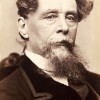
| Jan 1830 | Publication of Charles Lyell's Principles of GeologyJanuary 1830 saw the publication of the first volume (of three) of Charles Lyell’s Principles of Geology. Lyell’s work, though contested, establishes the preeminence of Uniformitarian principles in the interpretation of Geological phenomena, and allows vast temporal scope for Charles Darwin’s subsequent model of evolutionary development.
image courtesy of wikipedia: https://en.wikipedia.org/wiki/File:Charles_Lyell00.jpg |
Michaela Jensen |
| circa. 1830 to circa. 1870 | The Rise of the Victorian Working LadyThe increasing demographic imbalance between men and women in Britain in the nineteenth century forced many women and girls from the middle classes to seek employment to maintain themselves because, in the words of one commentator, “there were not enough husbands to go round.” Working for pay, however, was considered déclassé and the employments that emerged as two of the most popular for middle-class women, nursing and typewriting, had to overcome cultural resistance. The major constraints on efforts to find suitable work for middle-class women were the social and cultural restrictions inherent in Victorian notions of respectability and femininity. But, given the economic and demographic realities of the time, women, as the English Woman’s Journal asserted in 1858, were going to have to work, and “work as they . . . [had] not done yet” (364). Articles in the media about women and work advocated a broad range of possibilities, from the entirely genteel, such as china painting, to the physically and organizationally demanding, such as running a dairy farm. Many of these suggestions were impractical, either because they would not provide a sufficient income or because they required specialized knowledge and other resources that most young women would not have (Young, “Professionalism” 201.). Ultimately, the three areas of work that had the most promise for young middle-class women in the second half of the nineteenth century were teaching, nursing, and typewriting—all jobs that were the principal areas of work for respectable young women throughout the twentieth century. All these areas of work were expanding in the nineteenth century, but only teaching carried with it the aura of both femininity and propriety essential to respectable employment for middle-class women. Teaching in schools was a logical extension of governessing, and while the opening up of board schools in the 1870s did lower the prestige of teaching to some extent, it also opened up many more opportunities for women. |
Jillian Innes |
| The middle of the month Autumn 1830 | First Successful British Railway LineThe Liverpool to Manchester Railway was the first successful Railway line to be built in Britain. At the time it was built by a man named, George Stephenson and was successfully completed in the year 1830. This great historical step created a long-awaited link between two major cities in Britain, causing an economic shift in the areas affected by the change. The Liverpool to Manchester Railway helped to create an easier, faster, and less expensive form of transportation as well as provide another means of economic trade and transportation of goods. We see throughout many types of Victorian Literature a significant change in the environments and the means of transportation in the different novels written from this time period. Railways at this time helped to create this initial change, particularly the Liverpool to Manchester Railway. http://www.bbc.co.uk/schools/gcsebitesize/history/shp/britishsociety/railwaysrev2.shtml Jill Innes: The opening of the first direct railway line from London to the Kent coast in 1862 challenged traditional dichotomies between town and country, and contributed to a growing nostalgia associated with the river. Fin-de-siècle writers used the apparent opposition between rail and river, city and country, to ask new questions about the place of women in a rapidly changing world; the transition to a new century further strained the traditional dichotomy between feminised pastoral and masculinised industrial, a tension reflected in the problematic portrayal of rail and water in the work of E. Nesbit. This was especailly interesting seeing how the railway impacted the plot in Lady Audley's SEcret. It it weren't for the many types of updates in technology Lady Audley's Secret would have not been a good story. It just wouldn't have worked!! http://www.branchcollective.org/?ps_articles=carolyn-w-de-la-l-oulton-co... |
Kayla Czappa |
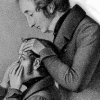
| 15 Jan 1834 | Thomas Pettigrew Hosts First Mummy UnwrappingThomas Pettigrew was the first individual to host a mummy unwrapping. These unwrappings became so popular that they became a common social event during the Victorian Era. |
Kelsie Tylka |
| 14 Aug 1834 | The New Poor Law of 1834The Poor Law Amendment Act of 1834, nicknamed the ‘New’ Poor Law, established the workhouse organization. Before this law, resources such as parish poorhouses and almshouses were available to starving families and those living on the streets. These places provided food, clothing, blankets, and even occasional cash to those in need of it. However, with the ‘New’ Poor Law, these establishments were closed down, and in its place was the workhouse. The workhouse was a system of intense, back-breaking labor of the poor in exchange for meagre food and shelter. To labor in the workhouse, the poor had to live there. This rule was highly distressing to the poor because it forced families to abandon many of their belongings, their homes, and even each other as the workhouses separated people by age and gender. Dickens himself never lived in a workhouse, but it was discovered after his death, that his family had been imprisoned in a debtors’ prison. As restricting and miserable as a debtors’ prison was, Dickens believed it was superior to the conditions of a workhouse. At least in the debtors’ prison, young Dickens and his family could stay together. Although he didn’t experience living in a workhouse, Dickens was a reporter for a time during the Poor Law. As such, he witnessed the hardships brought upon by the workhouse. He was a witness to young children being separated from their families and forced to perform extensive labor beyond their years. He got a sense of what it meant for poor people to be desperate, blamed, starving, and mistreated. Additionally, Dickens observed how these workhouses were run by heartless men who didn’t care about the inhumane conditions of their workhouse or the suffering of their laborers. One of these figures of the “heartless men” shows up in Oliver Twist as the man in the white waistcoat. This character represents the arrogant, uncaring officials of the workhouses who were prejudiced against the poor. During this time, they thought of the poor as lowly beggars who were to blame for their circumstances. This hypocritical idea is shown multiple times in Oliver Twist as the higher-ups preach to the poor to change their ways, yet don’t provide them with a sufficient way to do so. One character that portrays this self-righteousness of the higher-up is Mr. Bumble. Mr. Bumble takes great pride in hurting and abusing the children of the workhouse. With Oliver, specifically, Mr. Bumble never believes Oliver is telling the truth and believes Oliver is an inherently bad child. If people like Mr. Bumble believe that children like Oliver are fundamentally evil, how do they expect children and the poor to better themselves as they often preach them to do? To sum, as we examine the ‘New’ Poor Law and Dickens’ own observations of the act, we’re able to see the hypocrisy and prejudice of the upper and middle classes towards the poor and why Dickens was so passionate about this subject. Officials like Mr. Bumble preach Christian morality, and yet, are merciless towards the workhouse laborers. This was one of the main points that Dickens gets across to readers of his novel. He highlights the institutional cruelty of the workhouse officials through satirizing characters like Mr. Bumble to show how the Poor Act was highly detrimental to people of the lower class while drawing from his own experiences as a child and reporter to make his novel personal. Richardson, Ruth. “Oliver Twist and the Workhouse.” The British Library, The British Library, 18 Feb. 2014, www.bl.uk/romantics-and-victorians/articles/oliver-twist-and-the-workhouse.
|
Celeste Acosta |
| Feb 1837 to Apr 1839 | Oliver Twist
Related ArticlesHeidi Kaufman, “1800-1900: Inside and Outside the Nineteenth-Century East End” |
David Rettenmaier |
| 1839 | Early Efforts; Poetry by Marion and Celia MossMarion and Celia Moss were Jewish poets and sisters who published this book of poetry together when they were 16 and 18 years old. Karen Weisman writes on the novel, saying, "[Early Efforts] is a volume laden with multiple—and often mutually contradictory—presentations of subjectivity, many of them relating to their Jewish authors’ consideration of England as a nation, an idea, and as an anchor for identity." In other words, the volume was a look at England through a Jewish perspective, and though it might not have been extremely effective in this right, Weisman argues that the volume of poetry is an early landmark in Anglo-Jewish Romanticism. Early Efforts sheds some light on England's contradictory treatment of Jews during this time. Weisman explains how the English population has been "alienating, sheltering, dismissive, [or] grudgingly tolerant" of its Jewish section at alternating times. The book covers material that is relevant to Jews and material that is not. The style of the poetry varies as the girls were influenced by romantic poets as well as Victorian female poets. |
Ashlyn Churchill |
| May 1839 to Jul 1839 | Charlotte Bronte a Governess to the Sidgwick familyCharlotte Bronte's experience as governess for the Sidgwick family, along with the accounts of her sister's experiences as governesses, heavily influenced many of the characters in her novels. |
Kelsie Tylka |
| 17 Aug 1839 | 1839 Act on Custody of InfantsOn 17 August 1839, passage of an Act to Amend the Law Relating to the Custody of Infants. The Act allowed a separated wife to petition the court for custody of her children under the age of seven. The campaign to change the law was led Caroline Norton (pictured). She experienced domestic violence in her own failed marriage. In response, she wrote a pamphlet that discoursed on the natural rights and gifts of mothers. Image courtesy of Wikimedia: https://commons.wikimedia.org/wiki/File:Portrait_of_Caroline_Norton.jpg Sources: http://www.branchcollective.org/?page_id=68 https://www.parliament.uk/about/living-heritage/transformingsociety/pri… |
Griffin Kerr |
| Nov 1840 | David Livingstone Sets Sails for AfricaIn 1840 David Livingstone sets sail for Africa with the London Missionary Society. He becomes one of colonial Britain's most famous explorers and missionaries. |
Michaela Jensen |
| 1844 to 1844 | Factories Act of 1844In 1844, Parliament passed a new Factories Act that limited the maximum working hours of children to six and one half hours per day, allowing three hours for schooling. Young people, aged 13-18, were limited to a maximum of twelve hours of work per day. |
Ashley Nadeau |
| 24 May 1844 | "What hath God wrought?": Samuel Morse's Famous MessageOn May 24th, 1844, Samuel F. B. Morse electronically transmitted the message "What hath God wrought?" While it took him many years, Morse was finally able to receive a grant that allowed him to build a telegraph line from Washington to Baltimore. The telegraph would go on to revolutionize the world's communication. Image: http://people.seas.harvard.edu/~jones/cscie129/nu_lectures/lecture5/ele… |
Katelynn Morrow |
| circa. 1846 to circa. 1849 | Typhus outbreakTyphus was a disease that hit Ireland around 1816 and then spread to England later. It affected many people from all classes, because of the idea it did originate from lice. However, it hit the areas that weren't very clean a lot harder. Williams, B. (n.d.). Infectious Diseases in History. Retrieved October 7, 2018, from http://urbanrim.org.uk/ |
Kayla Czappa |
| 24 Aug 1846 | Patrick Brontë’s Cataract Surgery
ArticlesMary Wilson Carpenter, “A Cultural History of Ophthalmology in Nineteenth-Century Britain” |
David Rettenmaier |
| 1847 | "Freak of Nature" Enters Common ParlanceThe Oxford English Dictionary defines “freak of nature,” as meaning an “abnormally developed individual of any species”. According to the OED, 1847 is the year that "freak of nature" enters common parlance. That very same year, the periodical Punch identified a growing popular demand for living curiosities. Under the heading “The Deformito-Mania,” Punch bemoaned the public’s “prevailing taste for deformity, which seems to grow by what it feeds upon” (90). Sources: http://www.branchcollective.org/?page_id=68 Durbach, Nadja. “On the Emergence of the Freak Show in Britain.” BRANCH: Britain, Representation and Nineteenth-Century History. Ed. Dino Franco Felluga. Extension of Romanticism and Victorianism on the Net. http://www.branchcollective.org/?ps_articles=art_emergence_of_the_freak https://commons.wikimedia.org/w/index.php?search=congress+of+freaks&tit… |
Griffin Kerr |
| 1848 | The Pre-RaphaelitesIn 1848, a secret brotherhood of artists who called themselves the Pre-Raphaelites was formed to oppose the Royal Acadamy. They sought to make art with a heavy focus on realism. |
Ashlyn Churchill |
| 1848 | First Direct Railway in UKThe impact of the early railway was registered as both exciting and horrifyingly destructive by Victorian writers, perhaps most famously by Dickens in Dombey and Son (1848). Michael Freeman has suggested that the sense of wonder associated with this new form of transport could only really be felt by the first travellers by rail, for whom “history was being written in the present” (19). But as the next generation of writers show, this history was being constantly updated |
Jillian Innes |
| Jun 1850 | In Memoriam
Related Articles |
David Rettenmaier |
| circa. 1851 | Fallen Women in Victorian ArtThis article shows the highlighted negativity that was associated with the “fallen woman” during the Victorian Era. During the Victorian Era, it was finally socially acceptable to use this as a subject in paintings and art. These were meant to be used as warnings for all women out there—to see the potential downfall that was ahead of you if you didn’t stay virtuous. Going through time, you can see a slight shift in the subjects and stories behind these paintings. At first, it is one young woman being cast away by her father and family (Richard Redgraves, The Outcast). It then moves to the subject of a married woman, having been unfaithful to her husband and her family (Augustus Egg, Past and Present). These paintings of the time continue to get more complex in nature, as shown in Rossetti’s Found, which portrays a man trying to bring his past love, a current prostitute, back home. Yet, she is resisting. This shows a greater complexity, thinking that this may be a choice by the woman—she doesn’t want the constraint of a marriage. There is another painting which shows a “fallen woman” drowned because of assumed feelings of guilt (George Fredrick Watts', Found Drowned). Lastly, and even farther along in the Victorian Era, we have the painting Take Your Son, Sir, by Ford Madox Brown. Here the subject of the painting is making the man take some form of responsibility for the child, by giving the child into his arms. |
McKaley Clark |
| 1852 | King's Cross StationPlans for King's Cross Station at its current location were drawn up in 1848, and the station opened with two platforms in 1852. The station acted as the London hub for the Great Northern Railway. Thus, King's Cross worked to decrease the distance between different areas of England as train travel was expanded in London. |
Katelynn Morrow |
| 1853 | The Awakening ConsciencePainted by William Holman Hunt in 1853 The Awakening Conscience depicts a man and his mistress. The mistress is in the midst of a spirtual revelation about how her life needs to change, and she is going towards the light of redemption. Hunt was a founding member of the Pre-Raphealite Brotherhood along with Dante Gabriel Rosetti and John Everett Millais. The Pre-Raphaelites were against what they considered to be the unimagitive and historical painting of the Royal Academy and instead believed in art of serious subjects with maximum realism. |
Madison Hollingsworth |
| 1854 to 1862 | “The Angel in the House” by Coventry PatmorePoem written in 1854 that introduced the trope of the "Angel in the House". |
Kelsie Tylka |
| 1854 | "Cry of the Children" Quoted in Charles Dickens's Household WordsAn article titled "Ground in the Mill" in Household Words, edited by Charles Dickens, highlighted the harsh working environments that went on in factories, specfically with child labor. This article quotes "The Cry of the Children" in support of its criticism of these working conditions. It was published after "The Cry of the Children" and about seven years before EBB passed away. |
Katie Ray |
| 25 Oct 1854 | Charge of the Light Brigade
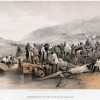
On 25 October 1854, British forces undertook the charge of the Light Brigade at the Battle of Balaklava. Image: Tinted lithograph showing the embarkation of sick persons at the harbor in Balaklava" (William Simpson, artist; Paul & Dominic Colnaghi & Co., publishers, 24 April 24 1855). This image is available from the United States Library of Congress's Prints and Photographs division under the digital ID ppmsca.05686. The image is in the public domain in the United States because its copyright has expired. No other engagement of the war has stuck so vividly in the popular consciousness, aided by Tennyson's poem of the same name, by far the best-remembered cultural product of the war. On the morning of October 25th, 1854, over six hundred British men rode the wrong way down a “valley of death” (so christened first by The Times and later by Tennyson) as enemy guns attacked from all sides. Not two hundred made it out alive. The charge resulted from a series of miscommunications between Lord Raglan, the Commander-in-Chief of the British Forces, and Lord Lucan, the Commander of the Cavalry. Both Tennyson’s poem and many other contemporary responses to the charge suggest that reactions to this event were deeply conflicted, expressing real bewilderment about how to integrate it into preexisting models of patriotic feeling. Moreover, a new form of heroism grew out of the bewildering experience of the Light Brigade’s defeat—and a new sense of a national identity that was based in part on this new heroism. ArticlesStefanie Markovits, "On the Crimean War and the Charge of the Light Brigade" |
David Rettenmaier |
| 1857 to 1858 | Sepoy MutinyThe Sepoy Mutiny, and unsuccessful rebellion agaisnt British rule, spreads across India. |
Madison Hollingsworth |
| 24 Nov 1859 | On the Origin of SpeciesOn 24 November 1859, Charles Darwin publishes his On the Origin of Species by Means of Natural Selection. This book introduced the theory of evolution--species evolve over time through the process of natural selection. These theories were highly controversial because they conflicted with many of the prevelant theologial beliefs of the time. |
Griffin Kerr |
| 29 Jun 1860 to 1865 | Murder of Francis Savile KentOn the night of June 29, 1860 3 and 1/2 year old Francis Savile Kent was found brutally murdered. His nursemaid was first indicted for the crime, but no evidence was found to convict her. Soon after his 16 year old half-sister Constance Kent was held for questioning, but was let go. Constance was seen as something of a folk heroine and the police were criticized for accusing an accomplished, intelligent, and upper class lady for the murder. Constance later confessed to killing Francis in 1865. The murder, along with the sensationlization of it by the press, had a big impact on Victorian society as a whole. |
Madison Hollingsworth |
| 1861 | Book of Household ManagementThe Book of Household Management was published in 1861 by Isabella Beeton. This is ultimaetly a cookbook with a tasteful side theme of household management for the middle-class domestic wife. This book could be used as cookbook with its own "domestic manual offering advice on servants, children, dinner parties, clothing and furnishings"(Zlotnick). It gave you the best recipes for dinner along with ways to properly manage your household. This book could even be considered the perfect book for your everyday domestic middle-class house wife in the Victorian era. |
Lydia Lords |
| circa. 1862 | The Railway & The RiverIn the article ‘”Coquetting amid incredible landscapes’: Women on the River and the Railway”, author Carolyn W. de la L. Oulton expresses the tension between the pastoral way of living compared to the urbanization of London. The finished railway from London to Kent in 1862 completely changed history. Through the increased technology of travel, the more simplistic times were changing. One was successful in getting from the country to the city in a matter of hours instead of days. With this, women were now able to better travel on their own as well. It was no longer a coach ride with only themselves or family members, but a train ride- sitting in close proximity with strangers. This ease in travel for women challenged the long held belief that the industrialized was masculine and the country landscape was seen as feminine. Both the cities and the country side were of easy access. Along with the railway, travel via the riverside also took off. Again challenging the typical literature stereotypes of women. The river had been used in the past by authors such as Dickens as a representation for women and their sexuality/morality. However, now the river is used as a connection piece. Connecting the city and the country, this idea of “no escape” becomes eminent- wherever one goes to escape, others can quickly follow. Not only has this shift in travel changed the real life experiences, but it has shifted the literary expectations for readers. Along with the new travel via railway, came an impact in reading. Some argued that travelers should enjoy the nature that is quickly passing by on the train. Others believed in spending the time reading. There were book stalls near railways which aided the push for reading.
|
McKaley Clark |
| 1862 | First High Society Dog ShowThe first high society dog show took place in London 1862, which began "dog fancy" in Victorian Society. |
Kelsie Tylka |
| 1864 | The Illustrated Police NewsThe Illustrated Police News was a weekly periodical first published in 1864 (2 years after Lady Audley's Secret was published). The founder of the newspaper was George Purkess, a London publisher. The newspaper combined "sensational or unusual stories, often drawn from the London Police Courts, but also reports of mishap from elsewhere in Britain and the world" and illustrators dramatized renditions of the stories. The newspaper was incredibly popular and "while repeatedly emphasising the "true" nature of the stories, it was their entertainment and curiosity value that was crucial to the success of the news." While some scholars have argued that the stories were factual, most agree that they were embellished to increase sales. Source: https://www.britishnewspaperarchive.co.uk/titles/illustrated-police-news --Also, if you visit this link it will show you an issue of The Illustrated Police News published on the same date that you are visiting the site (if you visit it on Nov. 2nd, it will show you an issue published on Nov. 2nd)
|
Griffin Kerr |
| 1868 | 1868 Pharmacy ActThis was one of the first major acts of Parliament to limit the sale of drugs, such as opium and its popular derivative laudanum. The Act established a system of licensing and registration of chemists as well as a list of drugs that, when sold, had to be listed in a “registry.” |
Michaela Jensen |
| 1870 | 1870 Married Women's Property ActUnder the 1870 Married Women’s Property Act, coverture, which was “the legal doctrine that made two people legally one upon marriage,” was severely reduced (Ablow 1). Women were hereafter able to better access ownership of their own property without it immediately being subsumed into their husband’s estate upon marriage. There were many laws that led up to the passing of this act that slowly chipped away at the institution of coverture, which gave husbands all rights over their wives’ property, legal decisions, and even gave them sole custody of their children. At stake here is the very identity of women. The 1870 Act gave them the ability to act as autonomous agents, although Jill Rappoport points out that while women may not have legally had much power or influence under coverture and primogeniture (the tradition that dictated wealth pass on to the first son or closest male heir), women certainly had influence over their own husbands, often convincing them to act in their favor (3). While Charlotte Bronte’s Jane Eyre takes place many decades before the passing of the 1870 Act, Bronte would have seen some of the previous laws building up toward it. Most notably, as Rachel Ablow posits, would perhaps been the Custody of Infants Act of 1839, which gave women the ability to gain custody of their children under seven years of age (1). The rights of women under the institutions of coverture and primogeniture were beginning to come under scrutiny during the time that Bronte was writing, and many of the issues surrounding them are present in Jane Eyre. The novel deals with themes of marriage throughout. The institutions of coverture is not particularly problematic for the novel’s protagonist, Jane, although if she had agreed to marry St. John, it might have become so. Instead, it is more of an issue for Jane’s love interest, Mr. Rochester. Rochester is bound in marriage to a woman he does not love, and, who by all appearances, is insane. The concept of “one flesh” in coverture, while typically and perhaps too simplicially seen as problematic almost entirely for women, applies too to Rochester and Bertha Mason, however much Rochester may wish otherwise. Rochester is bound to make decisions for his wife. Yes, he makes some arguably questionable decisions, but nevertheless, Bertha Mason’s essentially becoming his property binds Rochester to a life he detests. They are both victims of this institution that is only just starting to come into question and experience change at the time that the novel is written. Works Cited Rappoport, Jill. “Wives and Sons: Coverture, Primogeniture, and Married Women’s Property.” BRANCH: Britain, Representation and Nineteenth-Century History. Ed. Dino Franco Felluga. Extension of Romanticism and Victorianism on the Net. Web. 7 Oct. 2018. Ablow, Rachel. “‘One Flesh,’ One Person, and the 1870 Married Women’s Property Act.” BRANCH: Britain, Representation and Nineteenth-Century History. Ed. Dino Franco Felluga. Extension of Romanticism and Victorianism on the Net. Web. 7 Oct. 2018.
Image: http://www.intriguing-history.com/married-womens-property-act/ |
Katelynn Morrow |
| 1870 | The Education Act of 1870The Education Act of 1870 opened up the educational world for elementary aged kids despite many protests. Before the act, education was only made available to students of upper and middle classes. Once the act was established it allowed kids of the lower and working classes to attend. There were many complications when this act was first established, but later acts and amendments solved these complications, and was ultimately the reason for future generations to recieve a greater education. |
Lydia Lords |
| 1874 to 1879 | The Continued Publication of "Problems of Life and Mind"George Henry Lewes, psychologist of the Nineteenth-Centruy, published a multi-volume combination of the era's psychology and science. |
Layton West |
| 1875 | Goblin Market, Prince’s Progress & Other PoemsChristina G. Rossetti, illustrated by Dante Gabriel Rossetti Goblin Market, Prince’s Progress & Other Poems (Macmillan, 1875)
The Levetus siblings built upon the legacy of an earlier brother and sister collaboration – the Rossettis. ‘Goblin Market’ is Christina Rossetti’s best known poem. When it was first published in 1862, it was considered a children’s moral tale, but modern audiences are often struck by its sexual violence and homoerotic undertones.
|
George Bandy |
| circa. 1875 to circa. 1905 | Cross-CorrespondencesThe cross-correspondences is a series of automatic scripts and other trance utterings from a group of mediums involved in the Society for Psychical Research (SPR). These scripts were put together to convey messages from spirits or telepathy according to the psychical researchers. The correspondences took place over many decades and consisted of multiple automatic writtings and utterances from trances. Although there were speculations, many believe in the cross-correspondences and believe them to intelligble and improtant messages from beyond the veil. |
Lydia Lords |
| 1876 to 1879 | The Great India FamineIn Southern and Western India during 1876, population and food source collided. |
Layton West |
| 1876 to 1878 | Crop Failures in India Cause FamineThe Great Indian Famine began in 1876 and lasted until 1878. Close to eleven million people died in southern and western India. The famine was brought about by the failed monsoon that year that would normally bring in precipitation for crops. Farmers counted on the moisture and tragically, it never came. As a result, crops failed and the cost of grains skyrocketed. The farmers, already deeply in debt, sold equipment, cattle, and even their lands to be able to get food to feed their families. The policies of the British did not help the people of India and were the cause of the indebtedness of the Indian people. The officials in charge of determining the amount of taxes were self-serving individuals who were not honest in their assessments, leading to unfair levels of taxes. When the drought began, the farmers were already indebted unfairly. Unfortunately, the drought lasted not just one year, but two. Much of the area’s productions turned to cash crops and the price of those crops dropped. This is most notable in the cotton crops, where cultivators lost their sources of income. At the center of the indebted farmers was the hefty annual land taxes that came due despite the failure of crops. By 1875, the crisis was so dire that the farmers rioted against the local moneylenders when they refused to lend more money to the peasants who needed cash to pay their taxes. In the midst of this crisis, there were many who looked to see the cause of such turmoil. Many speculated that overpopulation was the cause. They argued that the most densely populated regions were the most affected. The British looked to the railways to correct these issues and proposed the building of railways at this time. They argued that is was not lack of food that was the problem, but access to food. Eventually, the rains came and the crops were once again established. Despite this, the railways were expanded and were seen as a way of preventing a famine. Regardless of whether the railways would actually help, the theory that they could help helped change the way famine is viewed--not so much as lack of food, but lack of access to food.
Kathleen Frederickson, “British Writers on Population, Infrastructure, and the Great Indian Famine of 1876-8.″ http://www.branchcollective.org/?ps_articles=kathleen-frederickson-british-writers-on-population-infrastructure-and-the-great-indian-famine-of-1876-8. Accessed 10 December 2018. |
Holly Kelly |
| 1878 to 1880 | Second Anglo-Afghan WarBritain desired to use Afghanistan as a buffer state against Russian incursion into British territory. Amir Sher Ali Khan attempted to keep a Russian convoy out of Kabul, but ultimately failed. The British demanded their mission be allowed and Ali Khan refused them and turned them back at Khyber Pass. The British retailiated with a force of 40,000 men and at the end of the war forced the Afghanis to sign a treaty with them. |
Michaela Jensen |
| circa. Spring 1880 | London's Jewish East EndLondon's Jewish East End was where most of the Jewish immigrants chose to settle, causing a massive influx into areas such as Whitechapel and Spitalfields which were featured in the Jack the Ripper Murders. Consequently because of this at the beginning of the investigation police thought that the murders were being committed by a Jew. |
Lindsay Olsen |
| circa. 1895 | Homosexuality & Oscar WildeThis article explores the common misconceptions of Oscar Wilde, the Victorian Era on the concept of homosexuality, and the trials of Wilde. It goes in depth to see Wilde as an actual person, instead of the archetypical gay martyr that he has become known for. Wilde grew up and lived on a lower social class level. Many believe him to be an aristocrat because of his family name, however not only was he poor, but he also was Irish and never fully accepted into England. The Victorians were most worried about the crime of sodomy- due to their Christian background and beliefs. Proof of sodomy would result in prison for life, when there was lack of proof the punishment would be two years in prison for gross indecency. The misconstrued idea of lack of knowledge about homosexuality is in fact wrong during the Victorian Era. Again, homosexuality was defined as sodomy. There were bars all throughout London where men could meet other men. It wasn’t something that was completely uncommon and unknown. Wilde participated in three different trials. The first wasn’t even a trial for sodomy, but instead a trial for defamation of Wilde’s name (defamation done by his boyfriend’s father). The intense prosecution from the first trial lead to the other two- putting Wilde into prison for gross indecency. Wilde died shortly after being released from prison. While the imprisonment ruined Oscar’s chance at future writing, it didn’t kill his previous work. His work didn’t die with his prison sentence. In fact, it brought more fame to him and his name. His name became the name for the action of homosexuality, and his work still continues to be explored. |
McKaley Clark |
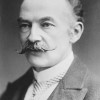
| 1896 | Thomas Hardy’s “End of Prose”
Articles |
David Rettenmaier |
| 1920 | Dangerous Drugs Act of 1920The Dangerous Drugs Act of 1920 is an Act that restricted drug use within the United Kingdom in an attempt to bring foward the dangers of drug addiction. The Act made out to control the export, import, sale, distribution and/or possession of drugs such as raw opium, morphine, cocaine, ecogonine, and heroin. These drugs were widely used as medical and recreational drugs at this time leading to numerous accounts of drug addiction. Drug addiction was treated as disease until it was realised that drugs, and the addiction to them, were the problem, which set the governement out to implement this Act in 1920. |
Lydia Lords |