Literary and other events of the Victorian period
Timeline
Table of Events
| Date | Event | Created by |
|---|---|---|
| 1815 to 1870 | Italian RisorgimentoTo be written |
Karen Dieleman |
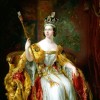
| 28 Jun 1838 | Queen VictoriaQueen Victoria began her reign after her coronation on June 28, 1838. This was the beginning of a 63 year long reign as monarchy which is the longest reign of any British monarch to date. Her husband, Prince Albert, greatly influenced how she ruled as monarch. Victoria loved and respected him as he helped change her habits and her political sympathies as well as training in how to conduct business, maintain the ministry of home life, and in establishing a private intelligence service abroad. Queen Victoria’s reign was marked by important improvements within Britain. A few important improvements include accelerated industrial, political, and military progress. These progressions are part of the reason why an era was named after Victoria. She was a queen who desired to keep political power as a monarch and was reigning during the transformation of the sovereign’s political role into a ceremonial role. Victoria believed that the sovereign had an important and active role in in British politics. The sovereign’s role in foreign affairs and in keeping alliances held sincere importance. Queen Victoria marked the end of the Romantic period.
Sources: http://www.keats-shelley-house.org/en/romanticism/timeline-1837 https://www.britannica.com/biography/Victoria-queen-of-United-Kingdom |
Victoria Heltzel |
| 17 Jul 1841 | Punch launchedOn July 17 1841, Punch, a mass-circulation periodical, was launched. Articles |
David Rettenmaier |
| 2 May 1842 | Second Chartist Petition
ArticlesChris R. Vanden Bossche, "On Chartism" Related ArticlesJo Briggs, “1848 and 1851: A Reconsideration of the Historical Narrative” |
David Rettenmaier |
| 8 Aug 1842 | Manchester strike
ArticlesChris R. Vanden Bossche, "On Chartism" Related ArticlesJo Briggs, “1848 and 1851: A Reconsideration of the Historical Narrative” |
David Rettenmaier |
| 1843 | Wordsworth becomes Poet LaureateTo be written |
Karen Dieleman |
| 24 May 1843 | Pusey's Oxford Sermon on the EucharistOn 24 May 1843, E. B. Pusey gave a sermon at
 Christ Church, Oxford, on “The Holy Eucharist a Comfort to the Penitent”; the University authorities deemed the sermon heretical and punished Pusey, an act which constituted a key skirmish between the Oxford Movement and the Established Church. Christ Church, Oxford, on “The Holy Eucharist a Comfort to the Penitent”; the University authorities deemed the sermon heretical and punished Pusey, an act which constituted a key skirmish between the Oxford Movement and the Established Church.
ArticlesLaura Mooneyham White, "On Pusey's Oxford Sermon on the Eucharist, 24 May 1843" Related ArticlesBarbara Charlesworth Gelpi, "14 July 1833: John Keble's Assize Sermon, National Apostasy" |
Karen Dieleman |
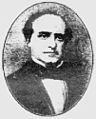
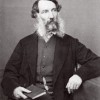
| 1844 | Vestiges of the Natural History of Creation publishedWritten by Edinburgh publisher Robert Chambers but published anonymously in October 1844, Vestiges of the Natural History of Creation provided a grand cosmic narrative of evolutionary change and became an immediate sensation. Its condemnation by leaders of both science and the church contributed to Charles Darwin’s delay in publishing his own evolutionary theory but also helped spread acceptance of what was then called “the transmutation of species” and “the development hypothesis.” Image: Robert Chambers, c. 1863. Reproduced from John van Wyhe, The History of Phrenology on the Web. This image is in the public domain in the United States because its copyright has expired. ArticlesJonathan Smith, “The Huxley-Wilberforce ‘Debate’ on Evolution, 30 June 1860″ Related ArticlesNancy Armstrong, “On Charles Darwin’s The Descent of Man, 24 February 1871″ Ian Duncan, “On Charles Darwin and the Voyage of the Beagle” Anna Henchman, “Charles Darwin’s Final Book on Earthworms, 1881” Martin Meisel, "On the Age of the Universe" Cannon Schmitt, “On the Publication of Charles Darwin’s On the Origin of Species, 1859″ Daniel Bivona, “On W. K. Clifford and ‘The Ethics of Belief,’ 11 April 1876″ |
Karen Dieleman |
| 1844 | Elizabeth Barrett publishes A Drama of Exile and Other PoemsTo be written |
Karen Dieleman |
| 1 Jul 1848 | Trial of Chartist leaders
The summer of 1848 witnesses violence as Chartist leaders are arrested and secret plots against the government are infiltrated. By the end of August, after the arrest of several hundred Chartists and Irish Confederates, the movement for violent uprising in England is broken. ArticlesJo Briggs, “1848 and 1851: A Reconsideration of the Historical Narrative” |
David Rettenmaier |
| Sep 1848 | Pre-Raphaelite Brotherhood founded
Related ArticlesElizabeth Helsinger, “Lyric Poetry and the Event of Poems, 1870″ Morna O’Neill, “On Walter Crane and the Aims of Decorative Art” Linda M. Shires, "On Color Theory, 1835: George Field’s Chromatography" |
David Rettenmaier |
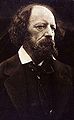
| 1850 | Alfred, Lord Tennyson becomes Poet LaureateTo be written |
Karen Dieleman |
| 1850 | Elizabeth Barrett Browning publishes Sonnets from the PortugueseTo be written |
Karen Dieleman |
| 1850 | Alfred, Lord Tennyson publishes In Memorium A.H.H.To be written |
Karen Dieleman |
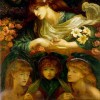
| Feb 1850 | “The Blessed Damozel”
Related Articles |
David Rettenmaier |
| Jun 1850 | In Memoriam
Related Articles |
David Rettenmaier |
| 29 Sep 1850 | Pope Pius IX restores England's Roman Catholic ecclesiastical hierarchyOn 29 September 1850, Pius IX restored England’s ecclesiastical hierarchy; the post-seventeenth-century system of Vicars Apostolic was replaced with a hierarchy in line with the system still in place in Ireland. This change contributed to the so-called Papal Aggression over the years 1850-52, a campaign against Roman Catholocism. ArticlesMiriam Burstein, “The ‘Papal Aggression’ Controversy, 1850-52″ Related ArticlesBarbara Charlesworth Gelpi (Stanford), “14 July 1833: John Keble’s Assize Sermon, National Apostasy” |
Karen Dieleman |
| 1851 | Charles Dickens publishes Great ExpectationsTo be written |
Karen Dieleman |
| Jan 1851 | London Labour and the London Poor
ArticlesHeidi Kaufman, “1800-1900: Inside and Outside the Nineteenth-Century East End” |
David Rettenmaier |
| 1851 | Release of Religious Census of the United KingdomThe United Kingdom released its religious census. The returns revealed that four out of five worshipers in Wales attended Nonconformist places of worship rather than Anglican Churches. Image: Cover of the original census report. This image is part of the public domain in the United States because its copyright has expired. Courtesy of Google Books. Articles |
Karen Dieleman |
| 1851 | George Eliot publishes The Mill on the FlossTo be written |
Karen Dieleman |
| 1 May 1851 to 15 Oct 1851 | Great Exhibition
The Great Exhibition of 1851 was an event in the history of: exhibitions; world’s fairs; consumerism; imperialism; architecture; collections; things; glass and material culture in general; visual culture; attention and inattention; distraction. Its ostensible purposes, as stated by the organizing commission and various promoters, most notably Prince Albert, were chiefly to celebrate the industry and ingeniousness of various world cultures, primarily the British, and to inform and educate the public about the achievement, workmanship, science and industry that produced the numerous and multifarious objects and technologies on display. Designed by Joseph Paxton, the Crystal Palace (pictured above) was a structure of iron and glass conceptually derived from greenhouses and railway stations, but also resembling the shopping arcades of Paris and London. The Great Exhibition of the Works of Industry of All Nations became a model for World’s Fairs, by which invited nations showcased the best in manufacturing, design, and art, well into the twentieth century. ArticlesAudrey Jaffe, "On the Great Exhibition" Related ArticlesAviva Briefel, "On the 1886 Colonial and Indian Exhibition" Anne Helmreich, “On the Opening of the Crystal Palace at Sydenham, 1854″ Anne Clendinning, “On The British Empire Exhibition, 1924-25″ Barbara Leckie, “Prince Albert’s Exhibition Model Dwellings” Carol Senf, “‘The Fiddler of the Reels’: Hardy’s Reflection on the Past” |
David Rettenmaier |
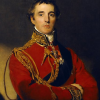
| 18 Nov 1852 | Wellington's funeral
ArticlesSean Grass, “On the Death of the Duke of Wellington, 14 September 1852″ |
David Rettenmaier |
| 1853 to 1856 | Crimean WarTo be written |
Karen Dieleman |
| Aug 1853 to Nov 1854 | Cholera EpidemicThe third major cholera epidemic in the UK began in August 1853 and extended through November 1854. It is during this epidemic that John Snow deduced the mode of transmission, by water contaminated with feces. Articles |
David Rettenmaier |
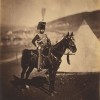
| 2 Oct 1853 to 30 Mar 1856 | Crimean War
ArticlesStefanie Markovits, "On the Crimean War and the Charge of the Light Brigade" |
David Rettenmaier |
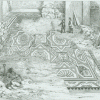
| 1854 | Roman pavement discovered
Articles |
David Rettenmaier |
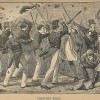
| 28 Mar 1854 | Britain declares war on Russia, thus entering the Crimean WarOn 28 March 1854, Britain declares war against Russia, thus entering the Crimean War. Image: Russo-British skirmish during Crimean War (anonymous plate). This image is in the public domain in the United States because its copyright has expired. In 1854, in defense of the Turks and of British access to eastern trade routes, Britain entered into war in the Crimea (click for geospatial information). The two-year campaign represented the nation’s first major military engagement since the end of the Napoleonic wars. It thus sheds light on mid-Victorian attitudes towards national identity, offering a counter-narrative to views of the 1850s dominated by responses to the Great Exhibition of 1851. As literary and visual representations of the war reveal, reactions to this conflict were both more nuanced and more ambivalent than our preconceptions about Victorian jingoism might anticipate. ArticlesStefanie Markovits, "On the Crimean War and the Charge of the Light Brigade" |
Karen Dieleman |
| 10 Jun 1854 | Sydenham Crystal Palace opens
Opening of the Crystal Palace at Sydenham on 10 June 1854. Image: The Crystal Palace on fire (30 November 1936; author unknown). This image is in the public domain in the United States because its copyright has expired. The resurrection of the Crystal Palace of 1851 in its new setting at Sydenham, with an expanded architectural complex and enhanced functional brief, embodies the Victorian emphasis upon visuality as a means of acquiring and conveying knowledge. In addition, the new Crystal Palace was shaped by prevailing concepts of rational recreation and beneficial commerce that insisted that private and public interests could be simultaneously satisfied and lead to a stronger nation and even Empire. ArticlesAnne Helmreich, "On the Opening of the Crystal Palace at Sydenham, 10 June 1854" Related ArticlesAudrey Jaffe, "On the Great Exhibition" Aviva Briefel, "On the 1886 Colonial and Indian Exhibition" Anne Clendinning, “On The British Empire Exhibition, 1924-25″ |
David Rettenmaier |
| 25 Oct 1854 | Charge of the Light Brigade
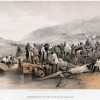
On 25 October 1854, British forces undertook the charge of the Light Brigade at the Battle of Balaklava. Image: Tinted lithograph showing the embarkation of sick persons at the harbor in Balaklava" (William Simpson, artist; Paul & Dominic Colnaghi & Co., publishers, 24 April 24 1855). This image is available from the United States Library of Congress's Prints and Photographs division under the digital ID ppmsca.05686. The image is in the public domain in the United States because its copyright has expired. No other engagement of the war has stuck so vividly in the popular consciousness, aided by Tennyson's poem of the same name, by far the best-remembered cultural product of the war. On the morning of October 25th, 1854, over six hundred British men rode the wrong way down a “valley of death” (so christened first by The Times and later by Tennyson) as enemy guns attacked from all sides. Not two hundred made it out alive. The charge resulted from a series of miscommunications between Lord Raglan, the Commander-in-Chief of the British Forces, and Lord Lucan, the Commander of the Cavalry. Both Tennyson’s poem and many other contemporary responses to the charge suggest that reactions to this event were deeply conflicted, expressing real bewilderment about how to integrate it into preexisting models of patriotic feeling. Moreover, a new form of heroism grew out of the bewildering experience of the Light Brigade’s defeat—and a new sense of a national identity that was based in part on this new heroism. ArticlesStefanie Markovits, "On the Crimean War and the Charge of the Light Brigade" |
David Rettenmaier |
| 17 Nov 1855 | Men and Women
Robert Browning’s Men and Women was a major literary event in nineteenth-century Britain in its shift of emphasis from the private, atemporal and generally non-social genre of Romantic lyricism to the ironies and enigmas of human awareness and social relationships, to dramatic action in human speech. His men and women are presented overtly as speech acts, grounded in psychological and cultural origins, and in the ambiguities of linguistic processes. Readers often found Browning’s mode of writing obscure, but its methods and implications consistently engage with other domains of Victorian thought, in religion, biology, and psychiatry. While the status of this publication was not widely understood at the time, its value is manifest in its reception history, in the discussion and representations that constitute its ongoing existence as a historical event. Articles |
David Rettenmaier |
| 30 Mar 1856 | Treaty of Paris
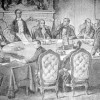
On 30 March 1856, signing of the Treaty of Paris, ending the Crimean War. Image: Treaty of Paris, the participants (Contemporary woodcut, published in Magazin Istoric, 1856). This image is in the public domain in the United States because its copyright has expired. ArticlesStefanie Markovits, "On the Crimean War and the Charge of the Light Brigade" |
David Rettenmaier |
| 15 Nov 1856 | Aurora Leigh
ArticlesMarjorie Stone, “The ‘Advent’ of Aurora Leigh: Critical Myths and Periodical Debates” |
David Rettenmaier |
| 1857 to 1860 | Poems by Alfred Tennyson - UlyssesPoems by Alfred Tennyson is a beautiful volume that was published in 1857 in London, England. Interestingly, three years later it was republished in 1860 by Bradbury and Evans, Printers, Whitefriars. It is known that revisions were made to some of the poems in this edition, and they were probably being made in this three-year period between the completion and the publication. This brings up many questions, one of which has to do with who wanted to make changes, Tennyson himself or his publishers? |
Nicole Mitchell |
| May 1857 | "Moxon Tennyson" published
Articles |
David Rettenmaier |
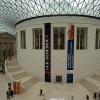
| 2 May 1857 | Opening of Reading Room of the British Library
Related Articles |
David Rettenmaier |
| 25 May 1857 to 25 Jun 1857 | Pre-Raphaelite Art Exhibit
Related Articles |
David Rettenmaier |
| 22 Jun 1857 | Victoria and Albert Museum opened
Related ArticlesCarol Senf, “‘The Fiddler of the Reels’: Hardy’s Reflection on the Past” |
David Rettenmaier |
| 28 Aug 1857 | Matrimonial Causes Act of 1857
ArticlesKelly Hager, “Chipping Away at Coverture: The Matrimonial Causes Act of 1857″ Related ArticlesRachel Ablow, “‘One Flesh,’ One Person, and the 1870 Married Women’s Property Act” Jill Rappoport, “Wives and Sons: Coverture, Primogeniture, and Married Women’s Property” |
David Rettenmaier |
| 1858 | English Woman’s Journal first published
Articles |
David Rettenmaier |
| May 1858 | Augustus Egg’s Triptych exhibited
ArticlesDeborah Epstein Nord, “On Augustus Egg’s Triptych, May 1858″ |
David Rettenmaier |
| Aug 1858 | First attempt at transatlantic cableIn August, 1858, to riotous celebrations in the United States, in which fireworks destroyed the cupola of New York’s City Hall, the first cable was successfully completed between Valentia, Ireland and Trinity Bay, Newfoundland, only to cease functioning within a month. Articles |
David Rettenmaier |
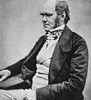
| 1859 | Darwin's "On the Origin of Species"Hailed as the foundation of evolutionary biology, Charles Darwin's On the Origin of Species explained the theory of natural selection and popularized Herbert Spencer's phrase "survival of the fittest." Written for the scientific community and the general public, the book appealed to a wide audience and generated scientific, philosophical, and religious discussion. |
Rose O'Gara |
| 1 Feb 1859 | Adam Bede
Related Articles |
David Rettenmaier |
| 1 Mar 1859 | “Modern Manufacture and Design”
Related ArticlesMorna O’Neill, “On Walter Crane and the Aims of Decorative Art” |
David Rettenmaier |
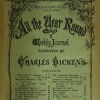
| 30 Apr 1859 | All the Year Round founded
All the Year Round was the first magazine with Dickens as proprietor-editor, and home to first important sensation novel, Woman in White. Articles |
David Rettenmaier |
| 1 Jun 1859 | British Novelists and their Styles
Articles |
David Rettenmaier |
| Jul 1859 | "Guinevere"
Related Articles |
David Rettenmaier |
| 24 Nov 1859 | On the Origin of Species
ArticlesNancy Armstrong, “On Charles Darwin’s The Descent of Man, 24 February 1871″ Ian Duncan, “On Charles Darwin and the Voyage of the Beagle” Anna Henchman, “Charles Darwin’s Final Book on Earthworms, 1881” Martin Meisel, "On the Age of the Universe" Cannon Schmitt, “On the Publication of Charles Darwin’s On the Origin of Species, 1859″ Related ArticlesDaniel Bivona, “On W. K. Clifford and ‘The Ethics of Belief,’ 11 April 1876″ |
David Rettenmaier |
| 1860 | Essays and ReviewsThe publication in March 1860 of the seven articles by liberal Anglicans comprising Essays and Reviews set off a firestorm of controversy within the Church of England and across British society. The “seven against Christ,” as they were called by their critics, embraced a Christianity in step with the new historical scholarship of the Bible and with modern science. ArticlesJonathan Smith, “The Huxley-Wilberforce ‘Debate’ on Evolution, 30 June 1860″ Related ArticlesIan Duncan, “On Charles Darwin and the Voyage of the Beagle” Anna Henchman, “Charles Darwin’s Final Book on Earthworms, 1881” Martin Meisel, "On the Age of the Universe" Cannon Schmitt, “On the Publication of Charles Darwin’s On the Origin of Species, 1859″ Daniel Bivona, “On W. K. Clifford and ‘The Ethics of Belief,’ 11 April 1876″ |
David Rettenmaier |
| 12 Mar 1860 | Poems before Congress
ArticlesAlison Chapman, "On Il Risorgimento" Related ArticlesMarjorie Stone, “On the Post Office Espionage Scandal, 1844″ |
David Rettenmaier |
| 30 Jun 1860 | Huxley-Wilberforce “Debate” on Evolution
ArticlesJonathan Smith, “The Huxley-Wilberforce ‘Debate’ on Evolution, 30 June 1860″ Related ArticlesNancy Armstrong, “On Charles Darwin’s The Descent of Man, 24 February 1871″ Ian Duncan, “On Charles Darwin and the Voyage of the Beagle” Anna Henchman, “Charles Darwin’s Final Book on Earthworms, 1881” Martin Meisel, "On the Age of the Universe" Cannon Schmitt, “On the Publication of Charles Darwin’s On the Origin of Species, 1859″ Daniel Bivona, “On W. K. Clifford and ‘The Ethics of Belief,’ 11 April 1876″ |
David Rettenmaier |
| 9 Jul 1860 | Nightingale Home and Training School for Nurses opened
ArticlesLara Kriegel, “On the Death—and Life—of Florence Nightingale, August 1910″ Related Articles |
David Rettenmaier |
| 1861 | George Eliot publishes MiddlemarchTo be written |
Karen Dieleman |
| Feb 1861 | Italy is united following the RisorgimentoTo be written |
Karen Dieleman |
| 1 Oct 1861 | Book of Household Management
ArticlesSusan Zlotnick, “On the Publication of Isabella Beeton’s Book of Household Management, 1861″ |
David Rettenmaier |
| 1862 | Christina Rossetti publishes Goblin MarketTo be written |
Karen Dieleman |
| 1 Mar 1862 | "On the Age of the Sun's Heat”
Articles |
David Rettenmaier |
| May 1864 | “Abt Vogler”
Related Articles |
David Rettenmaier |
| 2 Oct 1865 | George William Gordon executedGordon, a Jamaican former slave and elected member of the Jamaica House of Assembly, is executed by hanging after a court martial condemns him to death for his alleged role in encouraging the Morant Bay rebellion. Articles |
David Rettenmaier |
| Nov 1865 to Nov 1866 | Cholera EpidemicThe last cholera epidemic is conventionally termed “of 1866” as that was the period of the highest mortality. The epidemic arrived in Britain in September 1865 and ended in November 1866. Articles |
David Rettenmaier |
| Dec 1865 | “Jamaica Committee”
Articles |
David Rettenmaier |
| 1866 to 187 | Livingstone expedition to East Africa
ArticlesMatthew Rubery, "On Henry Morton Stanley’s Search for Dr. Livingstone, 1871-72" |
David Rettenmaier |
| The end of the month Spring 1866 | The Death of John KebleOn the 29th of March, 1866, the notable churchman and poet John Keble dies, followed soon by his wife Charlotte on the 11th of May. This sparks an almost immediate reaction of reflection on his legacy as a writer and church leader across England. Numerous publications consider his life and work in the following years, many focusing on his most influential text: the collection of poems liturgically organized in The Christian Year. In the five years that followed Keble’s death, his name is celebrated with a major biography and a college at Oxford (pictured here) which would be dedicated to the teachings of the Church of England. He and his wife are burred at the All Saints Churchyard in Hursley. To read a related blog post, click here: https://blogs.baylor.edu/19crs/2020/01/15/keble-in-conversation-reception-and-use-of-kebles-language-in-the-letters-of-edward-and-elizabeth-dickinson-dowden/ |
Stewart Riley |
| 11 May 1866 | Black FridayThe Collapse of the City of London's oldest bill-brokerage firm and discount company, Overend, Gurney, and Company initiates the financial panic of 1866, marking a change in perception of the banking industry and stimulating new economic theories during the 1860s. Articles |
David Rettenmaier |
| 2 Jul 1866 | Hyde Park demonstrationHyde Park Demonstration of the Major Reform League on 23 July 1866. After the British government banned a meeting organized to press for voting rights, 200,000 people entered the Park and clashed with police and soldiers. Related ArticlesPeter Melville Logan, “On Culture: Matthew Arnold’s Culture and Anarchy, 1869″ |
David Rettenmaier |
| 15 Aug 1867 | Second Reform Act
ArticlesJanice Carlisle, "On the Second Reform Act, 1867" Related ArticlesCarolyn Vellenga Berman, “On the Reform Act of 1832″ Elaine Hadley, “On Opinion Politics and the Ballot Act of 1872″ |
David Rettenmaier |
| Published toward the end of the year. | Moxon Publishes Illustrated IdyllsIn 1868 Edward Moxon and Co. published an ambitious and ornate illustrated edition of Alfred, Lord Tennyson's Idylls of the King. The engravings were provided by Gustave Doré, who had recently illustrated John Milton's Paradise Lost and the Bible. Although the volume was assumed to be successful, its publication was characterized by tensions between Tennyson and James Bertrand Payne, the manager of Moxon and editor of the edition. To read a related blog post, click here: http://blogs.baylor.edu/19crs/2020/01/15/layers-of-interp…-king-in-context/ |
Andrew Hicks |
| 27 Feb 1868 | "On Geological Time."
Articles |
David Rettenmaier |
| 25 Jan 1869 | Culture and Anarchy
ArticlesPeter Melville Logan, “On Culture: Matthew Arnold’s Culture and Anarchy, 1869″ |
David Rettenmaier |
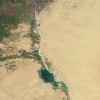
| Nov 1869 | Suez Canal opens
Related Articles |
David Rettenmaier |
| Dec 1869 | “The Coming of Arthur”
Related Articles |
David Rettenmaier |
| Feb 1870 | Elementary Education Act
Related Articles |
David Rettenmaier |
| 9 Aug 1870 | 1870 Married Women's Property Act
This Act established limited protections for some separate property for married women, including the right to retain up to £200 of any earning or inheritance. Before this all of a woman's property owned before her marriage, as well as all acquired after the marriage, automatically became her husband's alone. Only women whose families negotiated different terms in a marriage contract were able to retain control of some portion of their property. ArticlesRachel Ablow, "On the Married Woman's Property Act, 1870" Related ArticlesKelly Hager, “Chipping Away at Coverture: The Matrimonial Causes Act of 1857″ Jill Rappoport, “Wives and Sons: Coverture, Primogeniture, and Married Women’s Property” Anne Wallace, “On the Deceased Wife’s Sister Controversy, 1835-1907″ |
David Rettenmaier |
| 24 Feb 1871 | Descent of Man
ArticlesNancy Armstrong, “On Charles Darwin’s The Descent of Man, 24 February 1871″ Related ArticlesIan Duncan, “On Charles Darwin and the Voyage of the Beagle” Anna Henchman, “Charles Darwin’s Final Book on Earthworms, 1881” Cannon Schmitt, “On the Publication of Charles Darwin’s On the Origin of Species, 1859″ |
David Rettenmaier |
| 1872 | Aurora Leigh, Tauchnitz edition published in GermanyTo be written |
Karen Dieleman |
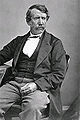
| 2 Jul 1872 | Stanley finds Livingstone
On 2 July 1872, the New York Herald reported news of the meeting between Henry Morton Stanley and Dr. David Livingstone in Africa. The Scottish missionary had been out of contact for nearly three years when Stanley traveled to Africa in search of him. The meeting took place at Ujiji in either October or November 1871 (the precise date is unknown). The meeting was one of the most sensational news stories of the nineteenth century. Stanley’s greeting “Dr. Livingstone, I presume?” is still a well known phrase. The meeting turned public attention to the African slave trade and was a pivotal moment in the relationship among the United States, Europe, and Africa. ArticlesMatthew Rubery, "On Henry Morton Stanley's Search for Dr. Livingstone, 1871-72" Related Articles |
David Rettenmaier |
| 6 Nov 1872 to 22 Dec 1872 | Around the World in Eighty Days Related Articles |
David Rettenmaier |
| Feb 1873 | Walter Pater publishes Studies in the History of the RenaissanceTo be written |
Karen Dieleman |
| 1874 to 1877 | Stanley expedition to Africa
ArticlesDane Kennedy, "The Search for the Nile" |
David Rettenmaier |
| Aug 1874 | Public Worship Regulation ActTo be written |
Karen Dieleman |
| Aug 1874 | Public Worship Regulation ActTo be written |
Karen Dieleman |
| 1875 | Morris & Co. founded
Related Articles |
David Rettenmaier |
| Mar 1875 | Morris & Co. foundedTo be written |
Karen Dieleman |
| 8 Feb 1876 | Victoria opens parliament
Related ArticlesJulie Codell, “On the Delhi Coronation Durbars, 1877, 1903, 1911″ |
David Rettenmaier |
| 15 Aug 1876 | Cruelty to Animals Act
ArticlesSusan Hamilton, “On the Cruelty to Animals Act, 15 August 1876″ Related ArticlesPhilip Howell, “June 1859/December 1860: The Dog Show and the Dogs’ Home” Mario Ortiz-Robles, “Animal Acts: 1822, 1835, 1849, 1850, 1854, 1876, 1900″ |
David Rettenmaier |
| 1878 | Patent issued for the tinfoil phonographTo be written |
Karen Dieleman |
| Nov 1878 | Britain invades AfghanistanTo be written |
Karen Dieleman |
| 25 Nov 1878 | Whistler-Ruskin trial opens
Articles |
David Rettenmaier |
| Sep 1879 | Kabul uprising
ArticlesZarena Aslami, “The Second Anglo-Afghan War, or The Return of the Uninvited” Related ArticlesAntoinette Burton, “On the First Anglo-Afghan War, 1839-42: Spectacle of Disaster” |
David Rettenmaier |
| 1880 | Emily Pfeiffer publishes Songs & SonnetsTo be written |
Karen Dieleman |
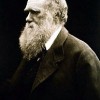
| 19 Apr 1882 | Death of Charles Darwin
Related ArticlesNancy Armstrong, “On Charles Darwin’s The Descent of Man, 24 February 1871″ Ian Duncan, “On Charles Darwin and the Voyage of the Beagle” Anna Henchman, “Charles Darwin’s Final Book on Earthworms, 1881” Martin Meisel, "On the Age of the Universe" Cannon Schmitt, “On the Publication of Charles Darwin’s On the Origin of Species, 1859″ Jonathan Smith, “The Huxley-Wilberforce ‘Debate’ on Evolution, 30 June 1860″ Daniel Bivona, “On W. K. Clifford and ‘The Ethics of Belief,’ 11 April 1876″ |
David Rettenmaier |
| 1883 | Aurora Leigh translated into Dutch, as a prose narrativeElizabeth Barrett Browning’s 1857 verse-novel Aurora Leigh entered the cultural and social-political life of the Netherlands in the 1870s and 1880s through the work of three Dutch people: a literary critic, a social reformer, and a novelist. Conrad Busken Huet, the country’s leading literary and cultural critic, first brought the poem to Dutch attention in 1873 by showcasing it as a model of great art with high social and moral purpose, from which Dutch contemporary poetry could learn. Hélène Mercier, one of the leading social reformers of the country, then translated the poem into Dutch in 1883 to inspire the country’s social reform efforts. Its prophetic voice, Mercier declared, spoke as directly to the social conditions of the Netherlands in the 1880s as it had to those of England in the 1850s. Arguing that it was not necessary to retain Aurora Leigh’s poetic form for this voice to have effect, she translated the poem as prose. But Dutch novelist Martina van Walcheren did not agree. She produced a poetic translation in 1885 that her publisher supported at least in part because he opposed the emerging art-for-art’s sake movement. All these literary, social reformist, and aesthetic developments or debates were also fueled or complicated by national and international book economies and copyright questions.
ARTICLE
Karen Dieleman, "Aurora Leigh in the Netherlands, 1870-1900" |
Karen Dieleman |
| 1 Jan 1883 | 1882 Married Women's Property Act
ArticlesJill Rappoport, “Wives and Sons: Coverture, Primogeniture, and Married Women’s Property” Anne Wallace, “On the Deceased Wife’s Sister Controversy, 1835-1907″ Related ArticlesRachel Ablow, “‘One Flesh,’ One Person, and the 1870 Married Women’s Property Act” |
David Rettenmaier |
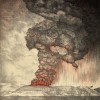
| 22 Aug 1883 | Krakatoa volcanic eruptionTo be written |
Karen Dieleman |
| Jan 1884 | Hopkins on Krakatoa
Hopkins’s letter analyzes the difference between normal sunsets and the recent sunsets affected by particulates from Krakatoa in the upper atmosphere, and he vividly describes the sky’s changing coloration the evening of December 16, 1883. ArticlesMonique R. Morgan, “The Eruption of Krakatoa (also known as Krakatau) in 1883″ |
David Rettenmaier |
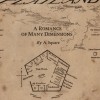
| Jan 1884 | Flatland
ArticlesDeanna Kreisel, “The Discovery of Hyperspace in Victorian Literature” |
David Rettenmaier |
| 1885 | Aurora Leigh translated into Dutch, as a poemElizabeth Barrett Browning’s 1857 verse-novel Aurora Leigh entered the cultural and social-political life of the Netherlands in the 1870s and 1880s through the work of three Dutch people: a literary critic, a social reformer, and a novelist. Conrad Busken Huet, the country’s leading literary and cultural critic, first brought the poem to Dutch attention in 1873 by showcasing it as a model of great art with high social and moral purpose, from which Dutch contemporary poetry could learn. Hélène Mercier, one of the leading social reformers of the country, then translated the poem into Dutch in 1883 to inspire the country’s social reform efforts. Its prophetic voice, Mercier declared, spoke as directly to the social conditions of the Netherlands in the 1880s as it had to those of England in the 1850s. Arguing that it was not necessary to retain Aurora Leigh’s poetic form for this voice to have effect, she translated the poem as prose. But Dutch novelist Martina van Walcheren did not agree. She produced a poetic translation in 1885 that her publisher supported at least in part because he opposed the emerging art-for-art’s sake movement. All these literary, social reformist, and aesthetic developments or debates were also fueled or complicated by national and international book economies and copyright questions. ARTICLE Karen Dieleman, "Aurora Leigh in the Netherlands, 1870-1900" |
Karen Dieleman |
| 1886 | Thomas Hardy publishes The Mayor of CasterbridgeTo be written |
Karen Dieleman |
| 4 May 1886 to 14 Oct 1886 | Colonial and Indian Exhibition
Featuring extravagant displays from British colonial holdings, the exhibit was organized by the Prince of Wales as an “imperial object lesson” in England’s power and grandeur. ArticlesAviva Briefel, "On the 1886 Colonial and Indian Exhibition" Related ArticlesAudrey Jaffe, "On the Great Exhibition" Anne Helmreich, "On the Opening of the Crystal Palace at Sydenham, 10 June 1854" Anne Clendinning, “On The British Empire Exhibition, 1924-25″ Erika Rappaport, “Object Lessons and Colonial Histories: Inventing the Jubilee of Indian Tea” |
David Rettenmaier |
| 1 Jan 1887 | Year of Jubilee
Related ArticlesErika Rappaport, “Object Lessons and Colonial Histories: Inventing the Jubilee of Indian Tea” |
David Rettenmaier |
| 1 Jan 1888 | Report on the eruption of Krakatoa
The report compiles and analyzes data from around the world, gathered from scientific instruments, the periodical press, and the public, relating to the eruption, falling pumice and dust, tsunamis, air waves, sounds of the explosions, unusual sunsets, blue and green appearances to the sun and moon, and a hazy ring around the sun. ArticlesMonique R. Morgan, “The Eruption of Krakatoa (also known as Krakatau) in 1883″ Related Articles |
David Rettenmaier |
| 1888 | The perfected phonographTo be written |
Karen Dieleman |
| 1888 | First Arts & Crafts ExhibitionTo be written |
Karen Dieleman |
| Aug 1888 to Sep 1889 | Jack the Ripper murdersFrom August 1888 to September 1889, the serial killer known as the Whitechapel Murderer or Jack the Ripper stalked women living in the East End of London. Related ArticlesHeidi Kaufman, “1800-1900: Inside and Outside the Nineteenth-Century East End” |
David Rettenmaier |
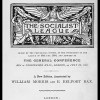
| Aug 1888 | Bloomsbury Socialist Society formed
ArticlesFlorence Boos, “The Socialist League, founded 30 December 1884″ |
David Rettenmaier |
| 1 Oct 1888 | First Arts & Crafts exhibition
ArticlesImogen Hart, “On the Arts and Crafts Exhibition Society” Morna O’Neill, “On Walter Crane and the Aims of Decorative Art” |
David Rettenmaier |
| 13 Jul 1889 | Robert Browning Responds to Edward Fitzgerald's Disgraceful Assault on Elizabeth Barrett BrowningDuring 1887 and into 1888, Robert Browning works on revising his collected works. He completes the first 10 of the planned 19 volumes. Among the first 10 volumes is his master work, The Ring and the Book. It is widely believed to be devoted to his wife, Elizabeth Barrett Browning, in the closing lines of the first and twelfth book, where he calls upon "lyric love." Early in July 1889, Browning sees the postumously collected letters and works of Edward Fitzgerald lying on a table while he is visiting a friend. He reads through them and finds Fitzgerald's letter to William Hepworth Thompson of Trinity College and the cruel remarks concerning Elizabeth Barrett Browning's recent death. In response, 28 years after Fitzgerald composed the letter and six years after his death, Browning angrily pens and has published the sonnet "To Edward Fitzgerald" in The Athenaeum no. 3220 on 13 July 1889. To read a related blog post, click here: http://blogs.baylor.edu/19crs/2020/01/15/robert-brownings…barrett-browning/ |
Ray Stockstad |
| 1890 | William Morris publishes News from NowhereTo be written |
Karen Dieleman |
| Oct 1890 | In Darkest England and the Way OutIn October 1890, General William Booth, a British Methodist preacher who founded The Salvation Army and became its first General, published In Darkest England and the Way Out, which criticized the conditions of the poor in Great Britain. Related ArticlesHeidi Kaufman, “1800-1900: Inside and Outside the Nineteenth-Century East End” |
David Rettenmaier |
| 13 Mar 1891 | Opening of the Independent Theatre SocietyTo be written |
Karen Dieleman |
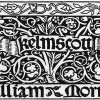
| 8 May 1891 | Kelmscott publishes first book
|
David Rettenmaier |
| 1 Jan 1892 | "St. Telemachus"
Particles from Krakatoa traveling through the upper atmosphere produced lurid sunsets, which inspired the opening lines of this poem. Tennyson’s imagery and figurative language resonate with several features of the eruption. ArticlesMonique R. Morgan, “The Eruption of Krakatoa (also known as Krakatau) in 1883″ |
David Rettenmaier |
| 1892 | Publication of Christina Rossetti's "The Face of the Deep: A Devotional Commentary on the Apocalypse"Rossetti's devotional commentary includes bits of poetry interspersed among a primarily prose text. The title page of Rossetti's Verses, published in 1893, includes the following note, "Reprinted from 'Called to be Saints,' 'Time Flies,' and 'The Face of the Deep.'" Most of the poems in the opening sonnet sequence of Verses, "Out of the Deep Have I Called Unto Thee," are from The Face of the Deep. Examining poems from Verses, such as “A Vain Shadow," in their original contexts in The Face of the Deep can open up new ways of reading them. The attached picture shows "A Vain Shadow" in its context in Rossetti's commentary. To read a related blog post, click here: http://blogs.baylor.edu/19crs/2020/01/15/creation-in-cont…face-of-the-deep/ |
Ryan Sinni |
| 6 Oct 1892 | Death of Tennyson
ArticlesLinda Peterson, “On the Appointment of the ‘Poet Laureate to Her Majesty,’ 1892-1896” |
David Rettenmaier |
| 1893 | Christina Rossetti publishes VersesTo be written |
Karen Dieleman |
| 1894 | "New Aspect of the Woman Question"In March 1894, Sarah Grand's “The New Aspect of the Woman Question” was published. The essay in North American Review, vol.158, no.448, March 1894, pp.270–6 has been credited with identifying the "New Woman." ArticlesMeaghan Clarke, “1894: The Year of the New Woman Art Critic” |
David Rettenmaier |
| 27 Jun 1894 | End of the 3-Volume Novel
ArticlesRichard Menke, “The End of the Three-Volume Novel System, 27 June 1894″ |
David Rettenmaier |
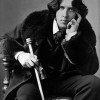
| Apr 1895 to May 1895 | Trials of Oscar Wilde
ArticlesAndrew Elfenbein, “On the Trials of Oscar Wilde: Myths and Realities” |
David Rettenmaier |
| 1 Jan 1896 | Alfred Austin chosen as Poet Laureate
ArticlesLinda Peterson, “On the Appointment of the ‘Poet Laureate to Her Majesty,’ 1892-1896” |
David Rettenmaier |
| 1896 | Alfred Austin becomes Poet LaureateTo be written |
Karen Dieleman |
| 1896 | Kelmscott Press publishes its Chaucer editionTo be written |
Karen Dieleman |
| 1896 | Thomas Hardy declares the 'End of Prose'To be written |
Karen Dieleman |
| 1918 | Publication of 'The Poems of Gerard Manley Hopkins'In 1918, Poet Laureate Robert Bridges published the first extended collection of Gerard Manley Hopkins’s poetry—The Poems of Gerard Manley Hopkins. This edition is known for Bridges's somewhat harsh prefatory material, where he criticizes Hopkins’s strange poetic style and calls it superfluous. However, it is precisely through Hopkins’s superfluous or unnecessary style—represented by features like additional accents and intentional obscurity—that Hopkins disrupts the expectations of his readers and teaches them how to behold and appreciate the natural world around them. To read a related blog post, click here: http://blogs.baylor.edu/19crs/2020/01/15/injured-by-a-nat…nge-poetic-style/ |
Christina Lambert |